

When you fill a prescription for a medication like warfarin, levothyroxine, or phenytoin, you might assume the pharmacy can swap it for a cheaper generic version without issue. But in many states, that’s not allowed-and the rules change depending on where you live. This isn’t about brand names or cost. It’s about NTI drugs-medications where even tiny changes in dosage can cause serious harm. A 5% shift in blood levels might mean a seizure, a stroke, or a life-threatening clot. And while the federal government says generics are safe to swap, 27 states have stepped in with their own rules to protect patients.
What Makes an NTI Drug Different?
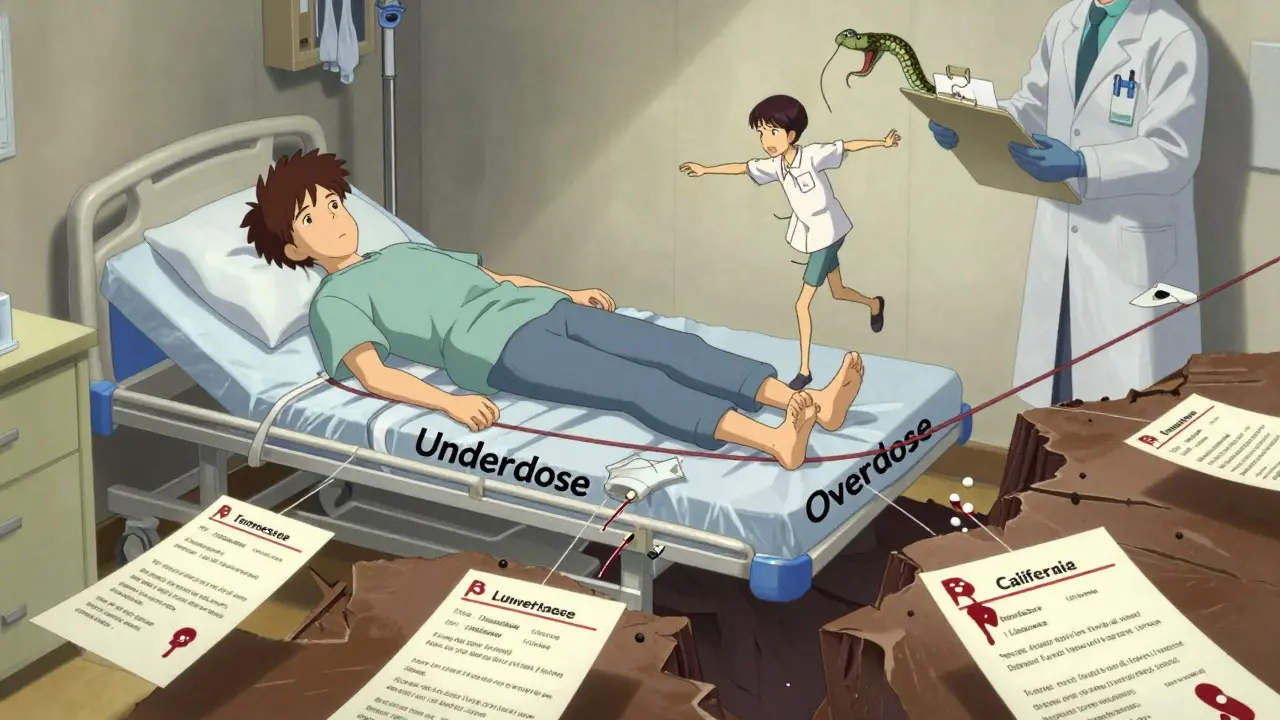
NTI stands for Narrow Therapeutic Index. These are drugs with a very small window between a dose that works and one that’s toxic. Think of it like walking a tightrope: step a little too far left, and you fall into underdosing. Step too far right, and you’re in overdose territory. Common examples include lithium for bipolar disorder, levothyroxine for hypothyroidism, warfarin for blood thinning, and antiepileptic drugs like carbamazepine and valproate.
The FDA doesn’t officially label drugs as NTI in its Orange Book, which lists therapeutic equivalence ratings. But pharmacists and doctors know which ones are risky. A 2023 study in the Journal of the American Pharmacists Association found that states with specific NTI substitution bans saw nearly 19% fewer adverse events linked to warfarin-though the absolute number was small, the risk is real. For someone on a stable dose of levothyroxine, switching to a generic can cause TSH levels to spike or drop, leading to fatigue, weight gain, or heart rhythm problems. One meta-analysis showed over 32% of patients on brand-name levothyroxine had to adjust their dose after switching to a generic.
State-by-State Rules: No Uniformity Here
There’s no national standard. Each state decides its own path, and the differences are striking.
In Kentucky and Pennsylvania, pharmacists are legally barred from substituting certain NTI drugs. Kentucky’s list includes digitalis glycosides, antiepileptics, and warfarin sodium tablets. Pennsylvania’s list is similar. If a patient gets a prescription for Synthroid or a specific brand of phenytoin, the pharmacist must dispense exactly that-no generics allowed.
South Carolina takes a different approach. Instead of a legal ban, it issues strong recommendations against substituting NTI drugs like lithium, as well as specific brands like Premarin and Synthroid. It also adds "critical drugs" like insulin, anticoagulants, and time-release asthma meds to its caution list. Pharmacists can still substitute, but they’re expected to know the risks and consult the prescriber.
Tennessee allows substitution for most "A-rated" drugs (those the FDA considers equivalent) but makes a hard exception: no swapping antiepileptic drugs for patients with epilepsy or seizures. It’s a targeted rule, not a blanket ban.
Meanwhile, Iowa tells pharmacists to rely on the FDA’s Orange Book and doesn’t maintain its own NTI list. If a drug has an "A" rating, it’s fair game. No extra rules.
California has one of the most detailed laws. Under Business and Professions Code Section 4070.5, pharmacists must notify the prescriber if they substitute any "critical dose drug"-defined as one where a 10% or less change in blood concentration could be dangerous. This includes not just NTI drugs but also drugs like digoxin and cyclosporine. The goal isn’t to block substitution-it’s to force communication.
And then there’s Texas. Its Health and Safety Code Section 562.053 bans substitution of anticonvulsants for epilepsy patients unless the prescriber gives explicit written permission. It’s not about the drug class-it’s about the patient’s condition.
Why the Confusion? Pharmacists Are Caught in the Middle
A 2023 survey by the National Community Pharmacists Association found that 68.3% of pharmacists who work across multiple states have been confused about substitution rules. Over 40% admitted they accidentally broke a state law in the past year.
Imagine working at a pharmacy chain with locations in Tennessee and Kentucky. In Knoxville, you can substitute most generics but not antiepileptics. In Lexington, you can’t substitute any of the state’s listed NTI drugs-even if they’re the same medication. You’re not just remembering rules-you’re remembering which state’s rules apply to which prescription.
Some states use "dispense as written" (DAW) codes on prescriptions to block substitution. Others don’t. Some require prescribers to check a box. Others don’t. The Life Raft Group’s 2024 guide breaks states into three types: Mandatory (must substitute unless blocked), Permissive (can substitute if allowed), and Restrictive (can’t substitute certain drugs). But even that’s oversimplified. A drug might be restricted in one state but not its neighbor, even if they share a border.
What’s the FDA’s Stance?
The FDA has been clear since 1997: the current bioequivalence standards-allowing generics to differ by up to 20% in absorption-are safe for all drugs, including NTIs. Dr. John Jenkins, former head of the FDA’s drug evaluation office, called state restrictions unnecessary. "The science doesn’t support it," he said in a 2021 editorial.
But doctors and pharmacists see real-world harm. Dr. Jerry Avorn from Harvard argues that a 20% range is too wide for drugs like levothyroxine, where a 5% difference can trigger clinical instability. The American College of Clinical Pharmacy backs state-level bans, citing evidence that patients on brand-name drugs often need dose adjustments after switching.
The irony? The FDA once created its own NTI list in 1995-but never made it official. Now, states are filling the gap.
What’s Changing in 2025 and Beyond?
The tide is turning. In January 2024, the National Association of Boards of Pharmacy launched the Model State NTI Substitution Act. It proposes a single, evidence-based list of NTI drugs that states can adopt. Twelve states have already introduced it as legislation.
At the same time, the FDA announced in September 2024 it would reevaluate its position after the Senate Committee on Aging cited a Government Accountability Office report: 2,847 adverse events between 2019 and 2023 were potentially tied to NTI drug substitutions. That’s not just a statistic-it’s people in the hospital.
IQVIA predicts that by 2027, 38 states will have adopted standardized rules. That could cut prescription errors by over 20%. But it might also reduce generic use for NTI drugs by 8.3 percentage points-meaning more patients pay full price for brand-name versions.
What This Means for You
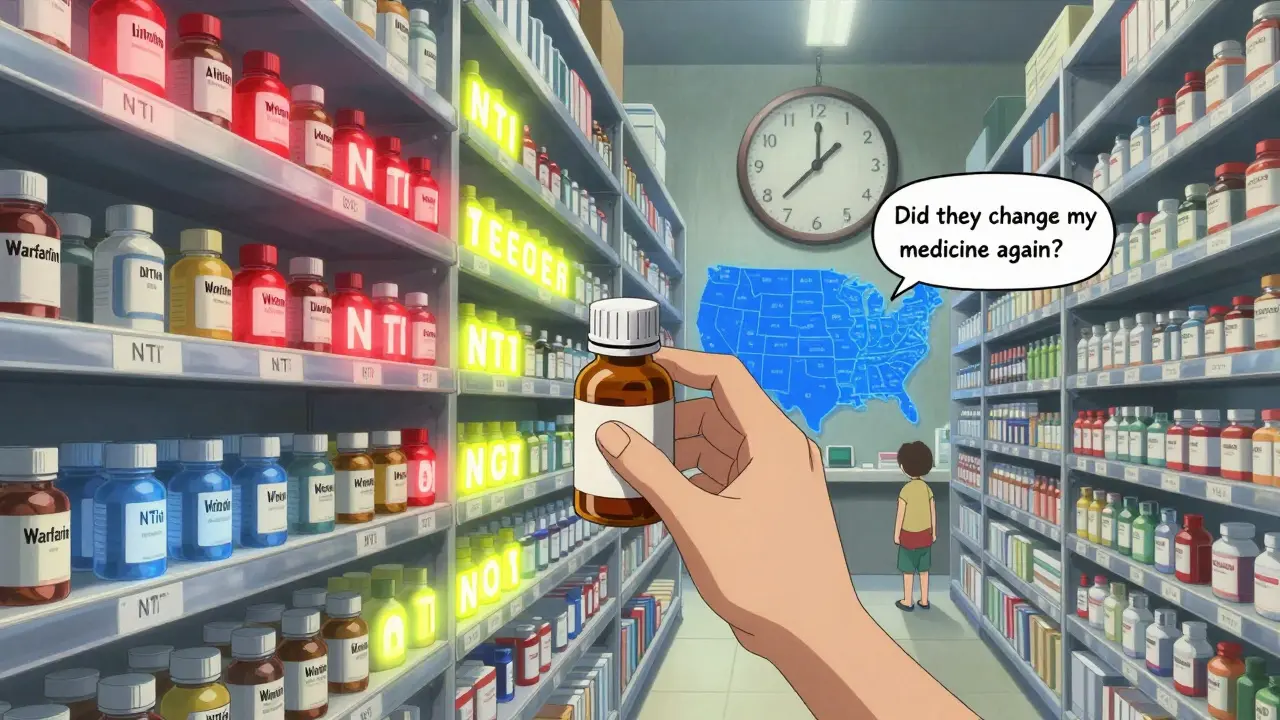
If you take an NTI drug, don’t assume your pharmacy will switch you to a generic. Always ask:
- Is this drug on my state’s restricted list?
- Did my doctor write "dispense as written" on the prescription?
- Have I been told to stay on the same brand?
Even if your state doesn’t have a law, your doctor might still prefer you stay on one version. Keep a list of your medications and their brands. If you notice changes in how you feel after a refill-fatigue, dizziness, irregular heartbeat-tell your pharmacist and doctor right away.
And if you travel or move between states, bring your prescription bottle and a copy of your medication list. Rules change at the border. Your safety shouldn’t depend on your ZIP code.
Are NTI drugs officially listed by the FDA?
No, the FDA does not officially designate or maintain a public list of Narrow Therapeutic Index (NTI) drugs. While the FDA’s Orange Book assigns therapeutic equivalence ratings (A or B), it does not label any drug as NTI. States like Kentucky and Pennsylvania have created their own lists based on clinical evidence, but these are state-specific and not federally recognized.
Can a pharmacist substitute an NTI drug without my doctor’s permission?
It depends on your state. In 27 states, substitution of NTI drugs is either prohibited or requires prescriber authorization. In others, pharmacists can substitute if the drug has an "A" rating from the FDA’s Orange Book. Always check your prescription for "dispense as written" (DAW) codes. If none is present, the pharmacist may substitute unless state law blocks it.
Which drugs are commonly classified as NTI?
Common NTI drugs include levothyroxine (for thyroid conditions), warfarin (a blood thinner), lithium (for bipolar disorder), phenytoin and carbamazepine (antiepileptics), digoxin (for heart rhythm), cyclosporine (an immunosuppressant), and theophylline (for asthma). These drugs require precise dosing because small changes in blood levels can lead to serious side effects or treatment failure.
Why do some states ban substitution while others don’t?
States that restrict substitution cite clinical evidence showing patients can experience instability after switching generics-especially with drugs like levothyroxine or warfarin. States without restrictions rely on the FDA’s position that bioequivalence standards (up to 20% variation) are sufficient. The debate centers on whether real-world outcomes justify stricter rules, even if federal guidelines say otherwise.
What should I do if I’m switched to a generic NTI drug?
If you’re switched to a generic version of an NTI drug, monitor for new symptoms like unusual fatigue, heart palpitations, mood changes, or unexplained bruising. Contact your pharmacist and prescriber immediately. Ask if your state allows substitution and whether your medication is on a restricted list. Request a blood test if applicable-like a TSH level for thyroid meds or INR for warfarin-to ensure your levels are still in range.
What’s Next?
The system is messy, but change is coming. With 12 states already moving toward the Model NTI Act, we’re likely heading toward a national standard. Until then, patients need to be their own advocates. Don’t assume a generic is safe just because it’s cheaper. Ask questions. Know your drug. Know your state’s rules. And if something feels off after a refill-speak up. Your life might depend on it.
Ivan Viktor
March 3, 2026 AT 14:24Jeff Card
March 5, 2026 AT 05:47Donna Zurick
March 6, 2026 AT 12:06Sharon Lammas
March 7, 2026 AT 19:22Gretchen Rivas
March 9, 2026 AT 05:38marjorie arsenault
March 9, 2026 AT 23:22Milad Jawabra
March 10, 2026 AT 02:14Stephen Vassilev
March 11, 2026 AT 09:02Shivam Pawa
March 13, 2026 AT 00:01Zacharia Reda
March 13, 2026 AT 09:34John Smith
March 14, 2026 AT 06:25Jessica Chaloux
March 15, 2026 AT 02:14Darren Torpey
March 15, 2026 AT 02:32