

Every spring, when the pollen counts rise and your eyes start itching, you probably reach for the same OTC allergy pill you’ve used before. But what if that pill isn’t actually the best choice for your symptoms? Not all antihistamines are created equal. Some make you sleepy. Others barely touch your congestion. And some work faster than others. Choosing the right one isn’t about brand loyalty-it’s about matching the medicine to your life, your symptoms, and your body.
First-Generation vs. Second-Generation: The Big Divide
There are two main types of OTC antihistamines, and the difference matters more than you think. First-generation ones like diphenhydramine (Benadryl) and chlorpheniramine (Chlor-Trimeton) were developed in the 1940s. They work quickly-sometimes in as little as 15 to 30 minutes-and they’re cheap. But they cross into your brain, which is why about half the people who take them feel drowsy. That’s not just a mild yawn. It’s full-on fatigue, slower reaction times, and impaired focus. If you drive, work with machinery, or need to stay sharp for a meeting, these aren’t the right pick. Second-generation antihistamines like cetirizine (Zyrtec), loratadine (Claritin), and fexofenadine (Allegra) came along in the 1990s. They’re designed to stay out of your brain. That means less drowsiness, longer-lasting relief, and once-daily dosing. They take a little longer to kick in-usually 1 to 3 hours-but they last 24 hours. That’s why they make up nearly 80% of the OTC allergy market today.How Each One Compares: Speed, Strength, and Sedation
Let’s break down the three most common second-generation options. They all treat runny nose, sneezing, and itchy eyes. But their differences can make one a better fit for you.- Zyrtec (cetirizine): Works fastest among the three-often within an hour. Studies show it’s about 15-20% more effective at blocking histamine than Claritin. That’s why many people with moderate to severe allergies swear by it. But it’s also the most likely to cause drowsiness. About 10-15% of users feel sleepy, especially at the full 10mg dose. If you’re not sleeping well or have a busy day ahead, start with 5mg.
- Claritin (loratadine): The gentlest of the three. Only 5-10% of users report drowsiness. It’s the go-to for people who need to stay alert all day. But it’s also the weakest. A 2018 meta-analysis found it provided 23% less symptom relief than Zyrtec for moderate-to-severe allergic rhinitis. If your allergies are mild and mostly seasonal, Claritin might be enough. If you’re constantly sneezing or your eyes are swollen, you might need something stronger.
- Allegra (fexofenadine): The least sedating of all. Only 2-5% of users feel drowsy. It’s the best choice if you’re sensitive to side effects, work night shifts, or drive long distances. It doesn’t cross the blood-brain barrier at all. But it’s also the slowest to start working-sometimes taking up to 3 hours. And it’s picky about what you eat or drink. Grapefruit juice can cut its absorption by 33%. Avoid taking it with fruit juice or high-fat meals.
Here’s how they stack up in real-world use:
| Medication | Dose | Onset | Duration | Drowsiness Risk | Best For |
|---|---|---|---|---|---|
| Zyrtec (cetirizine) | 10mg daily | 1 hour | 24 hours | 10-15% | Severe symptoms, nighttime relief |
| Claritin (loratadine) | 10mg daily | 1-3 hours | 24 hours | 5-10% | Mild symptoms, daytime use |
| Allegra (fexofenadine) | 180mg daily or 60mg twice daily | 2-3 hours | 24 hours | 2-5% | Zero drowsiness needed, sensitive users |
| Benadryl (diphenhydramine) | 25-50mg every 4-6 hours | 15-30 min | 4-6 hours | ~50% | Acute reactions, short-term use |
Decongestant Combos: When You Need More Than Just an Antihistamine
If your nose is completely blocked, an antihistamine alone won’t cut it. That’s where products like Zyrtec-D, Claritin-D, and Allegra-D come in. They combine an antihistamine with pseudoephedrine, a nasal decongestant. These can reduce congestion by up to 42% more than antihistamines alone. But there’s a catch. Pseudoephedrine raises blood pressure. It can make your heart race. If you have high blood pressure, heart disease, or an overactive thyroid, avoid these. Even if you’re healthy, you’ll need to show ID to buy them because of federal restrictions on pseudoephedrine sales. They’re kept behind the pharmacy counter. And here’s something most people don’t realize: if you take a decongestant combo every day, you can develop rebound congestion. Your nose gets worse when you stop. That’s why these are meant for short-term use-no more than 3 to 5 days.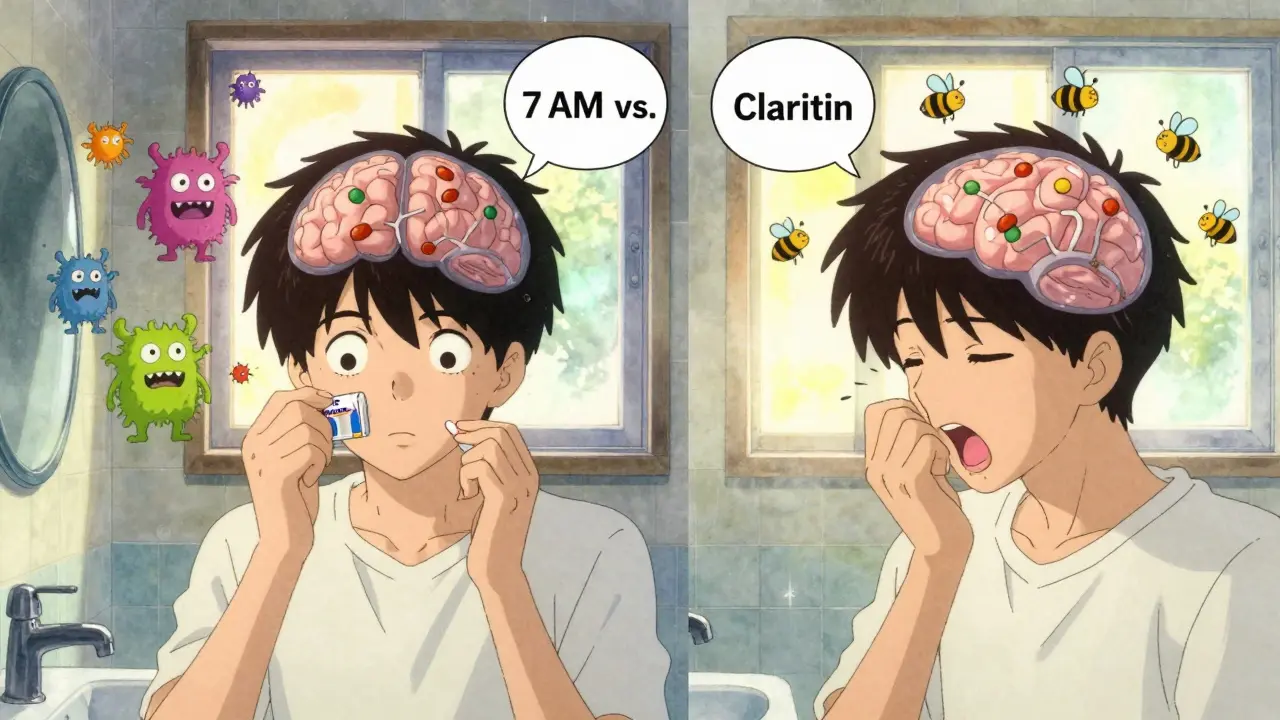
What the Experts Say (And Why It’s Not One-Size-Fits-All)
You’ll hear conflicting advice. Some allergists say Allegra is the best because it doesn’t touch your brain. Others say Zyrtec is more effective. The American Academy of Allergy, Asthma & Immunology says both Zyrtec and Allegra are equally good first-line options. The NHS in the UK says there’s little evidence one is better than another. Why the confusion? Because your body reacts differently than someone else’s. One person’s miracle drug is another person’s drowsy disappointment. A 2021 review found that fexofenadine has the best balance of effectiveness and low sedation for daytime use. But cetirizine’s mild drowsiness actually helps some people sleep better at night when allergy symptoms keep them awake. Real-world data backs this up. On Reddit’s r/Allergies, 68% of users prefer Zyrtec for bad flare-ups. But 22% pick Allegra because they can’t afford to feel tired. Amazon reviews show Zyrtec gets high marks for speed but low marks for sleepiness. Claritin gets praised for being “non-drowsy” but criticized for not working on severe allergies.Dosing Tips: More Isn’t Better
It’s tempting to take two Zyrtec tablets if one doesn’t work. Don’t. The FDA says taking more than 10mg of cetirizine per day doesn’t improve relief-it just increases drowsiness by 40%. Same with Claritin: stick to 10mg daily. For Allegra, the standard dose is 180mg once a day, or 60mg twice a day. Never exceed the label. Also, don’t rush. Antihistamines don’t work like painkillers. If you take one for the first time and don’t feel better after a few hours, don’t switch. Give it 7 to 10 days of consistent use. Allergies build up over time. So does relief.
What to Avoid: Food, Drinks, and Drug Interactions
Fexofenadine (Allegra) is sensitive to what you eat. Grapefruit juice cuts its absorption by a third. Apple and orange juice can do the same. Take it with water only. Cetirizine (Zyrtec) absorption drops by 15% if taken with food. Take it on an empty stomach for best results. Loratadine (Claritin) is the most forgiving. It doesn’t interact much with other drugs, which makes it safer if you’re on antibiotics like erythromycin or antifungals like ketoconazole. And never mix antihistamines. Taking Zyrtec and Benadryl together doesn’t make you feel better-it makes you dangerously sleepy.When to See a Doctor
OTC antihistamines work well for most people. But if you’re still struggling after trying two different second-generation options for two weeks, it’s time to talk to a doctor. You might need a nasal spray, allergy shots, or a prescription medication. Also see a doctor if you have:- High blood pressure or heart problems (avoid decongestants)
- Glaucoma or enlarged prostate (some antihistamines can make this worse)
- Pregnancy or breastfeeding (talk to your provider before taking anything)
- Side effects like confusion, rapid heartbeat, or trouble urinating
Most people find relief with OTC meds. But knowing which one to pick-and how to take it right-makes all the difference.
Is Zyrtec better than Claritin for allergies?
Zyrtec is generally more effective, especially for moderate to severe symptoms. Studies show it blocks histamine better and provides faster relief. But it’s also more likely to cause drowsiness. Claritin is weaker but much less sedating. If you need strong symptom control and can handle a little sleepiness, Zyrtec wins. If you need to stay alert all day, Claritin is the safer pick.
Can I take Allegra every day?
Yes. Fexofenadine (Allegra) is designed for daily use and has minimal side effects. It’s safe for long-term use in adults and children over 12. There’s no evidence it loses effectiveness over time. Just avoid grapefruit juice and take it with water.
Why does Benadryl make me so sleepy?
Diphenhydramine crosses the blood-brain barrier and blocks histamine receptors in your brain, which causes drowsiness. That’s why it’s used in sleep aids. While it works fast for sudden reactions, it’s not ideal for daily allergy management because of the fatigue, impaired focus, and risk of accidents.
Are generic antihistamines as good as brand names?
Yes. Generic versions of cetirizine, loratadine, and fexofenadine contain the exact same active ingredients as Zyrtec, Claritin, and Allegra. They’re just cheaper. The FDA requires generics to meet the same standards for safety and effectiveness. You’re paying for the brand name, not better medicine.
What’s the best OTC allergy medicine for kids?
For children over 2, loratadine (Claritin) and cetirizine (Zyrtec) are commonly used, but doses are weight-based and lower than adult doses. Always check the pediatric label. Fexofenadine (Allegra) is approved for kids 6 and up. Never give diphenhydramine to children under 6 without a doctor’s advice-it can cause dangerous side effects.
Do antihistamines help with congestion?
They help a little, but not much. Antihistamines mainly target runny nose, sneezing, and itching. Nasal congestion is caused by swollen blood vessels, which antihistamines don’t directly fix. For congestion, you need a decongestant like pseudoephedrine (in Zyrtec-D, Claritin-D, etc.) or a nasal spray like fluticasone. Antihistamines alone won’t clear a blocked nose.
How long should I try an antihistamine before switching?
Give it at least 7 to 10 days of consistent daily use. Allergies are chronic-you don’t feel relief right away like you do with a headache. Your body needs time to respond. If you’re still having symptoms after two weeks, try a different type. Don’t switch after one or two doses.
Final Tip: Track Your Response
Keep a simple log: write down which medicine you took, what time, what symptoms you had, and how you felt. After a week, you’ll see patterns. Maybe Zyrtec clears your sneezing but leaves your eyes itchy. Maybe Allegra helps your nose but not your throat. That’s your personal data-and it’s more useful than any online review.The right OTC allergy medicine isn’t the most popular one. It’s the one that works for you-without making you too tired, too wired, or too sick. Try one. Wait. Observe. Adjust. You’ve got this.
kenneth pillet
January 19, 2026 AT 12:28Been using Allegra for years. No drowsiness, no fuss. Just works. Took me three seasons to figure out grapefruit juice kills it though. Now I drink water. Simple.
Also, generics are identical. Save your cash.
Naomi Keyes
January 19, 2026 AT 23:00Let me clarify, with scientific precision: cetirizine exhibits a statistically significant (p < 0.05) histamine-receptor affinity compared to loratadine, per the 2018 meta-analysis cited in the original article-yet, individual pharmacokinetic variance-modulated by CYP3A4 enzyme activity, hepatic metabolism, and even circadian rhythm-can render this data misleading in real-world application. Therefore, while Zyrtec may be more potent, it is not universally superior. One must consider neurochemical sensitivity, not just clinical trials.
Jodi Harding
January 20, 2026 AT 14:13Zyrtec for me. Full 10mg. I’m tired anyway. At least my nose stops screaming. I don’t need to be alert-I need to stop sneezing in my own kitchen.
Also, Benadryl? No. Just no. That’s not medicine, that’s a nap in a pill.
Kristin Dailey
January 21, 2026 AT 07:00America’s best allergy medicine? Zyrtec. All the others are just imports trying to copy it. Made in the USA, works faster. End of story.
Robert Cassidy
January 22, 2026 AT 16:33You people treat antihistamines like they’re spiritual tools. It’s chemistry. Not enlightenment. You track your ‘response’ like it’s a tarot reading. I take what works. I don’t journal. I don’t meditate on my sneezes. I just take the damn pill and go about my life. You’re overcomplicating what’s supposed to be simple. You’re not healing your soul-you’re just allergic to pollen.
Wendy Claughton
January 23, 2026 AT 10:24So... I tried Zyrtec, felt like a zombie. Then Allegra-zero drowsiness, but took 4 hours to work. Then Claritin-barely did anything. So I switched to a nasal spray (Flonase) and my life changed. Why did no one mention this earlier? Sometimes the pill isn’t the answer. Your nose is swollen. Spray it. It’s not magic. It’s science. 🙏
Stacey Marsengill
January 24, 2026 AT 19:52They don’t want you to know the truth. Big Pharma doesn’t profit from you taking water and avoiding grapefruit. They profit from you buying Zyrtec-D, then Claritin-D, then Allegra-D, then… oh wait, now you need a prescription. That’s the game. You’re being played. The real cure? Stay indoors. Wear a mask. Don’t trust the labels. The system wants you dependent.
Zoe Brooks
January 26, 2026 AT 10:29Just tried the 5mg Zyrtec and wow. It’s like a miracle. No sleepiness, sneezing stopped. I’m not even mad about the $12 price tag anymore. You guys are right-start low, see how you feel. I thought I was a Claritin person. Turns out I’m just a 5mg Zyrtec person. 🙌
Joni O
January 26, 2026 AT 16:02Same. I used to take Benadryl every night. Then I realized I was just trading allergies for exhaustion. Now I take Allegra + saline rinse. No drama. No crash. Just… breathing. You got this. One step at a time. 💪
Aysha Siera
January 28, 2026 AT 11:32They’re all the same. The government controls the ingredients. They put the drowsiness in so you’ll buy more. They don’t want you awake. They want you docile. Look at the dates on the bottles. Same batch numbers everywhere. Coincidence? I think not.