

Ever wondered why your skin breaks out in a red, itchy rash after wearing a certain piece of jewelry or switching to a new laundry detergent? It might not be a simple irritation. You could be dealing with allergic contact dermatitis is an immune system reaction that occurs when your skin touches a specific substance, leading to inflammation and chronic itching. For many, the culprit is hidden in plain sight-inside the metal of a watch strap or the "fresh scent" of a lotion. The problem is that your skin doesn't come with a label telling you exactly what it hates. That is where patch testing comes in.
If you are struggling with a rash that won't go away, you need a definitive answer, not a guessing game. Patch testing is the gold standard for this. Unlike a quick prick test for hay fever, this process looks for delayed reactions. It's the only way to accurately map out which metals or fragrances are triggering your T cells to attack your skin. While it requires a bit of patience and a few days of avoiding your shower, the payoff is a clear list of what to avoid, which can lead to complete skin clearance for up to 80% of patients.
What Exactly is Patch Testing?
Think of patch testing as a controlled experiment on your own skin. Patch testing is a diagnostic procedure where small amounts of potential allergens are applied to the skin under adhesive patches to identify type IV hypersensitivity reactions. This is different from a typical allergy test because it doesn't happen instantly. Instead, it triggers a delayed-type hypersensitivity reaction mediated by T cells, which takes days to develop.
The process was pioneered in the 1930s by Josef Jadassohn and has since been refined by groups like the International Contact Dermatitis Research Group a global organization that standardizes the concentrations and types of allergens used in clinical skin testing (ICDRG). Today, dermatologists use standardized "series"-basically menus of the most common triggers-to see which ones cause a reaction on your back.
The Metal Culprits: Nickel, Cobalt, and Chromium
Metals are among the most frequent causes of contact allergy. You aren't usually allergic to the metal itself, but to the metal ions that leach out of the object and penetrate your skin. The most common offender is nickel, which is found in everything from earrings and belt buckles to some dental fillings. In fact, nickel allergy is reported in about 18.5% of tested patients.
Other common metals include cobalt and chromium. Cobalt is often found in some blue pigments and metal alloys, while chromium is frequent in leather tanning and cement. To test for these, doctors use specific concentrations, such as nickel sulfate at 5% in petrolatum. Because these metals are so pervasive in our environment, identifying them allows you to make specific changes-like switching to titanium jewelry or using nickel-free fasteners-that can stop the cycle of inflammation.
The Fragrance Puzzle: Why Mixes Aren't Enough
Fragrances are tricky because "fragrance" or "parfum" on a label is often a umbrella term for dozens of different chemicals. Roughly 8-15% of dermatitis patients react to fragrance materials. To catch these, doctors use fragrance mixes pre-blended combinations of common fragrance allergens used to screen patients efficiently, specifically Fragrance Mix I (FM I) and Fragrance Mix II (FM II).
However, relying only on these mixes is a mistake. Research shows that testing only with mixes misses about 10% of fragrance allergy cases. This happens because some chemicals, like lyral or hydroxycitronellal, may have been removed from mixes due to stability issues or are simply not included. For a complete diagnosis, you need a combination of the mixes plus individual fragrance chemicals, such as balsam of Peru (Myroxylon pereirae). Without this detailed approach, you might leave your clinic thinking you're "fragrance-free" while still reacting to a specific chemical in your soap.
| Allergen Entity | Common Sources | Typical Test Form | Reaction Speed |
|---|---|---|---|
| Nickel | Jewelry, Zippers, Coins | Nickel Sulfate 5% | Delayed (48-96h) |
| Cobalt | Blue dyes, Metal alloys | Cobalt Chloride 1% | Delayed (48-96h) |
| Fragrance Mix I | Perfumes, Shampoos | Standardized Blend | Delayed (48-96h) |
| Potassium Dichromate | Leather, Cement | 0.5% in Petrolatum | Delayed (48-96h) |
What to Expect: The Three-Visit Process
Patch testing isn't a "one and done" appointment. It requires a serious commitment to a specific schedule over one week. If you miss a reading, the results can be skewed because the reaction might have peaked and faded.
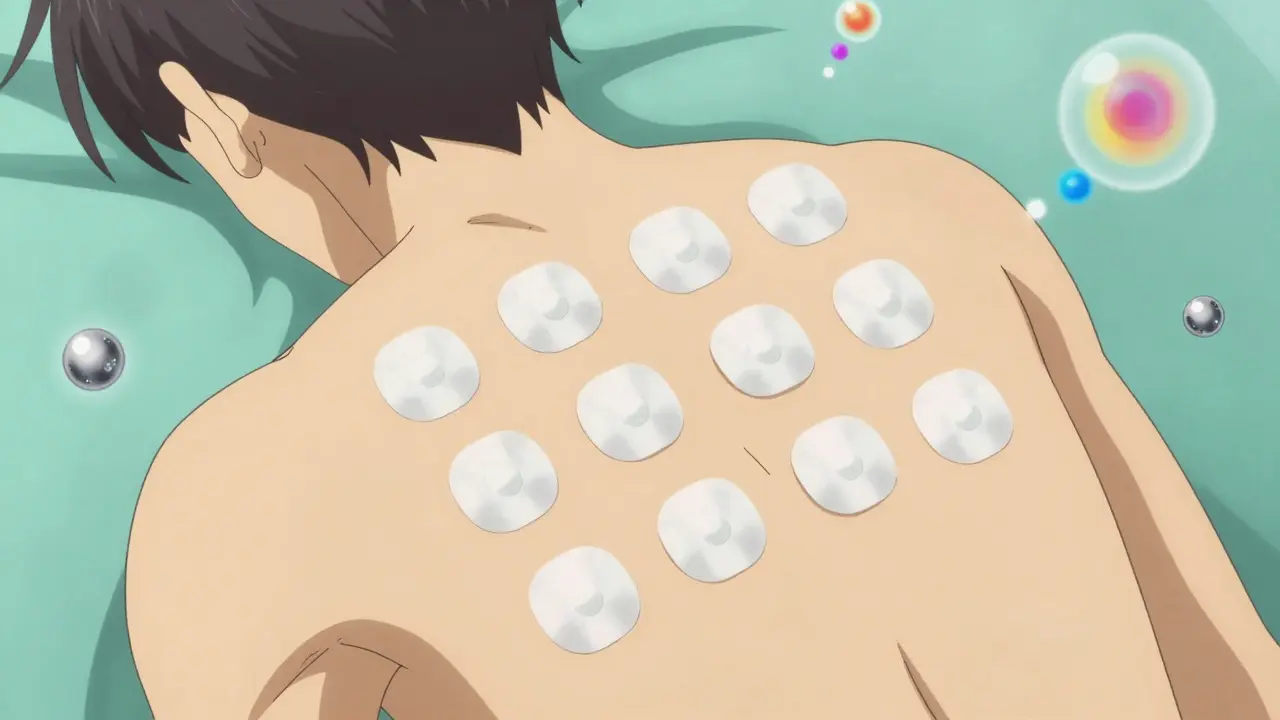
- Visit 1 (The Application): Your dermatologist applies the allergen panels to your upper back using specialized tape. Depending on the series-like the North American (NACDG) baseline which contains 80 antigens-this can take 30 to 45 minutes.
- Visit 2 (The First Reading): You return 48 hours later. The doctor removes the patches and looks for initial signs of inflammation.
- Visit 3 (The Final Reading): This usually happens 72 to 96 hours after the start. This is the most critical visit because many fragrance and metal allergies don't fully show up until the third or fourth day.
The reactions are graded on a scale. A "weak positive" might just be a few red bumps, while an "extreme reaction" involves heavy swelling and blisters. Your doctor's expertise is vital here to distinguish between a true allergy and a simple irritant reaction-which happens in 5-10% of tests.
The Hard Part: Surviving the 48 Hours
The biggest challenge for most people is the restriction on water. To keep the patches glued to your skin and the chemicals in place, you cannot let the test site get wet. This means no swimming, no strenuous exercise that causes heavy sweating, and usually no showering for at least 48 to 72 hours. Some people find this grueling, and about 15% of patients actually rip the patches off early because of itching, which unfortunately ruins the test results.
To make it through, wear loose cotton shirts that won't rub the patches off. Avoid bending your back excessively, as this can dislodge the tape. It's a tedious few days, but as many users on platforms like Reddit have shared, identifying that one specific fragrance in your laundry detergent can be life-changing for those with chronic hand eczema.

Beyond the Test: Living with Contact Allergies
Once you have your results, the real work begins. A positive test is just a map; you still have to navigate the world. You'll need to become a label-reader. In the European Union, regulations require the labeling of 26 specific fragrance allergens if they exceed certain concentrations. In the US, this is less standardized, making the test results even more important.
Be wary of products labeled "hypoallergenic" or "fragrance-free." These terms aren't always strictly regulated, and some "fragrance-free" products still contain hidden sensitizers like citral or farnesol. The best strategy is to use your patch test list as a checklist. If you're allergic to nickel, look for "nickel-free" or "surgical steel" labels. If you're allergic to Fragrance Mix II, you'll need to avoid specific aromatic compounds common in soaps.
How is patch testing different from a skin prick test?
A skin prick test looks for an immediate (IgE-mediated) reaction, like a hive appearing in minutes, typically used for food or pollen allergies. Patch testing looks for a delayed (T-cell mediated) reaction that takes days to develop, which is the hallmark of allergic contact dermatitis from metals and chemicals.
Can I shower during the patch test?
Generally, no. Most clinics prohibit showering or any water contact with the back for 48 to 72 hours. Water can dissolve the allergen or loosen the adhesive tape, leading to a false negative result.
What happens if I get a false positive?
False positives often occur when a substance acts as an irritant rather than an allergen. This is why you must see a board-certified dermatologist for the reading; they are trained to distinguish between a red patch caused by irritation and a true allergic response based on the appearance and timing of the rash.
Will the test find every possible allergen?
No. There are tens of thousands of potential sensitizers, but a comprehensive patch test usually only screens for 120 to 150 of the most common ones. If baseline and extended testing are negative, your doctor may suggest a "use test," where you apply your own suspected products under a patch.
How long does it take for the skin to clear after avoiding the allergen?
While it varies, clinical data from the American Contact Dermatitis Society shows that 60-80% of patients achieve complete clearance of their symptoms once they successfully and consistently avoid the identified triggers.
Next Steps and Troubleshooting
If you've just received a positive result, don't panic. Start by auditing your bathroom and laundry room. Check every ingredient list against your results. If you're unsure about a product, you can use online ingredient analyzers or ask your dermatologist for a safe-list of brands.
If you've had patch testing before but are still reacting to things, consider that your allergies can evolve. New chemicals are introduced to consumer products every year. You might need an updated "expanded series" that includes newer fragrance markers or regional allergens specific to where you live. If your first test was a "limited baseline," push for comprehensive testing that includes individual fragrance chemicals to ensure nothing was missed.