
When you pick up a prescription and see a different name on the bottle than what your doctor wrote, it’s natural to wonder: are generic drugs copies? Are they weaker? Less safe? Just cheap imitations? The short answer is no - but the full story is more interesting than most people realize.
What Exactly Is a Generic Drug?
A generic drug isn’t a knockoff. It’s not a copy in the way a fake handbag or pirated movie is. It’s a scientifically proven equivalent. The U.S. Food and Drug Administration (FDA) requires generic drugs to contain the exact same active ingredient, in the same strength, and in the same form as the brand-name version. If your doctor prescribes lisinopril for high blood pressure, the generic version has the same molecule - nothing more, nothing less. It’s the same medicine, just sold under a different name after the patent expires. The FDA doesn’t approve generics based on trust. They require proof. Before a generic drug hits the shelf, the manufacturer must show it delivers the same amount of active ingredient into your bloodstream at the same rate as the brand-name drug. This is called bioequivalence. The standard? The concentration of the drug in your blood must fall within 80% to 125% of the brand-name version. That’s not a guess - it’s a strict lab test, done with real people, measured over time.Why Do Generic Drugs Look Different?
If they’re the same medicine, why do generics look different? Why are they a different color, shape, or size? That’s because of trademark laws, not medicine. The brand-name company owns the appearance of their pill - the color, logo, imprint, even the flavor. Generic manufacturers can’t copy that. So they change the look. But the active ingredient? Identical. The differences you see are in the inactive ingredients: fillers, dyes, binders, or coatings. These don’t affect how the drug works. But they can affect how your body reacts - sometimes. For most people, these differences cause no issue. But for a small group, an allergy to a dye or a sensitivity to a filler might cause a mild reaction. That’s rare, but it’s real. And it’s why pharmacists sometimes ask if you’ve had issues with a specific generic before.Are Generic Drugs Cheaper Because They’re Inferior?
No. They’re cheaper because they don’t have to pay for the original research, marketing, or advertising. Brand-name drug companies spend billions developing a new drug - testing it in labs, running clinical trials, getting FDA approval. Once the patent runs out (usually 20 years after filing), other companies can make the same drug. They skip the expensive part. They don’t need to prove the drug works again - they just need to prove their version behaves the same in your body. The result? Generic drugs cost about 85% less on average. According to the Congressional Budget Office, a typical generic prescription costs $4.27. The brand-name version? Around $61.85. That’s not a small difference. For people on fixed incomes, or those juggling multiple prescriptions, this gap can mean the difference between taking their medicine and skipping doses.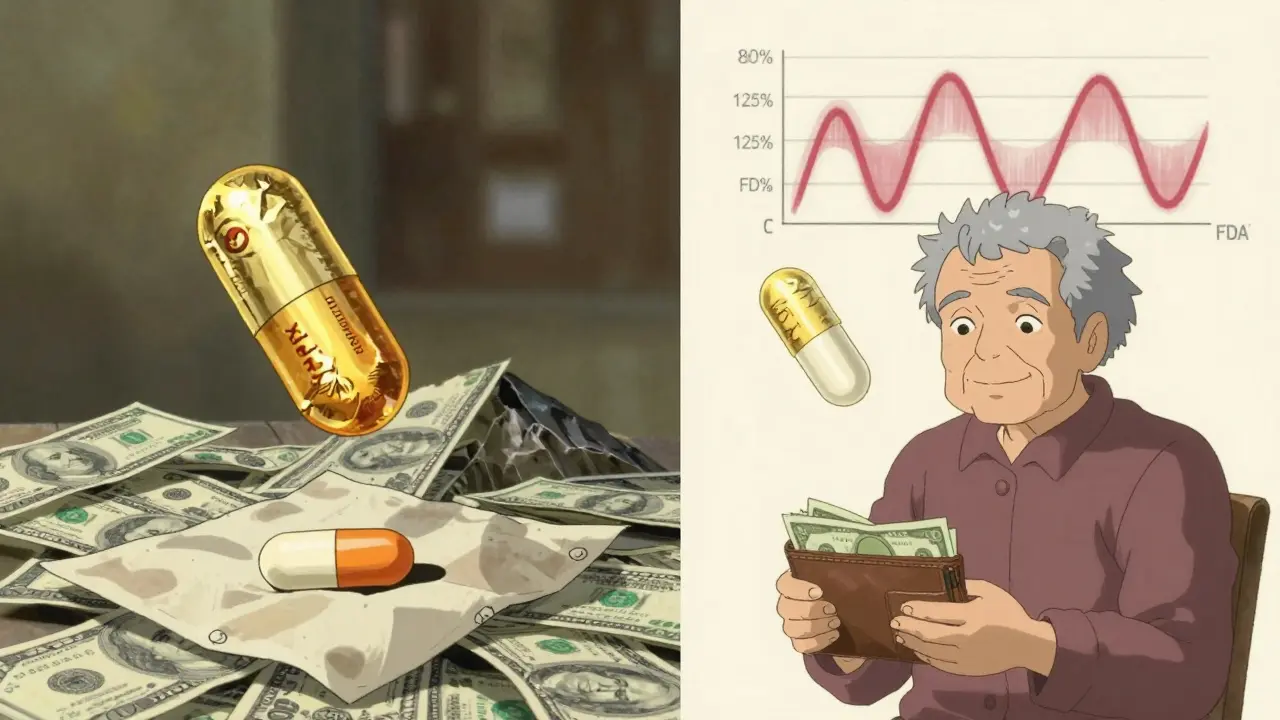
When Do Generics Not Work the Same?
There’s a small but important exception: narrow therapeutic index (NTI) drugs. These are medications where even a tiny change in blood levels can cause big problems. Too little? The drug doesn’t work. Too much? You get serious side effects. Examples include warfarin (a blood thinner), levothyroxine (for thyroid disease), and some seizure medications like phenytoin. For these, the FDA and doctors take extra care. Some patients do better staying on the same brand - not because the generic is bad, but because switching between different generic versions (each with slightly different inactive ingredients) might cause small fluctuations in how the drug is absorbed. Studies show that for 96% of non-NTI drugs, switching to a generic causes no change in effectiveness or safety. For NTI drugs, the success rate is still high - about 92% - but monitoring is tighter. If you’re on one of these drugs, your doctor might recommend sticking with one brand or generic version. Don’t assume you need the brand name - but do talk to your pharmacist or doctor if you notice changes after a switch.What Do Real People Experience?
People talk about this a lot - on forums, in pharmacies, in doctor’s offices. On Drugs.com, 82% of users who’ve tried both generic and brand-name versions say they feel no difference. On Reddit’s r/pharmacy, most threads report no issues. But a small number of people report feeling off after switching - headaches, nausea, or a sense that the drug “doesn’t feel right.” Often, these feelings are tied to the inactive ingredients. A dye that causes a mild rash. A coating that makes a pill harder to swallow. Or, sometimes, it’s just psychological. If you’ve been told generics are “not as good,” your brain might expect to feel something different. That’s real too - the nocebo effect is powerful. A Kaiser Family Foundation survey found that 89% of people who received generics were satisfied. And those on Medicare saved over $500 a year on average just by switching. That’s not small change.Why Do Some Doctors Still Prescribe Brand Names?
Some doctors do - and there are reasons. Sometimes it’s habit. Sometimes it’s because the patient has had a bad experience in the past (even if it wasn’t the drug’s fault). Sometimes it’s because the brand-name company pays for reps to visit offices and hand out samples. But research doesn’t support the idea that brand names are better. A Harvard Medical School study found that patients on brand-name drugs were 25% more likely to skip doses because of cost. Those on generics? Only 8% skipped. Better adherence means better health outcomes - period. The FDA reviewed over 1,800 reports of possible problems with generics between 2018 and 2022. Only 5.5 cases per year turned out to be actual bioequivalence failures. That’s less than 0.3%.
What’s Changing Now?
The generic drug market is growing - fast. In 2023, 90% of all prescriptions filled in the U.S. were generics. They account for just 23% of total drug spending. That’s a win for patients and the system. The FDA is working to speed up approvals. Backlogs used to be huge - over 4,200 pending applications in 2018. Thanks to new funding and streamlined processes, they’re aiming to cut approval times from 38 months to just 10 months by 2027. That means more generics, faster. New types of generics are also coming - biosimilars, which are complex versions of biologic drugs like Humira or Enbrel. These are harder to copy, but they’re starting to appear. And they’ll bring even more savings.What Should You Do?
If your doctor prescribes a brand-name drug, ask: “Is there a generic?” If you’re already on a generic and feel fine - keep taking it. If you switch and notice something off - tell your pharmacist. Don’t assume it’s the drug. It could be the filler. Or it could be nothing at all. Don’t pay more for a brand name unless your doctor specifically says you need it. For 9 out of 10 prescriptions, the generic is just as good - and far more affordable. The myth that generics are copies - and therefore inferior - is just that: a myth. They’re not copies. They’re equivalents. And they’ve helped millions of people stay healthy without going broke.Are generic drugs less effective than brand-name drugs?
No. Generic drugs must meet the same strict standards as brand-name drugs. The FDA requires them to have the same active ingredient, strength, dosage form, and route of administration. They must also prove bioequivalence - meaning they deliver the same amount of medicine into your bloodstream at the same rate. For 96% of drugs, generics work just as well as brand names.
Why do generic drugs cost so much less?
Generic drugs cost less because manufacturers don’t have to repeat expensive clinical trials. The original brand-name company paid for years of research and development. Once the patent expires, other companies can produce the same drug using the already-proven formula. They only need to prove their version behaves the same in the body - which is much cheaper. This competition drives prices down - often by 85% or more.
Can generic drugs have different side effects?
The active ingredient - the part that treats your condition - is identical. But generics can use different inactive ingredients like dyes, fillers, or coatings. Rarely, someone might be sensitive to one of these, causing a mild reaction like a rash or stomach upset. This isn’t the drug failing - it’s a reaction to an additive. If you notice new side effects after switching, talk to your pharmacist. They can help you find a different generic version or confirm if it’s worth switching back.
Are there any drugs where I should avoid generics?
Yes - but only for a small group called narrow therapeutic index (NTI) drugs. These include warfarin, levothyroxine, and some seizure medications. For these, even small changes in blood levels can matter. While most people switch safely, some doctors recommend sticking with one version - brand or generic - to avoid fluctuations. Always discuss this with your doctor. Don’t assume you need the brand name, but don’t assume switching is always risk-free either.
Can pharmacists substitute generics without my doctor’s approval?
In 49 states, yes. Pharmacists can substitute a generic for a brand-name drug unless the doctor writes “dispense as written” or “no substitution.” You can also ask for the brand name - even if a generic is available - and many pharmacies will still fill it at the generic price if they’re therapeutically equivalent. Check your state’s rules and talk to your pharmacist about your options.
How do I know if the generic I’m taking is approved by the FDA?
All FDA-approved generics are listed in the Orange Book, a public database of approved drug products. Your pharmacist can confirm if your generic is on that list. You can also look up the drug name on the FDA’s website. If it’s legally sold in the U.S., it’s been reviewed and approved. Avoid buying generics from unregulated online sources - they may not meet safety standards.
Do generics take longer to work than brand-name drugs?
No. The FDA requires generics to be bioequivalent, which means they must reach the same peak concentration in your blood at the same time as the brand-name version. If the brand-name drug starts working in 30 minutes, so does the generic. There’s no delay. Any perceived difference in speed is usually due to psychological factors or unrelated changes in your body or routine.
Swapneel Mehta
December 21, 2025 AT 15:24Really glad someone laid this out clearly. I’ve been taking generic lisinopril for years and never had an issue. My dad switched from brand to generic after Medicare and saved $80 a month-same results, just cheaper. The science isn’t complicated, but the marketing makes it seem like it is.
Stacey Smith
December 23, 2025 AT 13:16Americans are too lazy to research and too scared to save money. Generics are FDA-approved, same active ingredient, same bioequivalence standards. If you can’t trust the FDA, you shouldn’t be taking any medicine at all.
Ben Warren
December 24, 2025 AT 21:58It is imperative to acknowledge that the regulatory framework governing generic pharmaceuticals in the United States is both rigorous and scientifically grounded. The Food and Drug Administration mandates that bioequivalence be demonstrated within a 90% confidence interval of 80% to 125% for the area under the curve and maximum concentration parameters. This is not a mere formality; it is a statistically validated benchmark derived from pharmacokinetic studies involving healthy volunteers. To suggest otherwise is to misunderstand the foundational principles of clinical pharmacology.
Furthermore, the economic implications of generic substitution are not merely fiscal but also public health-oriented. The Congressional Budget Office’s findings regarding cost differentials are corroborated by multiple peer-reviewed analyses published in JAMA and The New England Journal of Medicine. The reduction in medication non-adherence associated with lower out-of-pocket costs is a documented phenomenon, particularly among elderly and low-income populations.
It is also worth noting that the perception of inferiority often stems from cognitive biases-specifically, the nocebo effect-which has been empirically demonstrated in double-blind crossover trials. Patients who believe they are receiving a less effective agent often report adverse effects, even when the administered substance is identical to the branded formulation.
Therefore, the continued stigmatization of generic medications constitutes a preventable public health burden, rooted not in pharmacological reality but in cultural mythology and corporate-driven misinformation.
Hannah Taylor
December 26, 2025 AT 09:37ok but what if the fda is in on it? i heard the big pharma guys own the whole system and they let the generics in just to make us dependent. also i read on a forum that some generics have aluminum in them?? like… poison??
Jason Silva
December 27, 2025 AT 17:55GENERIC DRUGS ARE A LIE. 😡 I switched to a generic for my thyroid med and I felt like a zombie for 3 weeks. My body knew. 🚨 The brand name saved my life. Don’t let them fool you. 💊🩸 #TrustYourBody
mukesh matav
December 29, 2025 AT 01:18My uncle in Delhi takes generic metformin. He’s been on it for 12 years. No issues. He doesn’t know what bioequivalence means, but he knows his sugar levels are stable. Sometimes the simplest truth is the right one.
Christina Weber
December 29, 2025 AT 09:22It is inaccurate to state that the FDA’s bioequivalence standard is ‘80% to 125%’ without clarifying that this refers to the 90% confidence interval for the geometric mean ratio of AUC and Cmax. The FDA’s guidance document for bioequivalence studies (21 CFR 320.24) explicitly requires this statistical framework, and failure to meet it results in rejection. Misrepresenting this as a simple percentage range is scientifically irresponsible.
Moreover, the claim that ‘96% of non-NTI drugs show no difference’ is misleading without citing the source. The actual data comes from a 2015 FDA meta-analysis of 1,800 post-marketing reports, but only 1.7% of those involved clinically significant outcomes. The rest were anecdotal or unrelated. Context matters.
Finally, the assertion that generics are ‘just as good’ ignores individual variability in metabolism, absorption, and sensitivity to excipients. While statistically insignificant for the population, these differences can be clinically meaningful for a subset of patients. Precision medicine should not be sacrificed for cost-efficiency.
Cara C
December 29, 2025 AT 19:58It’s so easy to get scared by stories online, but most of the time, switching to generic just means saving money without losing effectiveness. I used to worry too, until I talked to my pharmacist and learned how the system works. She showed me the Orange Book and explained the testing. Now I ask for generics every time-and I feel way better knowing I’m not overspending on medicine.
Michael Ochieng
December 30, 2025 AT 15:27I’m from Kenya, and here, generics are the only option for most people. We don’t have the luxury of brand-name drugs. But the WHO and local health ministries rigorously test them before distribution. My sister takes generic ART for HIV-same regimen, same results, same survival rate. The stigma around generics is a first-world problem.
Jackie Be
January 1, 2026 AT 05:01WHY DO WE EVEN HAVE BRAND NAMES THEN?? I swear if I find out they’re just repackaging the same pill with a different color I’m gonna lose it
John Hay
January 1, 2026 AT 23:35I used to think generics were sketchy. Then I got a bill for $300 for a brand-name antibiotic and switched to generic. Paid $7. Felt the same. My body didn’t care. Stop overthinking it. The science is solid.