
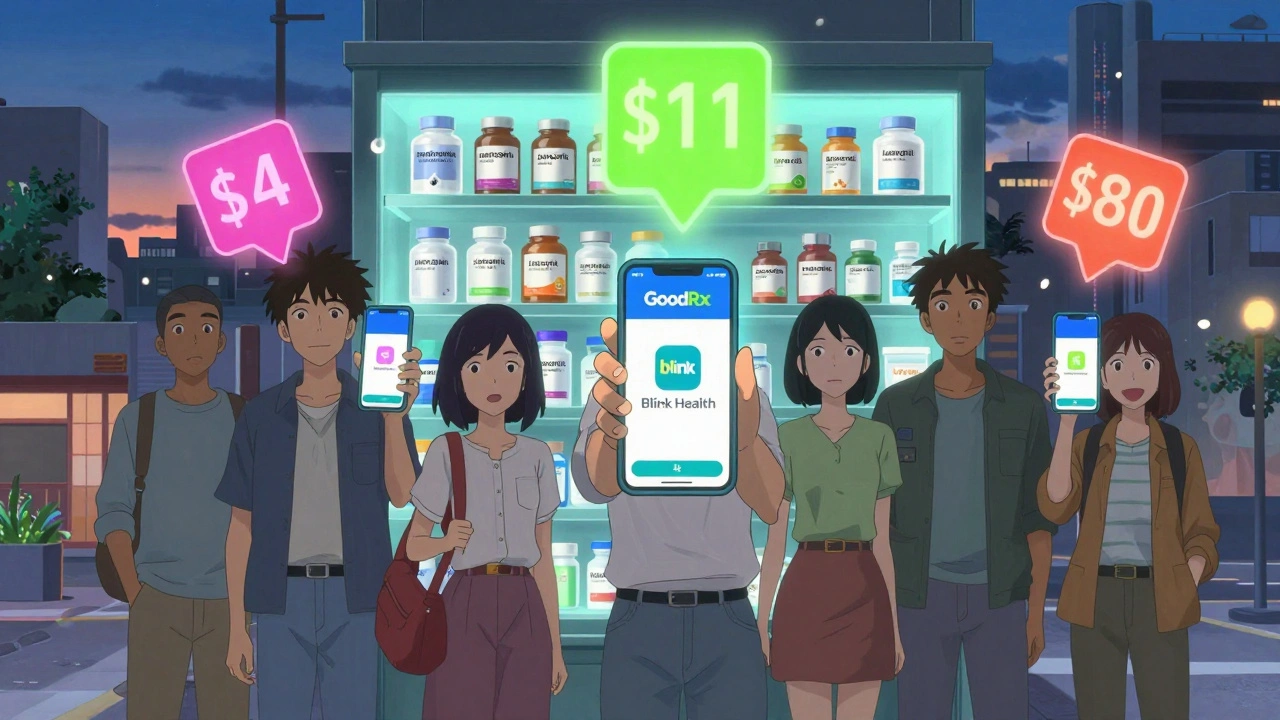
Buying generic medications shouldn’t feel like a financial gamble. Yet for millions of Americans paying out of pocket, the price tag on a 30-day supply of metformin or lisinopril can jump from $4 to $40-or even $80-depending on which pharmacy you walk into. That’s where coupon and discount card programs come in. They’re not insurance. They’re not government aid. But for people without full coverage, they’re often the only thing standing between them and skipping doses or going without meds altogether.
How These Programs Actually Work
These discount cards aren’t magic. They’re negotiated deals between third-party companies and pharmacies. Think of them like bulk-buying clubs-but for prescriptions. Companies like GoodRx, NeedyMeds, and Blink Health strike agreements with drug manufacturers and pharmacies to offer lower cash prices. When you show the card at the counter, the pharmacy pays a small fee to the discount provider, and you get the reduced rate. The most common model? $4 for a 30-day supply of certain generics. Walmart started this back in 2006. Now, Target, Kroger, and Costco offer similar deals on a short list of drugs. But the big players-GoodRx, for example-go further. They cover thousands of medications and claim savings of up to 85%. That sounds amazing. And sometimes, it is.Where You Actually Save the Most
The real wins come with generic drugs. A 2022 study in Circulation: Cardiovascular Quality and Outcomes looked at heart failure patients on three generic meds-lisinopril, carvedilol, and spironolactone. With a discount card, the monthly cost dropped to $11. Without it? Around $30. That’s a 65% savings. Same story for metformin, atorvastatin, levothyroxine. These are the drugs millions rely on daily. And for people on high-deductible plans, these discounts can mean the difference between taking meds or not. But here’s the catch: discount cards barely move the needle on brand-name drugs. Add one brand-name SGLT2 inhibitor like dapagliflozin to that same heart failure regimen, and the monthly cost jumps to $1,200-$1,500-even with the card. The discount? Maybe 10%. That’s not saving. That’s just slightly less bleeding.Who Benefits the Most?
If you’re uninsured, underinsured, or in the early part of your deductible year, these cards are lifesavers. A Reddit user in 2022 posted they saved $87 on their cholesterol meds using GoodRx. Another reported paying $3 for a 90-day supply of generic sertraline instead of $120 cash. These aren’t outliers. They’re common. But if you have decent insurance with low copays, you might not save anything. In fact, your insurance copay could be lower than the discount card price. That’s why pharmacists now routinely check three prices: your insurance, the cash price, and the discount card rate. They’re trained to find the cheapest option-for you.
The Hidden Costs: Time, Confusion, and Inconsistency
There’s a dark side. These programs don’t work the same everywhere. One user on Reddit said they got $15 for the same pill at the same pharmacy using Blink Health, but $42 with GoodRx. That’s not a typo. That’s how it works. Prices change daily. Sometimes hourly. A card that saved you last month might cost more this month. You also have to shop. You can’t just pick one card and forget it. You need to compare GoodRx, SingleCare, Blink, and even your pharmacy’s own loyalty program. Consumer Reports found 68% of users had to visit multiple pharmacies to find the best deal. Forty-two percent said this caused delays in filling prescriptions. For someone with diabetes or high blood pressure, waiting a few extra days isn’t just inconvenient-it’s dangerous. And it’s exhausting. Checking prices takes 5 to 15 minutes per medication. If you’re on five drugs? That’s over an hour a month just trying to afford your health. That’s not a solution. That’s a job.What You Need to Know Before You Use One
- Always check multiple apps. GoodRx isn’t always the cheapest. Try SingleCare, Blink, and RxSaver. Use the same drug name and dosage each time.
- Don’t assume your pharmacy is the same price. Even two CVS locations five miles apart can have different rates. Check before you go.
- Ask your pharmacist. They can run the numbers for you. Many now do it automatically.
- Know your insurance. Sometimes, your copay is better. Don’t waste your time.
- Stick to generics. Discount cards work great on generics. They barely help with brand names.
- Download the app. Most cards work via smartphone. No need to print anything.
The Bigger Picture
These programs grew because the system failed. Over 26% of U.S. adults skip doses because of cost. High-deductible plans pushed more people into paying full price. Drug prices kept climbing. So companies stepped in to fill the gap. But they’re not fixing the problem. They’re patching it. The real fix? Lowering the base cost of generics. Making brand-name drugs affordable. Creating transparent pricing. Until then, discount cards will keep growing. The market is projected to hit $3.8 billion by 2034. Some insurers are starting to integrate these discounts automatically. Express Scripts and OptumRx now apply the lowest price-insurance or card-without you lifting a finger. That’s the future. But right now, you still have to do the work.Final Reality Check
Coupon and discount card programs are not a cure. They’re a tool. A useful one-if you know how to use them. They can save you hundreds a year on your daily meds. But they won’t help if you’re trying to cut costs on expensive brand drugs. They won’t replace insurance. And they won’t make the system fair. But if you’re paying cash for your prescriptions? Start with GoodRx. Compare it to your pharmacy’s cash price. If it’s lower, use it. If not, don’t waste your time. And if you’re on multiple meds? Make a list. Check prices once a month. It’s tedious. But it might be the only thing keeping you alive.Generic drugs are safe. They’re effective. And they’re supposed to be cheap. The fact that you have to hunt for the lowest price just to afford them? That’s not normal. But it’s real. And right now, these cards are your best shot.
Are discount cards the same as insurance?
No. Discount cards are not insurance. They don’t pay part of your bill or cover you if you need hospital care. They’re simply negotiated cash prices for medications. You pay the full discounted amount at the pharmacy. No claims, no deductibles, no co-pays. Just a lower price if you pay cash.
Can I use a discount card with my insurance?
You can’t use them together. You choose one or the other. Sometimes your insurance copay is cheaper. Sometimes the discount card is. Always ask your pharmacist to check both before you pay. Some newer pharmacy benefit managers now automatically pick the lower price for you, but that’s still not the norm everywhere.
Which discount card saves the most money?
There’s no single winner. GoodRx often has the widest reach, but SingleCare or Blink Health might be cheaper for your specific drug or pharmacy. The only way to know is to compare. Use at least two apps for each prescription. Prices change daily, so what’s cheap today might not be tomorrow.
Do discount cards work for all generic drugs?
Most common generics like metformin, lisinopril, atorvastatin, levothyroxine, and sertraline are covered. But not every generic is included. Some specialty generics or newer formulations may not be discounted. Always check the app before assuming. If your drug isn’t listed, try searching the exact name or brand equivalent.
Why is the same drug priced differently at the same pharmacy?
Because each discount card negotiates its own deal with the pharmacy. One card might pay the pharmacy $1 to fill your script, another might pay $3. The pharmacy passes that difference to you as a lower price. It’s not random-it’s business. But it’s confusing. That’s why comparing cards is essential.
Can I use these cards if I’m on Medicare?
Yes. But Medicare Part D has its own rules. If your Part D plan’s copay is lower than the discount card price, use your plan. If the card price is lower, use the card. You can’t combine them. Always ask your pharmacist to check both options. Some Medicare Advantage plans now integrate discount pricing automatically.
Are discount card programs safe and legitimate?
Yes. GoodRx, NeedyMeds, Blink Health, and SingleCare are well-established, reputable companies. They don’t sell your data or charge you to use their service. They make money when pharmacies pay them a small fee for bringing customers. There’s no hidden cost to you. Just be cautious of fake sites that look like them-always use the official app or website.
What if I can’t find a discount on my medication?
Try NeedyMeds. They list patient assistance programs from drug manufacturers that offer free or low-cost meds to qualifying people. You might also ask your doctor about samples, or switch to a different generic version of the drug. Sometimes, a different manufacturer’s version is cheaper-even if it’s the same active ingredient.
Marvin Gordon
December 4, 2025 AT 12:58Just used GoodRx for my metformin last week-paid $3.50 for a 90-day supply. My insurance wanted $42. I didn’t even have to call anyone. Just opened the app, showed the barcode, and walked out. This isn’t magic. It’s just how broken the system is.
ashlie perry
December 6, 2025 AT 06:19They’re tracking you through these apps. Every time you search for a drug, they log it. Then they sell that data to pharma. Next thing you know, you’re getting ads for insulin right after you check lisinopril prices. It’s not free. You’re the product.
Ali Bradshaw
December 7, 2025 AT 14:33I’ve been using these cards since 2020. I’m on five generics. I save about $600 a year. It’s not glamorous, but it’s the difference between eating and breathing. I check prices every Sunday night while drinking tea. It’s my weird little ritual. Worth it.
an mo
December 9, 2025 AT 12:10These discount programs are just corporate band-aids on a systemic wound. Pharma oligarchs set inflated list prices knowing these intermediaries will undercut them just enough to look like heroes while keeping margins intact. It’s a rigged game disguised as consumer empowerment.
Rupa DasGupta
December 9, 2025 AT 18:34OMG I just paid $1 for sertraline with SingleCare 😭 I was gonna skip my dose this month… I cried in the pharmacy aisle. Thank u to whoever made this app 💕🙏
Ada Maklagina
December 11, 2025 AT 08:19My pharmacist just told me to stop using GoodRx. My insurance copay was $5. GoodRx was $8. She checked all three options before I even asked. People don’t realize pharmacists are trained for this now. Just ask.
Chris Brown
December 12, 2025 AT 21:55If you’re using discount cards, you’re complicit in the collapse of healthcare. You’re accepting the fact that medicine should be a scavenger hunt instead of a right. This isn’t innovation. It’s surrender.
aditya dixit
December 14, 2025 AT 05:48Back in India, we get metformin for 15 rupees-less than 20 cents. Here, people are choosing between insulin and rent. These discount cards aren’t solutions-they’re evidence of a civilization that lets its sick people bargain for survival. We’re not fixing the system. We’re just teaching people how to survive it.
Kylee Gregory
December 15, 2025 AT 12:21I think the real win here is that these programs forced pharmacies and insurers to start comparing prices transparently. Even if it’s messy, it’s pushing the system toward accountability. Maybe one day, the lowest price will be automatic-not something you have to hunt for like a treasure map.
Norene Fulwiler
December 16, 2025 AT 14:28My cousin in Nigeria gets her hypertension meds for $0.50 a month through a local NGO. Here, we’re comparing apps like it’s a game. We’ve normalized suffering. It’s not about saving money anymore-it’s about not dying because you forgot to check a barcode.
Annie Grajewski
December 18, 2025 AT 04:09goodrx is the best lol i saved 87$ on my cholestrol med but then i used blink and it was 90$?? like wtf is this magic?? also i think the pharmacy stole my card bc they charged me 42$ the next time??
Jennifer Patrician
December 18, 2025 AT 14:14These apps are owned by big pharma. They want you to think you’re saving money so you don’t demand real reform. The minute you start asking why these drugs cost $1000, they’ll make the discount disappear. Trust me, I’ve seen the emails.
William Chin
December 20, 2025 AT 09:04As a licensed pharmacist with 18 years of experience, I must emphasize that discount card pricing is not standardized, nor is it regulated. The discrepancies you observe are not anomalies-they are systemic failures of a profit-driven infrastructure. You are not shopping. You are navigating a minefield.
Lynette Myles
December 21, 2025 AT 23:38Same drug, same pharmacy, different price because each discount company negotiates separately. It’s not random. It’s business. Always check multiple apps. Don’t trust one.
Lucy Kavanagh
December 22, 2025 AT 14:55My sister’s doctor told her to use GoodRx because her insurance wouldn’t cover it. Then the insurance company sent her a letter saying they ‘discovered’ the discount and lowered her premium because she ‘wasn’t using benefits.’ They’re punishing people for trying to survive.