
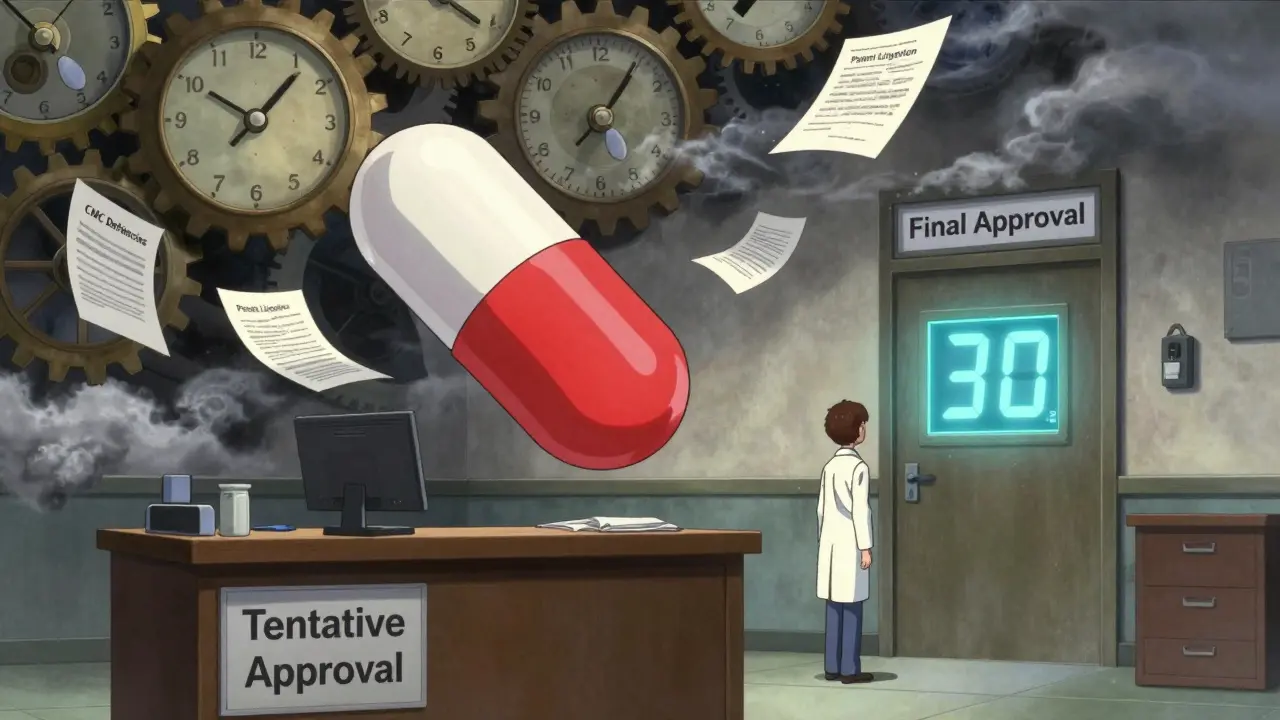
When a generic drug gets tentative approval from the FDA, it doesn’t mean it’s ready to hit pharmacy shelves. It means the agency has checked every scientific box - the chemistry, the manufacturing, the bioequivalence - and found it meets the same standards as the brand-name drug. But it still can’t be sold. Why? Because the patent clock hasn’t run out. Tentative approval is like getting your driver’s license before you’re old enough to drive. You’re qualified, but the law says you have to wait.
Why Tentative Approval Exists
The FDA created the tentative approval system under the Hatch-Waxman Act of 1984. The goal was simple: speed up access to affordable medicines. Instead of making generic manufacturers wait until a patent expired to even start the approval process, they could submit their application years in advance. If everything checks out, the FDA gives them tentative approval. That way, the moment the patent expires, the generic can launch immediately - no delays, no backlogs. But in practice, the system doesn’t always work that way. Many generics sit in tentative approval limbo for years. Some never launch at all. The problem isn’t the science. It’s everything else.Review Cycles: The Long Road to Approval
Getting a generic drug approved isn’t a one-time review. It’s a back-and-forth. The FDA sends a letter listing deficiencies. The company fixes them. The FDA reviews again. Repeat. Before 2012, the average generic application went through nearly four review cycles before approval. Even after the Generic Drug User Fee Amendments (GDUFA) were introduced to speed things up, the number only dropped to 3.2 cycles by 2022. That’s still a lot of waiting. The most common reasons for these delays? Chemistry, manufacturing, and controls (CMC) issues. Nearly one in three deficiencies come from incomplete or unclear manufacturing data. Bioequivalence studies - the tests that prove the generic works the same as the brand - are often poorly designed. Analytical methods? Not properly validated. These aren’t minor errors. They’re fundamental flaws that force the FDA to ask for more data, more testing, more time. Manufacturing facilities are another major bottleneck. In 2022, 41% of complete response letters (CRLs) - the FDA’s formal rejection - cited problems with the production site. Common issues? Poor quality control systems, failed environmental monitoring, or equipment that hasn’t been properly qualified. If the factory can’t prove it can make the drug consistently and safely, the FDA won’t approve it. Period.Patents: The Biggest Barrier
Even if the FDA says yes, the brand-name company can say no. When a generic manufacturer files for approval and claims the patent is invalid or won’t be infringed (called a Paragraph IV certification), the brand company has the right to sue. And if they do, the FDA is legally blocked from giving final approval for 30 months. That’s a statutory stay - a hard stop, no exceptions. Between 2010 and 2016, 68% of tentatively approved generics were held up by these lawsuits. Some lawsuits are legitimate. Many aren’t. Brand companies have learned to use the system to their advantage. They file lawsuits even when the patent is weak or expired. They file multiple patents on minor changes - a tactic called “product hopping.” They even pay generic makers to delay their launch - known as “pay-for-delay” deals. Between 2009 and 2014, 987 generic launches were blocked this way. Citizen petitions are another tool. Brand companies submit petitions to the FDA arguing that the generic’s testing methods are flawed - even when they’re not. Between 2013 and 2015, 67 petitions were filed. Only three were accepted. But each one delayed approval by months. One study found petitions filed within 30 days of patent expiration added an average of 7.2 months to the wait.
Applications That Don’t Get It Right the First Time
Too many generic applicants submit incomplete applications. In 2021, 29% of initial submissions had major gaps - missing stability data, unclear labeling, or incomplete container closure system details. The FDA can’t approve what’s not there. Stability data is especially critical. It shows the drug won’t break down over time. In 2022, 43% of all deficiencies were related to inadequate stability studies. For complex drugs - like inhalers, creams, or injectables - this gets even harder. These products require more testing, more validation, more time. On average, they go through 3.7 review cycles, compared to 2.9 for simple pills. And when the FDA sends a deficiency letter, applicants often take too long to respond. In 2022, the average time to reply to a CRL was 9.2 months. The FDA recommends six. That extra 3.2 months adds up fast - especially when you’re racing to launch after a patent expires.Market Forces: Just Because You Can Doesn’t Mean You Will
Even after a generic gets final approval, it might never hit the market. Why? Economics. If the brand drug only makes $30 million a year in sales, there’s little profit in making a generic. The cost to scale up manufacturing, run distribution, and compete on price might not be worth it. In 2022, 30% of approved generics never launched. For drugs under $50 million in annual sales, that number jumped to 47%. Manufacturers also wait. They don’t launch the day the patent expires. They wait for the right moment - when competitors are slow to enter, or when prices are highest. For complex generics like topical creams or inhalers, 62% of companies waited more than a year after approval to launch, often because they couldn’t ramp up production fast enough. And even when generics do launch, prices don’t always drop. A 2019 study found that if only one generic enters the market, prices stay at 80% of the brand’s price for two full years. That discourages other companies from entering, keeping competition low and prices high.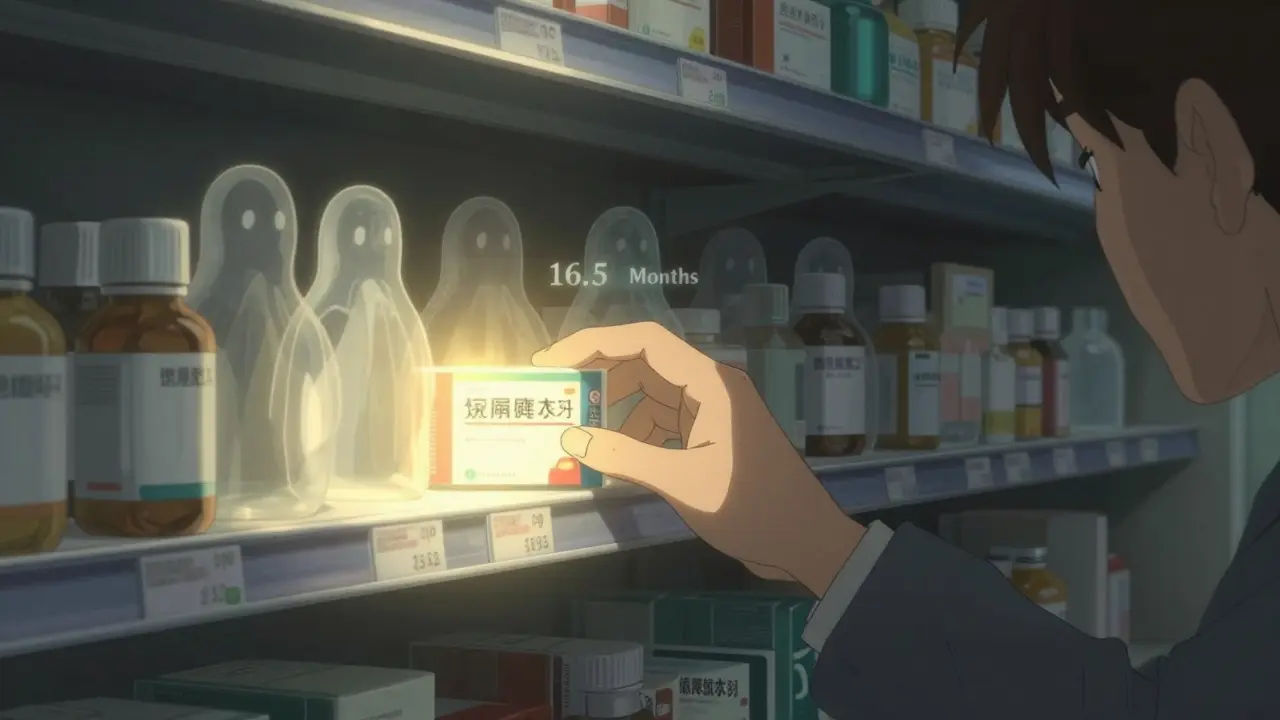
What’s Being Done to Fix It
The FDA knows the system is broken. That’s why they created the Competitive Generic Therapy (CGT) pathway in 2017. For drugs with little or no generic competition, CGT gives priority review. In 2022, 78% of CGT-designated drugs got tentative approval in under 8 months - half the normal time. They also launched a 2022 initiative to fast-track 102 high-priority tentative approvals. Of those, 67% got final approval within a year, compared to just 34% for others. That’s progress. GDUFA III, which runs from 2023 to 2027, sets ambitious goals: raise first-cycle approval rates from 28% to 70% by 2027, and cut review times for priority drugs to just 8 months. Congress has stepped in too. The CREATES Act of 2019 forces brand companies to provide samples of their drugs so generics can test them - something some companies refused to do. The Affordable Drug Manufacturing Act of 2023 aims to reduce supply chain bottlenecks. But progress is slow. The median time from tentative approval to market launch in 2022 was still 16.5 months. Patent litigation continues to delay thousands of generics. And the FDA admits resource constraints will keep timelines stretched through at least 2025.What This Means for Patients
Every delay in generic approval means higher drug prices. The Congressional Budget Office estimated patent-related delays cost U.S. patients $9.8 billion in 2018. By 2027, that number could hit $12.4 billion. Patients waiting for affordable versions of expensive drugs - for diabetes, heart disease, cancer - are paying the price. A generic that’s tentatively approved but stuck in litigation isn’t just a regulatory glitch. It’s a barrier to care. The system was designed to bring down costs and increase access. Too often, it’s being used to do the opposite.What does tentative approval mean for a generic drug?
Tentative approval means the FDA has reviewed the generic drug’s chemistry, manufacturing, and bioequivalence data and found it meets all safety and effectiveness standards. But the drug cannot be sold yet because patent or exclusivity protections on the brand-name version are still active. Once those protections expire, the FDA can quickly grant final approval and the generic can launch.
How long does it take to go from tentative approval to market launch?
The median time from tentative approval to market launch was 16.5 months in 2022. For some drugs, especially those involved in patent litigation or complex formulations, it can take years. In some cases, the drug never launches at all.
Why do some generics with tentative approval never reach the market?
Many generics are never launched because the market isn’t profitable enough. If the brand drug sells for less than $50 million annually, manufacturers often decide the cost of production and competition isn’t worth the return. Other times, companies wait for optimal pricing conditions or face delays scaling up manufacturing.
Can the FDA approve a generic drug before the patent expires?
No. Even if a generic has tentative approval, the FDA cannot grant final approval until all patents and exclusivities on the brand drug have expired. If a patent lawsuit is filed, the FDA is legally required to wait 30 months before approving the generic, regardless of whether the patent is valid.
What is the Competitive Generic Therapy (CGT) pathway?
The CGT pathway is a fast-track review process created by the FDA in 2017 for generic drugs with little or no competition. Drugs in this pathway get priority review, with 78% receiving tentative approval within 8 months - compared to the standard 18 months. It’s designed to speed up access to affordable versions of drugs where patients have few options.
Sarah Triphahn
January 15, 2026 AT 08:37And we wonder why insulin costs $300.
Vicky Zhang
January 17, 2026 AT 04:04I've seen people skip doses because they can't afford the brand. Don't let them forget that.
Allison Deming
January 18, 2026 AT 02:12One must ask: who benefits? Not patients. Not public health. Not even shareholders in the long run. Only those who view medicine as a commodity, not a human right.
Susie Deer
January 18, 2026 AT 20:49Fix the supply chain. Stop the lawsuits. Or shut up
Dylan Livingston
January 19, 2026 AT 00:54Let’s be honest - this isn’t about access. It’s about the illusion of access. The real problem is that we treat medicine like a lottery where the rich buy all the tickets and the rest of us just hope we don’t need the winning numbers.
Andrew Freeman
January 20, 2026 AT 02:03also who the fuck cares about 3.2 review cycles. if the drug works why are we doing this like its a phd thesis
says haze
January 20, 2026 AT 23:09The real villain isn’t the FDA. It’s the legal architecture that allows patent thickets to function as anti-competitive moats. And let’s not pretend that citizen petitions are about safety - they’re about delay. They’re about time. And time is the currency of profit.
When a drug’s patent expires and the generic sits for 18 months? That’s not inefficiency. That’s collusion with a paperwork stamp.
Alvin Bregman
January 22, 2026 AT 00:27people used to believe the system worked. now they just see lawyers and spreadsheets blocking lifesaving meds. its not about the science anymore. its about whether we still believe in fairness
maybe the real fix isnt more rules but more transparency. let everyone see the letters. let patients know why their medicine is stuck
Sarah -Jane Vincent
January 23, 2026 AT 23:53And don’t even get me started on the WHO. They’re in on it too. China’s making all the pills. India’s filing all the apps. And the FDA? They’re just the puppet masters with the strings.
Henry Sy
January 24, 2026 AT 12:22They talk about review cycles like it’s a spreadsheet. But people are dying while the lawyers file their 17th motion. This ain’t bureaucracy. It’s murder with a paperwork trail.
Anna Hunger
January 24, 2026 AT 22:07It is imperative that stakeholders avoid conflating market dynamics with regulatory failure. The delay in commercialization is a consequence of economic calculus, not institutional incompetence.
Jason Yan
January 26, 2026 AT 19:40What if we just took the flags down? What if we said - if the science checks out, the drug should be allowed to compete? Not in 16 months. Not after 3 lawsuits. Now.
It’s not about being anti-corporate. It’s about being pro-human.
shiv singh
January 28, 2026 AT 08:31You call this democracy? I call it theft with a law degree.