
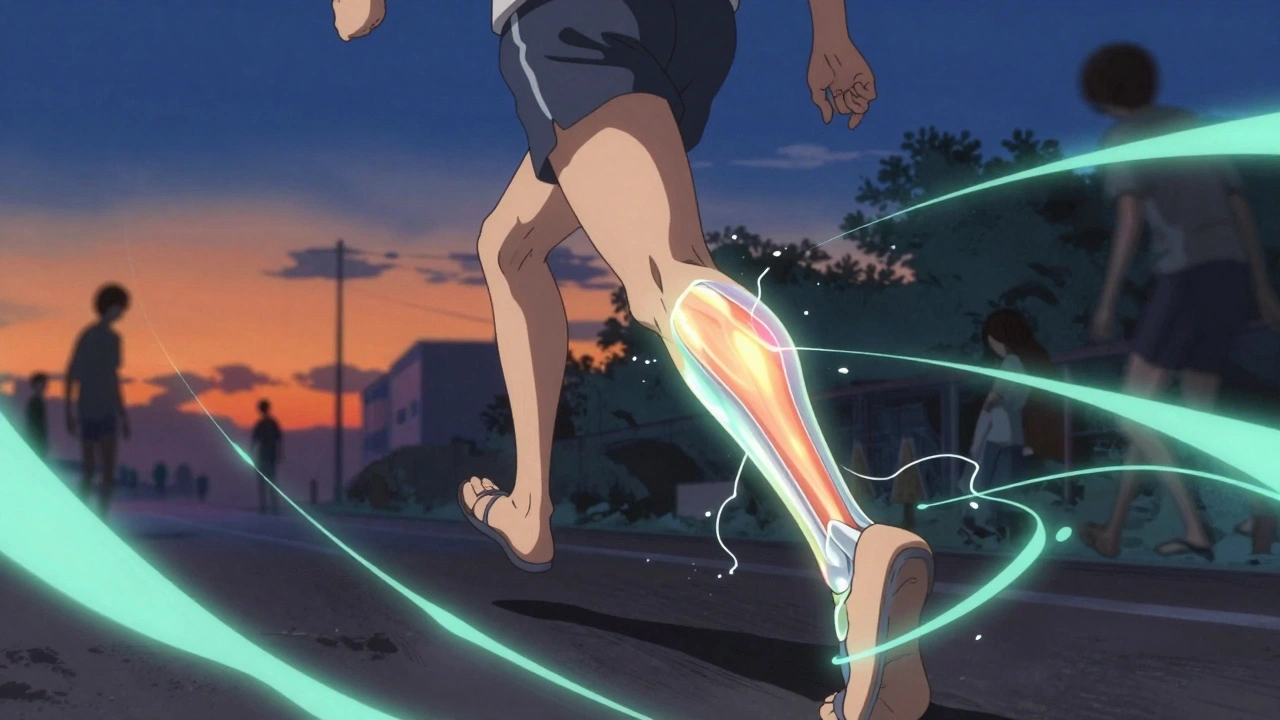
When your tendon hurts-not just a quick twinge, but a deep, persistent ache that lingers after running, jumping, or even walking-you’re not just dealing with inflammation. You’re dealing with tendinopathy. It’s not a sprain. It’s not a tear. It’s a breakdown in the tendon’s structure, often from overuse. And the good news? Most cases don’t need surgery. The better news? There’s solid science behind what actually works.
What Tendinopathy Really Is (And Why It’s Not Just Inflammation)
For years, doctors called it “tendinitis,” assuming it was inflamed tissue. But if you look under the microscope, there’s rarely swelling or immune cells around a chronic painful tendon. Instead, you see disorganized collagen fibers, increased blood vessels, and nerve growth-signs of failed healing. That’s tendinopathy: a degenerative, non-inflammatory condition where the tendon struggles to repair itself under load.
It hits runners hard-Achilles tendinopathy affects up to 10% of them at some point. Volleyball players? Patellar tendinopathy, or “jumper’s knee,” is common. Even office workers get it in the elbow from repetitive typing. The pain doesn’t come from a sudden injury. It builds slowly. You ignore it. Then one day, you can’t climb stairs without wincing.
And here’s the thing: rest won’t fix it. In fact, complete rest can make the tendon weaker. What it needs is the right kind of stress-controlled, progressive, and specific. That’s where eccentric training comes in.
Eccentric Training: The Gold Standard for Tendon Recovery
Eccentric training means focusing on the lowering phase of a movement-the controlled lengthening of the muscle-tendon unit. Think of it like slowly lowering yourself into a chair, not jumping down. For tendons, this slow, heavy load triggers biological changes that rebuild the damaged tissue.
Back in 1998, Dr. Hakan Alfredson showed that people with Achilles tendinopathy who did daily heel drops-standing on a step, raising up on both feet, then lowering slowly on just the painful one-had dramatic improvements after 12 weeks. Since then, dozens of studies have confirmed it. The Victorian Institute of Sports Assessment (VISA) scores, which measure pain and function, improve by 40-65% in most patients who stick with it.
For Achilles tendinopathy, the classic protocol is Alfredson’s heel drop: two legs up, one leg down. Do 3 sets of 15 reps, twice a day, with your knee straight (to target the gastrocnemius) and then bent (to target the soleus). You should feel a strong stretch and some discomfort-around 5-7 out of 10 on the pain scale. That’s okay. It’s not supposed to be pain-free.
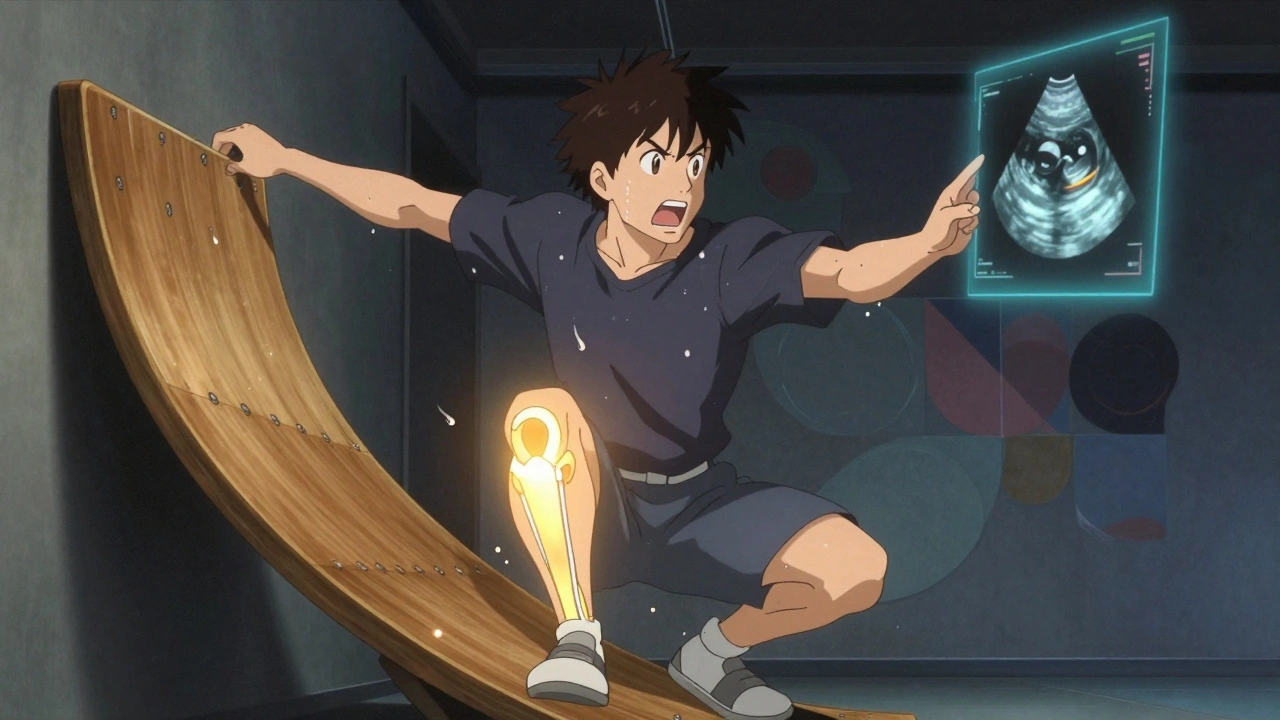
For patellar tendinopathy, the go-to exercise is the single-leg decline squat. You stand on a 25-degree angled board, hold onto something for balance, and slowly lower down over 3-5 seconds. Keep your knee aligned over your toes. Do 3 sets of 15 reps daily. It’s brutal at first. But ultrasound scans show real changes: the tendon thickens, collagen fibers realign, and stiffness improves by 15-20% after 8-12 weeks.
Heavy slow resistance (HSR) training is another option. Instead of just lowering, you do full reps slowly: 3 seconds up, 3 seconds down, at 70% of your one-rep max. Three times a week. A 2015 study found HSR worked just as well as eccentric training for Achilles tendinopathy-but people stuck with it longer because it hurt less at the start.
Why Eccentric Training Works (The Science Behind the Pain)
It’s not magic. It’s biology. When you load a tendon slowly and heavily, you activate tenocytes-the cells responsible for making collagen. These cells respond by producing more organized, stronger fibers. Ultrasound tissue characterization shows the tendon’s structure improves visibly after 8-12 weeks. That’s why you can’t rush it.
And here’s a key insight: pain during exercise doesn’t mean you’re hurting yourself. In fact, research shows better outcomes when you train at 7-8/10 pain tolerance, not “no pain.” The old advice to avoid all discomfort actually delays recovery. What you want to avoid is pain that lasts more than 24 hours, spikes the next day, or shoots above 7/10 during the set.
Isometric holds-holding a static contraction without movement-can help too. If your tendon is flaring up before a workout, doing a 45-second wall sit (for patellar) or a 30-second calf press against a wall (for Achilles) can reduce pain by 50% immediately. It’s a great bridge to get you back to eccentric work.
Injection Options: Quick Fix or Long-Term Risk?
When pain is unbearable, injections seem tempting. But they’re not a cure. They’re a temporary pause button.
Corticosteroid injections give fast relief-up to 50% pain reduction in the first 4 weeks. That’s why some doctors still offer them. But here’s the catch: a 2013 BMJ study found that 65% of people who got steroid shots needed another treatment within 6 months. Meanwhile, only 35% of those who did eccentric training did. Why? Steroids weaken tendon tissue over time. They reduce pain signals, but they don’t fix the structure. In some cases, they increase rupture risk.
Platelet-rich plasma (PRP) sounds fancy. You take your own blood, spin it to concentrate platelets, and inject it into the tendon. The theory? Platelets release growth factors that heal tissue. But the data? Mixed. A 2020 review in the American Journal of Sports Medicine found PRP offered only 15-20% more improvement than a placebo. Not enough to justify the cost (often $500-$1,000 out of pocket) or the discomfort of the injection.
Ultrasound-guided injections can help target the right spot, but even then, the long-term results don’t beat exercise. The best use for injections? As a short-term tool to get you through a flare-up so you can start or continue rehab. Not as a replacement.
Who Doesn’t Respond to Eccentric Training?
Not everyone gets better with eccentric training. Studies show about 30% of patients are non-responders. Why?
One reason: poor technique. A 2021 study found self-managed patients made errors in form 40% more often than those working with a physical therapist. Doing decline squats with knees caving in? That won’t help your patellar tendon. Letting your heel wobble during heel drops? You’re not loading the tendon right.
Another reason: too little load. If you’re doing 15 reps with no resistance, you’re not challenging the tendon enough. You need to feel it. That’s why HSR-using weights-can be better for some people. It’s easier to progress gradually.
And then there’s timing. If you’ve had the pain for years and ignored it, the tendon may be too far gone. That’s when load management becomes just as important as exercise. Are you still running 5 miles a day? Are you climbing stairs 20 times? You need to reduce the overall load on the tendon while you rebuild it.
What Actually Works: A Real-World Protocol
Here’s what success looks like, based on real patient outcomes and expert guidelines:
- Start with isometrics if pain is high. Hold a 45-second static contraction (e.g., wall sit for knee, calf raise against wall for heel) 2x daily. This reduces pain enough to begin eccentric work.
- Begin eccentric training 2-3 days per week. Use Alfredson’s heel drops for Achilles or decline squats for patellar. Aim for 3 sets of 15 reps. Pain should be 5-7/10 during the movement.
- Progress to HSR after 4-6 weeks if you’re not improving. Add resistance (dumbbells or a barbell) and do 3 sets of 15 reps slowly, 3x/week.
- Track your pain. Use a 10-point scale. If pain lasts over 24 hours, reduce load. If it’s consistently 3/10 or lower after 8 weeks, increase reps or add weight.
- Don’t quit before 12 weeks. Structural changes take time. Most people see real improvement between weeks 8 and 12.
- Use an app. The Tendon Rehab app (version 3.2, 2023) gives video demos, timers, and feedback. Users who used it had 85% adherence vs 65% with paper plans.
And yes-working with a physical therapist for at least two sessions to check your form makes a huge difference. One 2023 study found 92% of those who got coaching succeeded, compared to 68% who went it alone.
What’s Next for Tendinopathy Treatment?
The field is moving beyond one-size-fits-all protocols. Researchers are now looking at “precision rehabilitation.” That means testing your tendon’s load tolerance before prescribing exercises. Some clinics are using ultrasound elastography to measure stiffness, or even blood biomarkers to see how your tendon is responding.
Early trials are testing peptides that activate tenocytes directly. But those are still years away. For now, the best tool we have is movement-controlled, consistent, and progressive.
And while insurance coverage varies (NHS gives you 6 sessions; U.S. insurers often cover 8-12), the cost of not treating it is higher. Missed workouts, canceled trips, chronic pain-it adds up. Eccentric training costs little: just time, patience, and a step.
Final Thoughts: No Magic Bullet, But a Proven Path
Tendinopathy isn’t a quick fix. But it’s not a life sentence either. You don’t need surgery. You don’t need expensive injections. You need to load your tendon the right way, over time, and let it rebuild.
Most people who stick with eccentric training for 12 weeks get back to running, jumping, and living without pain. Some even say their tendon feels stronger than before. That’s not hype. That’s biology.
If you’re struggling, start slow. Use isometrics to manage pain. Get your form checked. Track your progress. And don’t give up before 8 weeks. The tendon doesn’t care about your schedule. It only responds to consistent, thoughtful load.
Can eccentric training make tendinopathy worse?
It can feel worse at first, especially in weeks 1-3, because you’re stressing a damaged tissue. But if pain exceeds 7/10 during exercise or lasts more than 24 hours afterward, you’re doing too much. Reduce the load or reps. Pain during exercise is normal; pain after is a signal to adjust. Most people improve within 4-6 weeks with proper progression.
Is it better to do eccentric or concentric exercises for tendinopathy?
Eccentric exercises are far more effective. A 2023 study on patellar tendinopathy showed eccentric training improved VISA-P scores by 40% more than concentric training. Concentric exercises (like rising up quickly) don’t load the tendon enough to trigger remodeling. Eccentric movements create the tension needed to rebuild collagen fibers.
How long does it take to see results from eccentric training?
You may feel less pain after 4-6 weeks, but structural changes take longer. Ultrasound scans show improved tendon texture and stiffness after 8-12 weeks. Most studies define success as 12 weeks of consistent training. Don’t stop early-even if you feel better, the tendon still needs time to fully remodel.
Should I get a corticosteroid injection for my tendon pain?
Only if you need short-term relief to start rehab. Steroid injections reduce pain quickly but don’t fix the tendon. Studies show 65% of people who get them need another treatment within 6 months. Eccentric training has a 65% success rate at 12 months with no side effects. Use injections as a bridge, not a solution.
Can I do eccentric training at home without a therapist?
Yes, but with caution. A 2023 study found 92% of people who worked with a therapist succeeded, compared to 68% who did it alone. Common mistakes include poor form on decline squats or letting the heel collapse during heel drops. Use video apps like Tendon Rehab, record yourself, or get one session with a physio to check your technique. Self-managed rehab works-but only if you’re precise.
What’s the difference between Achilles and patellar tendinopathy protocols?
For Achilles, use Alfredson’s heel drops: stand on a step, raise up on both feet, then lower slowly on one foot. Do it with knee straight and bent. For patellar, use single-leg decline squats on a 25-degree board. The movement is different because the tendons are in different locations and respond to different loads. Never swap protocols-doing heel drops for jumper’s knee won’t help.
Is PRP injection worth it for tendinopathy?
Not for most people. A 2020 review found PRP offered only 15-20% more improvement than a placebo. It costs $500-$1,000 per injection and requires multiple sessions. Eccentric training costs nothing but time and effort-and has better long-term results. PRP might be considered only if you’ve tried 12 weeks of exercise with no improvement and are considering surgery.
Ben Greening
December 10, 2025 AT 13:22Eccentric training remains the most evidence-based intervention for chronic tendinopathy, with robust longitudinal data supporting its efficacy across multiple tendons. The biomechanical stimulus of controlled lengthening induces tenocyte proliferation and collagen realignment, which is demonstrable via high-resolution ultrasound. While pain during loading is often misinterpreted as pathological, it is in fact a necessary component of tendon remodeling, provided it remains within a tolerable range (5-7/10) and resolves within 24 hours.
Nikki Smellie
December 11, 2025 AT 14:14Have you ever wondered why the pharmaceutical industry doesn't want you to know this? 🤔 Corticosteroid injections are profitable. Eccentric training? Free. And that’s why your doctor pushes shots - not because they work better, but because they’re reimbursable. The FDA has known for years that tendons weaken under steroids, yet the guidelines haven’t changed. Coincidence? I think not. 🕵️♀️💉
David Palmer
December 12, 2025 AT 06:44bro i tried the heel drops for 2 weeks and my achilles felt like it was gonna snap. just stopped. now i take ibuprofen and call it a day. why do people make this so hard? 🤷♂️
Doris Lee
December 13, 2025 AT 13:17Hey David - I totally get it, starting can feel scary 😊 But you’re not alone. Many people feel that way at first. What if you tried just 5 reps, twice a day, and gave yourself a week to adjust? Small steps still move the needle. You’ve got this. 💪
Jack Appleby
December 15, 2025 AT 11:49It is both astonishing and lamentable that the general populace continues to conflate symptomatic relief with therapeutic efficacy. Corticosteroid injections constitute a pharmacologically induced illusion of healing - a temporal palliative that undermines the tendon’s intrinsic reparative capacity. Eccentric loading, by contrast, is not merely a ‘treatment’ - it is a biomechanical epigenetic modulator that upregulates collagen synthesis via mechanotransduction pathways. To dismiss it as ‘just exercise’ is akin to denying the efficacy of resistance training for osteoporosis.
Regan Mears
December 15, 2025 AT 12:52Jack, you’re 100% right - but let’s not forget the human factor. People don’t fail because they’re lazy. They fail because they’re overwhelmed, confused, or scared. That’s why the 92% success rate with a physical therapist matters so much. A single 30-minute session to fix your squat form? Priceless. I’ve seen people cry because they finally felt their tendon respond. This isn’t just science - it’s hope with reps.
Kaitlynn nail
December 17, 2025 AT 12:24It’s all just vibration theory anyway. Tendons respond to frequency, not force. That’s why the real solution is standing on a tuning fork. 🌌
Rebecca Dong
December 17, 2025 AT 20:19Wait - so you’re telling me the whole medical system is lying to us? 😱 I’ve had 3 steroid shots and now my tendon is ‘thinner’ according to my cousin’s cousin who works at a lab? This is a cover-up. They don’t want us to heal. They want us to need more shots. And the app? Probably tracking us. Tendon Rehab? More like Tendon Spying. 📱👁️
Sarah Clifford
December 18, 2025 AT 20:18i did the squats for 3 weeks and my knee felt better. then i ran a 5k and it exploded. so now i just don’t move. #tendinopathywin