
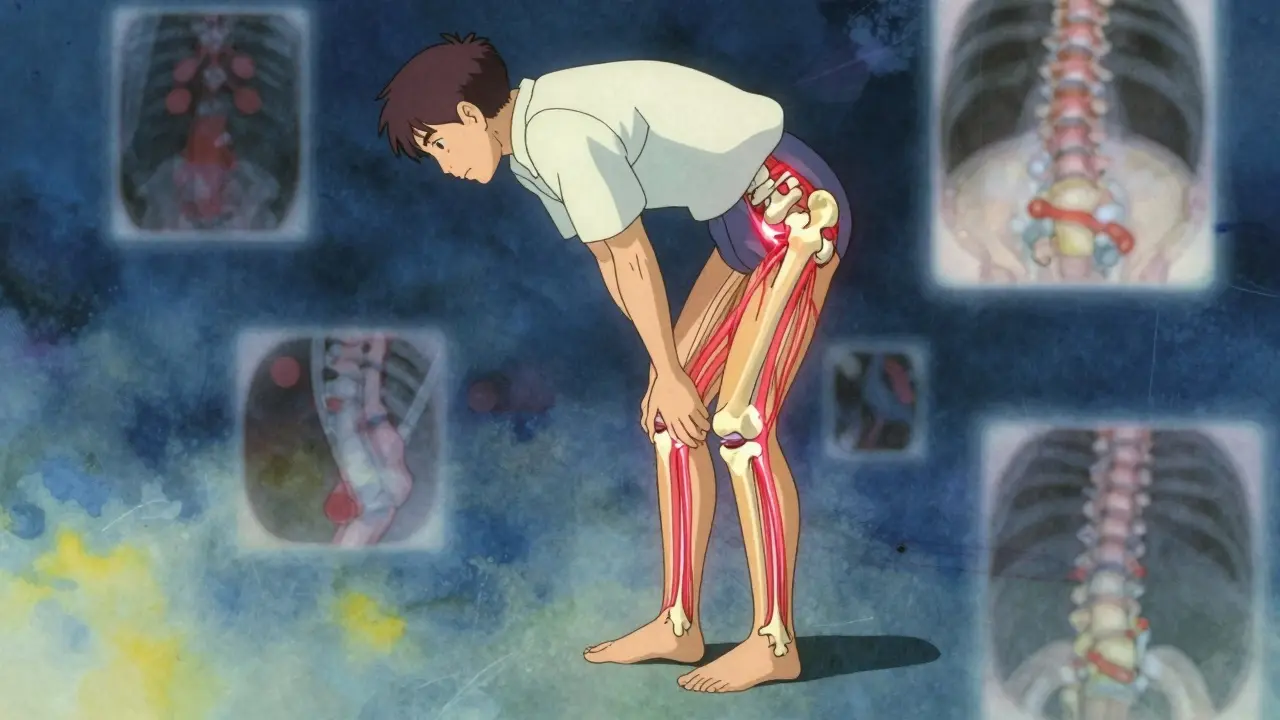
When your lower back aches after standing too long, or your hamstrings feel tight even after stretching, it might not just be a bad posture or overworked muscles. For many people, especially those over 50, that persistent discomfort could be spondylolisthesis-a slipped vertebra that’s quietly changing how your spine moves and feels.
It’s not rare. About 6 in every 100 adults have some degree of slippage in their lower spine. In kids, it’s less common but still happens, especially if there’s a family history. Most of the time, the problem happens where the last lumbar vertebra (L5) meets the first sacral bone (S1). That’s the spot that takes the most stress when you bend, lift, or stand for hours. And when that bone slips forward, it doesn’t just change your posture-it can pinch nerves, tighten muscles, and make walking feel like a chore.
Why Your Spine Slips: The Five Types of Spondylolisthesis
Not all slipped vertebrae are the same. The cause matters just as much as how far it’s slipped. There are five main types, each with a different story behind it.
Degenerative spondylolisthesis is the most common in adults over 50. It’s not caused by injury or genetics-it’s wear and tear. Arthritis breaks down the discs and joints between your vertebrae. As they shrink and weaken, the top bone slowly slides forward. This accounts for about 65% of all adult cases.
Isthmic spondylolisthesis starts with a tiny fracture in a part of the bone called the pars interarticularis. It’s often seen in young athletes-gymnasts, weightlifters, football players-who repeatedly arch their backs. That stress fracture doesn’t heal right, and over time, the vertebra slips. In fact, 7-12% of young athletes in these sports develop this fracture first, called spondylolysis, before it turns into slippage.
Dysplastic and pathologic types are rarer. Dysplastic means you were born with weak or oddly shaped spinal joints. Pathologic comes from diseases like bone tumors, osteoporosis, or infections that weaken the spine from within.
And then there’s traumatic-a sudden slip caused by a fall, car crash, or direct blow. It’s uncommon but serious.
How Do You Know If You Have It?
Here’s the surprising part: nearly half of people with spondylolisthesis feel nothing at all. They might only find out during an X-ray for something else.
But if symptoms show up, they follow a pattern. The most common is lower back pain that feels like a deep, dull ache-like a muscle strain that won’t go away. It gets worse when you stand or walk, and it gets better when you sit or lean forward. That’s because leaning forward opens up space between the vertebrae, taking pressure off the nerves.
Most people with symptoms also have tight hamstrings. Not just stiff-actually tight. You can’t touch your toes, no matter how hard you try. That’s because the slipped vertebra pulls on the nerves that run down the back of your legs, causing reflexive muscle tightening.
Other signs include stiffness in the lower back, trouble walking long distances, or a feeling of heaviness in the legs. In more severe cases-where the slip is over 50%-you might feel tingling, numbness, or even weakness in one or both legs. That’s nerve compression. And if it’s really bad, your lower back might start to curve inward more than normal (swayback), or even curve outward later (roundback).
How It’s Diagnosed: X-Rays, CTs, and MRIs
Your doctor won’t guess. They’ll look. The first test is always a standing lateral X-ray. That’s the key-it has to be done while you’re standing, because slippage can get worse under weight. The X-ray shows exactly how far the bone has moved.
They’ll grade it using the Meyerding system: Grade I is less than 25% slippage, Grade II is 25-50%, Grade III is 50-75%, and Grade IV is over 75%. Grade V means the bone has completely slipped off the one below it.
If your pain is sharp, shooting down your leg, or if you have numbness, they’ll order an MRI. That shows the soft tissues-discs, nerves, ligaments. It tells them if a disc is bulging or if a nerve is pinched. A CT scan gives a detailed view of the bones, especially if they’re looking for a fracture in the pars area.
One important thing: the degree of slippage doesn’t always match how bad your pain is. Someone with a Grade I slip might be in agony, while someone with a Grade III might feel fine. That’s why doctors don’t just look at the X-ray-they look at your whole picture.
Conservative Treatment: What Works Before Surgery
Most people don’t need surgery. In fact, 80-90% of cases improve with non-surgical care.
First, stop the activities that make it worse. That means avoiding heavy lifting, hyperextending your back, or sports that involve repeated arching. If you’re a runner or a gym-goer, you’ll need to adjust your routine.
Physical therapy is the cornerstone. A good program lasts 12-16 weeks and focuses on two things: strengthening your core muscles and stretching your hamstrings. Core strength helps stabilize the spine. Tight hamstrings pull on the pelvis and make the slip worse. Studies show about 65% of people stick with therapy long enough to see results.
Pain relief comes from over-the-counter NSAIDs like ibuprofen or naproxen. For more severe pain, doctors may suggest an epidural steroid injection. It’s not a cure, but it can calm down inflammation around the nerve and give you a few months of relief to work on rehab.
And don’t ignore lifestyle factors. If you smoke, quitting is non-negotiable. Smokers have over three times the risk of the bone failing to fuse after surgery. If you’re overweight, losing even 10 pounds can reduce pressure on your spine by 40%. A BMI over 30 increases surgical complications by nearly half.
Fusion Surgery: The Options When Everything Else Fails
If you’ve tried 6-12 months of conservative care and you’re still in pain, struggling to walk, or losing feeling in your legs, surgery becomes an option. The goal isn’t just to stop the slip-it’s to stop the pain.
Spinal fusion is the most common surgery. It joins two vertebrae together so they can’t move independently anymore. There are three main ways to do it.
Posterolateral fusion is the oldest method. The surgeon places bone grafts along the back of the spine and uses screws and rods to hold everything in place. It’s done in about 55% of cases. Success rates are good for mild slips (75-85%) but drop to 60-70% for severe ones.
Interbody fusion (PLIF or TLIF) is becoming the gold standard. Here, the surgeon removes the damaged disc between the vertebrae and inserts a spacer filled with bone graft material. This restores disc height, opens up the space for nerves, and provides better stability. It’s used in 35% of cases and has success rates of 85-92% across all slip grades.
Minimally invasive fusion uses smaller incisions and specialized tools. It’s less than 10% of surgeries but growing. Recovery is faster, and hospital stays are shorter. It’s not for everyone, but for the right patient, it’s a big win.
And there are new tools. In 2022, the FDA approved two new interbody devices designed specifically for spondylolisthesis. Early results show 89% fusion rates at six months-better than older models. Some surgeons now use bone morphogenetic protein (BMP) or stem cell treatments to boost bone growth. One 2023 study found BMP raised fusion rates to 94% in high-risk patients.
What Happens After Surgery?
Recovery isn’t quick. You’ll need 6-8 weeks of restricted activity-no lifting, twisting, or bending. Physical therapy starts around week 6 and lasts 3-6 months. Full recovery? That takes 12-18 months.
Success rates are high-78-85% of patients report satisfaction two years after surgery. But it’s not perfect. About 12-15% of people with severe slips need another surgery later. Why? Because the spine above or below the fusion can start to wear out faster. This is called adjacent segment disease, and it affects 18-22% of patients within five years.
What About Alternatives to Fusion?
Some patients wonder: can you fix this without fusing the spine? The answer is: maybe, but not for everyone.
Dynamic stabilization devices are being tested. These are flexible implants that limit harmful movement but still allow some motion. Early results for Grade I and II slips show 76% success at five years. But fusion still beats it at 88%. So right now, these are only for very specific cases.
And there’s ongoing research. A 2023 study identified 11 clinical and imaging signs that predict surgical success with 83% accuracy. That means doctors might soon be able to say, “You’re a good candidate,” or “Stick with therapy,” with much more confidence.
When to Seek Help
If your back pain lasts more than 3-4 weeks, especially if it radiates to your buttocks or thighs, get checked. If walking becomes hard, or you feel numbness or tingling in your legs, don’t wait. Early diagnosis means you have more options.
Spondylolisthesis isn’t a death sentence. For most, it’s manageable. For some, surgery changes everything. The key is knowing your grade, your symptoms, and your goals-and working with a team that listens.
Can spondylolisthesis heal on its own without treatment?
In most cases, no. The slipped vertebra won’t move back into place on its own. But symptoms can improve significantly with conservative care like physical therapy, activity modification, and pain management. Many people live without surgery by managing their condition. However, if the slip is severe or nerve compression is present, the body can’t fix the structural issue-only treatment can.
Is spondylolisthesis the same as a herniated disc?
No. A herniated disc happens when the soft cushion between vertebrae bulges or ruptures and presses on a nerve. Spondylolisthesis is when one bone slips forward over the one below it. They can happen together-in fact, they often do-but they’re different problems. A herniated disc causes sharp, shooting pain down the leg (sciatica), while spondylolisthesis causes a deep ache that worsens with standing and improves when leaning forward.
Does every case of spondylolisthesis need surgery?
No. In fact, only about 10-15% of people with spondylolisthesis end up needing surgery. Most cases respond well to physical therapy, pain relief, and lifestyle changes. Surgery is only considered if pain lasts over 6-12 months despite conservative treatment, or if there’s nerve damage like leg weakness or loss of bladder control.
How long does recovery take after spinal fusion?
Full recovery takes 12 to 18 months. The first 6-8 weeks involve strict activity restrictions. Physical therapy usually starts around week 6 and continues for 3-6 months. Bone fusion takes time-your body needs to grow new bone to lock the vertebrae together. Most people return to light work by 3-4 months, but heavy lifting and high-impact sports should be avoided for at least a year.
Can spondylolisthesis come back after surgery?
The fused vertebrae won’t slip again-that’s the point of fusion. But the spine above or below the fusion can start to wear out faster, a condition called adjacent segment disease. This happens in 18-22% of patients within five years and may require another surgery. That’s why careful patient selection and spinal alignment during surgery are so important.
Tommy Chapman
February 18, 2026 AT 11:15Robin bremer
February 19, 2026 AT 16:13Hariom Sharma
February 20, 2026 AT 06:08John Cena
February 20, 2026 AT 07:14aine power
February 21, 2026 AT 12:53Freddy King
February 22, 2026 AT 10:45Laura B
February 22, 2026 AT 20:08Nina Catherine
February 24, 2026 AT 03:35