
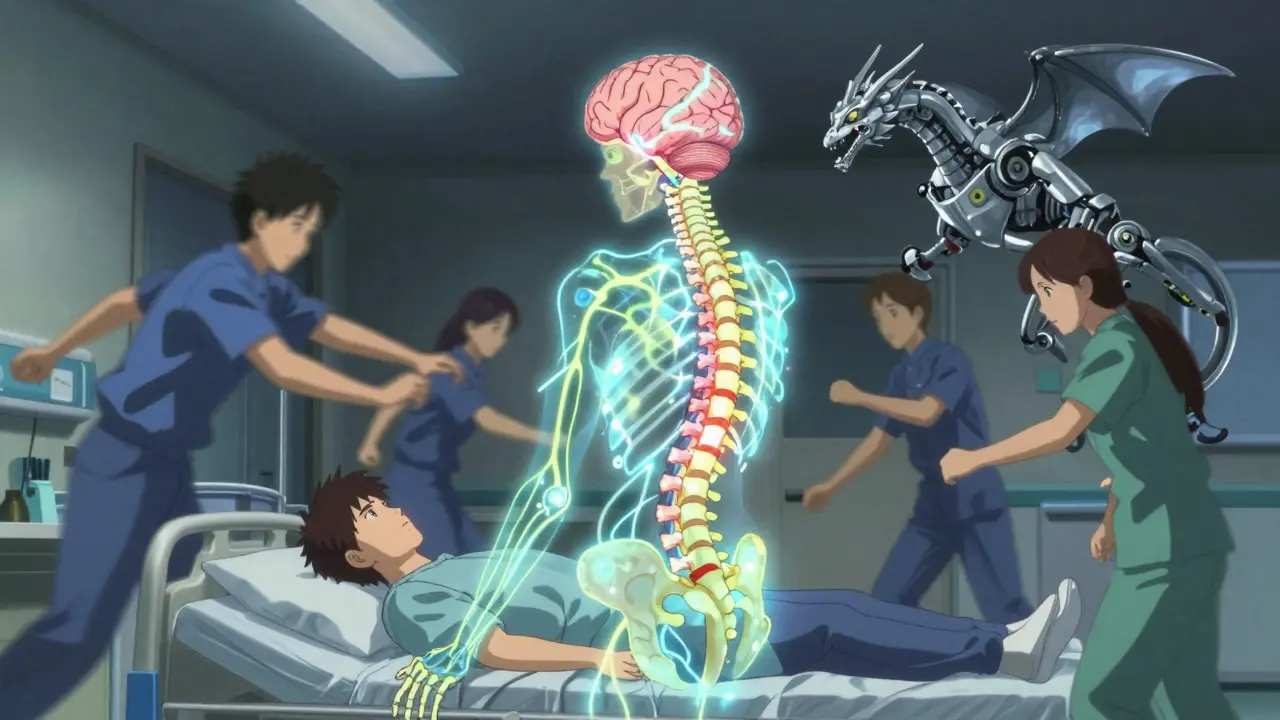
When a spinal cord is damaged, it’s not just the back that breaks-it’s the connection between your brain and the rest of your body. A spinal cord injury (SCI) doesn’t just mean paralysis. It means losing control over movement, sensation, and even basic functions like breathing, bladder control, and temperature regulation. The severity depends on where the injury happens and whether it’s complete or incomplete. But here’s the truth: recovery isn’t about waiting for a miracle. It’s about structured rehab, smart technology, and daily effort.
What Happens When the Spinal Cord Is Injured?
The spinal cord is like a thick cable full of nerves that carry signals from your brain to your muscles and organs. If it’s crushed, cut, or compressed, those signals get blocked. The higher the injury, the more functions are lost. A C1-C4 injury can mean losing the ability to breathe on your own. A T12 injury might leave you with full arm use but no leg movement. And if it’s a complete injury, you lose all sensation and movement below the injury site. Incomplete injuries are trickier-you might still feel some tingling or move a finger, but it’s unpredictable.Motor vehicle crashes cause nearly 4 out of 10 new SCIs each year. Falls are the second biggest cause, especially in people over 65. Violence, like gunshot wounds, makes up about 15%. Each year in the U.S., about 17,810 new cases are reported. Right now, around 302,000 people are living with SCI. Most of them are men, and the average age at injury is 43.
Rehab Starts the Day You’re Stabilized
Too many people think rehab begins after you leave the hospital. It doesn’t. In top centers, therapy starts within 24 to 72 hours-sometimes even while you’re still in the ICU. The goal? Prevent complications before they lock in.Early rehab focuses on three things: breathing, movement, and skin. If your injury is high (C3-C5), your diaphragm might not work right. That’s why therapists use assisted coughing, chest percussion, and incentive spirometers to keep your lungs clear. Pneumonia risk drops by 65% with these simple tools.
For movement, passive range-of-motion exercises are non-negotiable. If your limbs are limp, someone has to move them for you-at least once a day. If you’re spastic, you need it two or three times. Without this, your muscles shorten, joints stiffen, and you lose the chance to ever walk or reach again. Shoulder problems are especially common in cervical injuries. That’s why therapists spend extra time stretching your shoulders every day.
Therapy isn’t just one person pushing your arm around. It’s a team: physical therapists, occupational therapists, nurses, social workers, psychologists, and speech therapists. You get at least three hours of therapy, five days a week, in an inpatient program. That’s not optional. It’s the standard. And it works. People with incomplete injuries often regain 80-90% of their functional potential within the first year.
Assistive Devices: Tools That Give You Back Control
Rehab isn’t just about learning to move again. It’s about learning to live with what you can’t change. That’s where assistive devices come in.For mobility, wheelchairs are the foundation. But not just any chair. A custom seating system with pressure-relieving cushions can prevent pressure sores-something 25% of SCI patients deal with. Medicare covers 80% of the cost, but you’re still looking at $1,200 to $3,500 out of pocket for the right setup.
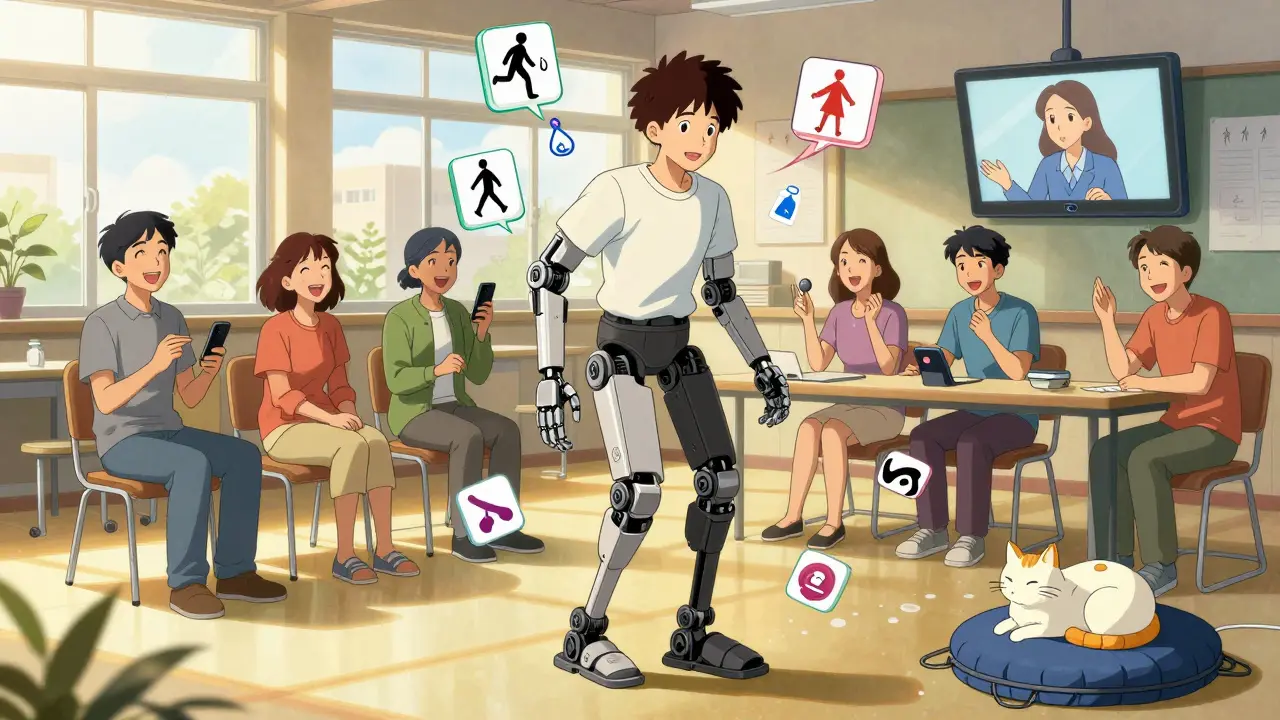
For those with hand function, robotic arms like Armeo help retrain grip and reach. For lower limbs, exoskeletons like Ekso and ReWalk let people stand and take steps. One user on Reddit said, “I took my first steps in three years with Ekso.” But there’s a catch: these machines need two or three therapists to operate safely. Sessions are limited to 30-45 minutes because they’re exhausting.
Functional Electrical Stimulation (FES) bikes are another game-changer. They send tiny electrical pulses to paralyzed leg muscles, making them pedal. Studies show FES cycling boosts heart health better than arm cycling-peak oxygen use goes up by 14.3%. But a home unit costs $5,000. Insurance rarely covers it. One user on the Reeve Foundation forum wrote: “It saved my muscle mass, but I had to pay for it myself.”
For bladder and bowel control, which affects nearly everyone with SCI, daily routines are critical. You might need catheterization, digital stimulation, or special diets. That’s 45 to 90 minutes a day, every day. No breaks. No shortcuts. And caregivers? They need training too. Bad transfers cause 32% of shoulder injuries in family members who help.

What Works Best? Treadmill vs. Overground Walking
If you have some movement left, walking rehab is a big part of recovery. But not all walking training is the same.Treadmill training with body weight support is now the gold standard for incomplete injuries. You’re suspended in a harness over a treadmill, and therapists help move your legs. It’s not natural walking-your steps are shorter, your pace faster-but it rewires your brain. Studies show it improves walking speed 23% more than regular overground walking after 12 weeks.
Why? Because it activates the same brain areas used in natural walking. Your nervous system learns to fire the right muscles in the right order. Overground walking is good for real-world practice, but it doesn’t give you the same neural boost.
But here’s the hard part: only 1-3% of people with complete paraplegia ever walk again. For incomplete injuries? Around 59% regain some walking ability. That’s why early testing matters. If you have even a flicker of movement in your toes, rehab can make a huge difference.
Spasticity, Pain, and the Hidden Struggles
The body doesn’t just go quiet after an SCI. Sometimes, it fights back.Spasticity-muscles that lock up or jerk uncontrollably-affects 65 to 78% of people with SCI. It can make sitting painful, sleeping impossible, or hygiene a nightmare. Treatment isn’t one-size-fits-all. Some take baclofen pills. Others get Botox injections directly into tight muscles. At Mayo Clinic, 78% of patients saw a 40-60% drop in spasticity scores with this combo.
Pain is another invisible burden. Neuropathic pain feels like burning, tingling, or electric shocks. It doesn’t respond to regular painkillers. You need nerve-targeted meds like gabapentin or pregabalin. And it’s not just physical. Depression hits 40% of SCI patients in the first year. That’s why peer counseling is so powerful. At Spaulding Rehabilitation, 82% of patients said talking to someone who’d been through it made them feel less alone.
Technology Is Changing the Game-But It’s Not Perfect
The future of SCI rehab is here, but it’s expensive and still evolving.Implantable diaphragm pacers, approved by the FDA in 2022, let people with C3-C5 injuries breathe without a ventilator 74% of the time. That’s life-changing. At Columbia University, a device called the Tethered Pelvic Assist Device helps with balance during standing and walking. And brain-computer interfaces? Early trials show 38% improvement in hand function for people with cervical injuries-just by thinking about moving.
But here’s the gap: most studies on these devices only follow patients for six months. The NIH says only 37% of research looks beyond that. We don’t know if these devices work long-term. And insurance? Medicare and private plans often deny coverage for “experimental” tech-even when it’s FDA-approved.
AI is now helping personalize rehab plans. By 2025, 65% of top centers will use software that adjusts your therapy based on your progress in real time. That’s huge. But it won’t help if you’re stuck in a facility that still uses paper charts.
The Real Barrier: Access and Motivation
The best rehab in the world doesn’t matter if you can’t get to it.Only 32% of general hospitals offer full SCI programs. You need to go to a specialized center-like Mayo Clinic, Spaulding, or Shepherd Center-to get the full package. But those centers are few. Travel, time, and cost become barriers.
And even when you’re in rehab, motivation fades. A survey by United Spinal Association found that 68% of people quit their home exercise programs within six months. Why? No follow-up. No accountability. No one checking in.
That’s why telehealth is growing fast. Now, 73% of top rehab centers offer virtual check-ins. You can show your therapist your range of motion on Zoom. You can get reminders for your bladder routine. You can join a peer group online. It’s not the same as in-person, but it’s better than nothing.
What You Need to Know Before You Start
If you or someone you love has a spinal cord injury, here’s what matters most:- Start rehab early. Don’t wait. The first 72 hours set the tone.
- Insist on a team approach. You need PT, OT, psychology, and social work-not just a doctor.
- Ask about FES and exoskeletons. Even if they’re not covered, they might be worth fighting for.
- Track your daily routines. Bladder, bowel, skin checks, stretches. Write them down. Missing one day can lead to infection or sores.
- Find your people. Peer support isn’t optional. It’s medicine.
- Know your insurance limits. Medicare covers wheelchairs, but not always the right ones. Ask for a detailed breakdown.
Recovery isn’t linear. Some days you’ll feel like you’re moving forward. Others, you’ll feel stuck. That’s normal. But progress isn’t about walking again. It’s about dressing yourself. It’s about going to the bathroom without help. It’s about laughing with your kids again. That’s the real goal.
Can you walk again after a spinal cord injury?
It depends on whether the injury is complete or incomplete. Only 1-3% of people with complete paraplegia regain walking ability. But for incomplete injuries, about 59% can walk again with training. Treadmill training with body weight support has been shown to improve walking speed by 23% more than regular walking practice. Even if you don’t walk, using an exoskeleton or FES bike can help rebuild muscle, improve circulation, and reduce spasticity.
How long does spinal cord injury rehab last?
Rehab happens in stages. Acute rehab starts within 24-72 hours after injury and lasts 6-12 weeks in a hospital setting. After that, subacute rehab continues for months with daily therapy. Community reintegration begins around 3-6 months, with outpatient sessions 2-3 times a week. But recovery doesn’t stop. Many people keep doing exercises and using assistive devices for life. The first year is the most critical for gains, but improvement can continue for years.
Are robotic exoskeletons worth the cost?
They’re expensive-up to $100,000-and insurance rarely covers them for home use. But in rehab centers, they offer real benefits: standing, stepping, and improved circulation. Sessions are limited to 30-45 minutes because they’re physically draining. For someone with a high injury, the psychological boost of standing again can be life-changing. But they’re not a cure. They’re a tool. Their real value is in helping you relearn movement patterns, not in replacing a wheelchair.
What’s the most common mistake in SCI rehab?
Skipping passive range-of-motion exercises. When muscles aren’t moved regularly, they tighten up and joints stiffen. That makes it harder to use assistive devices later. Another big mistake is ignoring skin care. Pressure sores can turn into life-threatening infections. And many people quit home exercises because they feel discouraged. Consistency matters more than intensity.
How do you manage bladder and bowel issues after SCI?
It’s a daily routine. For bladder, most people use intermittent catheterization every 4-6 hours. Some use indwelling catheters or external collection systems. For bowel, it’s about timing and stimulation-digital stimulation, suppositories, or special diets. This takes 45 to 90 minutes every day. Skipping it leads to infections, incontinence, or bowel obstruction. A personalized plan from a rehab nurse is essential. There’s no one-size-fits-all.
Can technology like brain-computer interfaces really help?
Early trials show promise. In people with cervical injuries, brain-computer interfaces have improved hand function by 38% by letting users control robotic arms with their thoughts. But these are still experimental. They’re not widely available, and long-term results aren’t proven. Still, they represent a major leap forward. For now, they’re mostly used in research centers. But if you’re eligible for a trial, it’s worth exploring.
What Comes Next?
If you’re just starting out, find a certified SCI Model System center. They follow national standards and have the most experience. Ask about peer mentoring, FES bikes, and telehealth follow-ups. If you’re further along, focus on maintaining what you’ve gained. Don’t let motivation slip. Set small goals. Celebrate every win-whether it’s reaching for your coffee or staying dry all night.The road is long. But you’re not alone. Thousands have walked it before you. And with the right tools, the right team, and the right mindset, you can build a life that’s full-even if it looks different than you planned.
Kunal Majumder
January 11, 2026 AT 18:55Man, this post hit different. I’ve been helping my cousin through SCI rehab for a year now, and yeah - early movement is everything. Saw him go from zero finger wiggle to holding a coffee cup. No magic, just daily PT and zero excuses.
Jaqueline santos bau
January 12, 2026 AT 23:14Ugh, I can’t believe people still think ‘miracles’ are the answer. My sister had a C6 injury and the hospital wanted to discharge her after two weeks because ‘she’s stable.’ TWO WEEKS. Like she was a broken toaster. They didn’t even mention FES bikes until we screamed for three months. People need to stop treating this like a sidebar to life.
Aurora Memo
January 14, 2026 AT 10:12Thank you for writing this with such care. I work with SCI patients in a small rural clinic, and most of what you said is exactly what we fight for every day - access, consistency, dignity. Even just one hour of proper OT per week makes a difference. We don’t need flashy tech. We need time, training, and respect.
chandra tan
January 14, 2026 AT 23:21From India - we don’t have exoskeletons or FES bikes in most places. But we do have family. My uncle uses a homemade sling and his daughter moves his legs every morning. No fancy gear, just love and routine. Sometimes the simplest things last the longest.
Dwayne Dickson
January 15, 2026 AT 09:12It is, without hyperbole, a statistical and physiological impossibility to achieve meaningful neuroplastic reorganization without structured, high-intensity, multidisciplinary intervention within the first 72 hours post-injury. The data is unequivocal. Yet, systemic underfunding and bureaucratic inertia continue to render these protocols inaccessible to 68% of the population. This is not a medical issue. It is a moral failure.
Ted Conerly
January 15, 2026 AT 10:00Don’t let the cost of an exoskeleton stop you. Talk to your social worker. Some nonprofits give grants. Some rehab centers let you use theirs for free if you’re in their program. I’ve seen people walk again - not because of magic, but because they refused to give up. You’re not alone in this.
Faith Edwards
January 16, 2026 AT 01:25It is profoundly disheartening to witness the commodification of suffering under the guise of ‘rehabilitation innovation.’ The exoskeleton industry, with its $100,000 price tags and thinly veiled marketing campaigns, preys on desperation. Meanwhile, the foundational truth - that passive range-of-motion prevents contractures - is treated like an afterthought. The real tragedy isn’t the injury. It’s the industry that turned healing into a luxury good.
McCarthy Halverson
January 17, 2026 AT 07:06Start early. Move daily. Skin checks. No excuses. That’s it.
Michael Marchio
January 17, 2026 AT 18:07Let’s be real - the whole SCI rehab industry is built on false hope. They tell you ‘59% can walk again’ but don’t mention that 90% of those are incomplete injuries with minimal damage. They show you videos of people using exoskeletons like it’s normal, but those machines need three therapists, cost more than a house, and the patient can’t even hold a conversation while using them. And don’t get me started on brain-computer interfaces - they’re still in labs. They’re not cures. They’re expensive distractions. The real fix? Better prevention. Stop texting while driving. Stop falling off ladders. That’s where the money should go.
Jake Kelly
January 17, 2026 AT 21:06I’ve been living with a T10 injury for 12 years. The first year was hell. But the day I learned to transfer myself without help? That was my first real win. It’s not about walking. It’s about doing the little things on your own. Keep going. You’ve got this.
Ashlee Montgomery
January 19, 2026 AT 11:12If we measure recovery by independence, not mobility, do we still call it rehabilitation or something else entirely? The body adapts. The mind redefines. What if the goal isn’t to restore what was lost, but to discover what remains? Maybe the injury doesn’t break the connection - it just redirects it.
neeraj maor
January 20, 2026 AT 04:28They’re lying about the stats. 17,810 new cases? That’s the official number. But how many people die before they get counted? How many in rural areas never make it to a hospital? And why is 90% of the research funded by companies that make wheelchairs and exoskeletons? They want you to think tech is the answer so you keep buying. Meanwhile, the real problem - lack of accessibility, insurance denials, and caregiver burnout - gets ignored. This isn’t science. It’s a business model.
Ritwik Bose
January 20, 2026 AT 11:28Thank you for sharing this. 🙏 From India, I’ve seen families carry the weight of SCI alone - no therapists, no funding. But your point about peer support? That’s true everywhere. A simple message from someone who’s been there - ‘I know how hard this is’ - means more than any machine. We need more of that.
Paul Bear
January 21, 2026 AT 01:59While the article appropriately emphasizes the necessity of early intervention and multidisciplinary rehabilitation, it conspicuously omits any discussion of the statistically significant correlation between prolonged immobilization and the development of heterotopic ossification - a condition that, left unmonitored, can permanently restrict joint mobility and compromise prosthetic efficacy. Furthermore, the omission of pharmacological management protocols for autonomic dysreflexia represents a critical gap in clinical guidance.
lisa Bajram
January 22, 2026 AT 08:13OMG this is EVERYTHING. I cried reading this. My brother got injured at 22 - now he’s 35 and he still does his FES bike every morning. We paid for it ourselves. Took a second mortgage. But when he stood up for the first time? I swear, the whole room just… stopped. This isn’t just rehab - it’s rebellion. Against despair. Against the system. Against the lie that ‘this is as good as it gets.’ You’re not broken. You’re just rewiring. Keep going. I’m rooting for you.
McCarthy Halverson
January 23, 2026 AT 11:32That last comment? Spot on. My sister did the same. FES bike. Every day. Even when she didn’t want to. That’s the real win - showing up.