
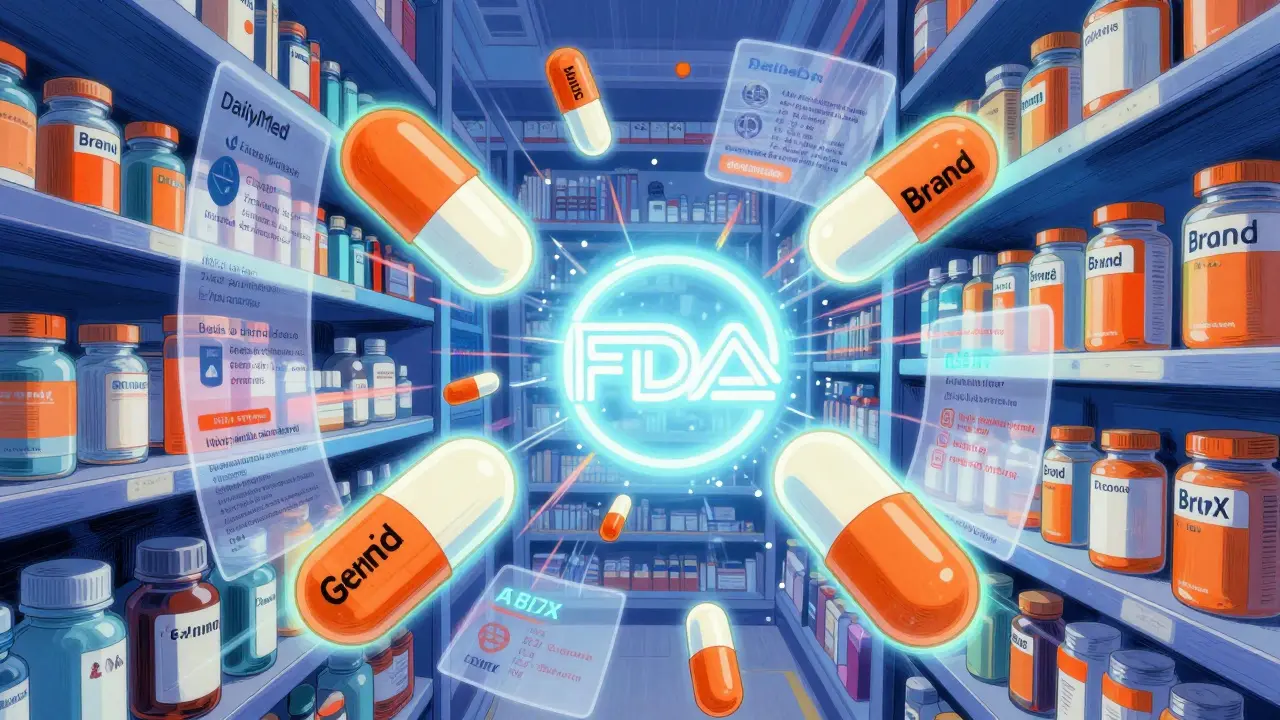
When you or a loved one takes a generic drug, you expect it to work the same way as the brand-name version. But not all generics are created equal. Some have subtle differences in how they’re absorbed, which can matter for drugs like levothyroxine, warfarin, or seizure medications. That’s why having trustworthy, up-to-date information isn’t just helpful-it’s critical. The good news? There are free, government-backed tools that give you accurate details about generic drugs, backed by decades of science and real-world use. You don’t need to pay for a subscription or guess which site to trust. Here’s what actually works.
DailyMed: The Official Source for FDA Drug Labels
DailyMed is the only website that provides the exact, legally approved labeling used by the FDA for every prescription and over-the-counter drug in the U.S. It’s not a summary. It’s the full text that pharmacies, hospitals, and regulators use to verify what’s in a pill and how it should be used. If you want to know the exact dosage instructions, warnings about pregnancy, or interactions listed by the FDA, DailyMed is where you go.
As of October 2023, DailyMed contained over 92,000 drug entries, updated within 72 hours of any FDA label change. That speed matters. When a new safety alert is issued-say, about a batch of generic metformin-DailyMed reflects it before most other sites even notice. It’s used by 89% of hospital pharmacists, according to the American Pharmacists Association, because it’s the gold standard for compliance.
But it’s not built for patients. The language is technical. You’ll see terms like "bioavailability," "pharmacokinetics," and "therapeutic equivalence." If you’re looking for simple explanations, this isn’t the place. But if you’re a caregiver, a pharmacist, or someone who needs to verify what’s written on the bottle, DailyMed is unmatched.
MedlinePlus: Patient-Friendly Drug Info in Plain Language
MedlinePlus, run by the National Library of Medicine, is what most patients should start with. It takes the same scientific data from DailyMed and turns it into clear, easy-to-read summaries. No jargon. No fine print. Just straightforward advice in English and Spanish, written at a 6th- to 8th-grade reading level.
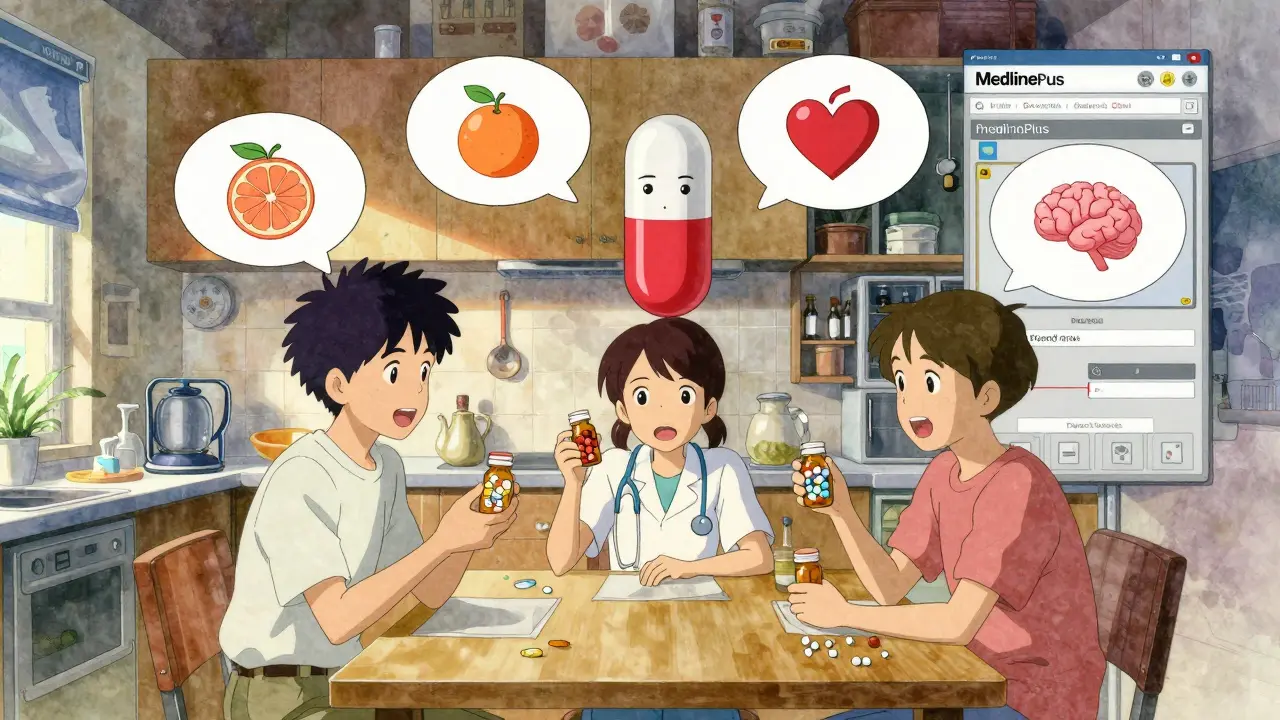
With over 17,500 drug monographs, MedlinePlus covers most common generics. It explains what the drug is used for, how to take it, what side effects to watch for, and what to avoid-like grapefruit juice with certain statins. It even has videos and images showing how pills look, which helps if you’re unsure whether the pill in your bottle is the right one.
Patients rate it 4.7 out of 5 on Google reviews, with 89% saying the explanations helped them feel more confident. But it has limits. It doesn’t go deep into rare side effects or complex dosing adjustments. And while it covers 65% of specialty generics, some newer or less common ones are missing. Still, for everyday use, it’s the most trusted free resource for patients.
Drugs.com: Fast, Practical, and Widely Used
Drugs.com isn’t government-run, but it’s one of the most reliable commercial sites out there. Founded by a pharmacist in 1999, it pulls data from FDA labels, professional databases like AHFS DI, and Micromedex. It updates daily, sometimes hourly, which is why 57% of community pharmacists use it regularly.
What makes Drugs.com stand out? Two tools: the interaction checker and the pill identifier. Type in two medications, and it instantly tells you if they can be taken together. Scan a pill with your phone camera, and it matches the color, shape, and imprint to over 24,000 drugs. In 2022 testing, it correctly identified 89.3% of unknown pills.
It’s not perfect. The site has ads, and some users complain about clutter. But if you need quick answers-say, while holding a new prescription at the pharmacy-Drugs.com delivers. It’s the go-to for 63% of physicians who need a fast reference during rounds, according to a 2022 JAMA survey.
The FDA Orange Book: Understanding Generic Substitution
Not all generics are interchangeable. That’s where the FDA Orange Book comes in. Officially called "Approved Drug Products with Therapeutic Equivalence Evaluations," it’s the only place that tells you which generics are rated as equivalent to the brand-name drug-and which aren’t.
For example, if your doctor prescribes a brand-name drug, the pharmacist can usually substitute a generic with an "AB" rating. But if a generic has an "BX" rating, it means the FDA hasn’t confirmed it works the same way. This matters for drugs with narrow therapeutic windows, like thyroid medicine or blood thinners. A 2023 study found that 12% of medication errors linked to generics came from confusion over these ratings.
The Orange Book lists over 20,000 generic products and updates monthly. You can search by brand name, generic name, or manufacturer. It’s not user-friendly, but it’s essential if you’re switching between different generic brands and notice changes in how you feel. Pharmacists use it to decide whether a substitution is safe. Patients should check it if they’ve had issues with generics before.
How These Resources Work Together
No single tool gives you everything. That’s why most healthcare professionals use a mix:
- Start with MedlinePlus if you’re a patient or caregiver-simple, clear, reliable.
- Check DailyMed if you need the official FDA label-especially if you’re verifying a change or dealing with a complex condition.
- Use Drugs.com for quick checks, interaction warnings, or identifying pills.
- Consult the FDA Orange Book if you’re switching between generic brands and notice side effects.
For example, imagine you’re taking a generic version of lisinopril and feel dizzy after switching brands. You’d first check MedlinePlus to confirm normal side effects. Then you’d look up the new generic in the Orange Book to see if it has an "AB" rating. If it does, you’d use Drugs.com to check for interactions with your other meds. If something still feels off, you’d pull up DailyMed to read the full prescribing information.
Experts agree: government resources like DailyMed and MedlinePlus are the foundation. Dr. Lucinda Maine of the American Association of Colleges of Pharmacy says, "DailyMed should be the first stop for any medication question requiring regulatory accuracy." Dr. Matthew Grissinger of the Institute for Safe Medication Practices adds, "MedlinePlus is the only consumer resource we consistently recommend to patients."
What’s Missing-and What’s Coming
Even the best tools have gaps. DailyMed doesn’t have mobile apps that work well. MedlinePlus doesn’t cover every rare generic. Drugs.com can’t predict how your genes might affect drug response. And the Orange Book still doesn’t fully account for real-world performance data.
But things are changing. In 2023, DailyMed launched an API that now connects directly to 87% of major hospital systems. MedlinePlus is adding multilingual alerts in 15 languages by late 2024. The FDA is planning to update the Orange Book with real-world evidence to improve how it rates generics.
For now, stick with what’s proven. Free, government-backed resources are more reliable than paid apps or random blogs. They’re updated daily, reviewed by scientists, and funded by taxpayer dollars to serve everyone-no matter your income, language, or location.
What to Do Next
If you’re taking a generic drug:
- Write down the name of your medication-both brand and generic.
- Visit MedlinePlus to read the patient-friendly summary.
- If you have questions about substitution, check the FDA Orange Book.
- Use Drugs.com to check for interactions with other meds or supplements.
- For legal or compliance needs, always refer to DailyMed.
Don’t rely on Google searches, social media, or pharmacy websites that don’t cite sources. When it comes to your health, accuracy beats convenience every time.
Are generic drugs as safe as brand-name drugs?
Yes, generic drugs are required by the FDA to have the same active ingredient, strength, dosage form, and route of administration as the brand-name version. They must also meet the same strict manufacturing standards. The main difference is cost-generics are typically 80-85% cheaper. However, some generics may have different inactive ingredients, which can affect how the drug is absorbed in rare cases, especially with narrow therapeutic index drugs like levothyroxine or warfarin. Always check the FDA Orange Book for therapeutic equivalence ratings if you notice changes in how you feel after switching generics.
Why do some generic drugs seem to work differently than others?
While all approved generics must be bioequivalent, small differences in how they’re absorbed can occur due to variations in inactive ingredients, manufacturing processes, or release mechanisms. For most drugs, this doesn’t matter. But for medications with a narrow therapeutic index-where the difference between a safe dose and a toxic one is small-these differences can be significant. That’s why the FDA uses the Orange Book to rate generics. Drugs with an "AB" rating are considered interchangeable. Those with an "BX" rating are not. If you switch brands and notice side effects, talk to your pharmacist. They can check the Orange Book and help you stay on the same generic.
Can I trust Drugs.com as much as government sites?
Yes, for most practical purposes. Drugs.com pulls its data directly from FDA labels, AHFS DI, and Micromedex-same sources hospitals use. Its interaction checker is one of the most accurate free tools available. However, it’s not an official government source like DailyMed or MedlinePlus. For legal or regulatory purposes, always defer to DailyMed. For everyday use-checking side effects, interactions, or identifying pills-Drugs.com is reliable and fast. Many pharmacists use both: DailyMed for compliance, Drugs.com for quick checks.
Is MedlinePlus only for patients, or can healthcare providers use it too?
MedlinePlus was designed for patients, but it’s widely used by healthcare providers too. Its clear language helps explain medications to patients during appointments. Over 450,000 healthcare professionals visit it monthly. While it doesn’t replace professional databases like Lexicomp or Micromedex for complex clinical decisions, it’s excellent for patient education, verifying basic facts, and translating technical terms into plain language. Many clinics use MedlinePlus handouts as part of their discharge instructions.
Do I need to pay for better drug information?
No, not for most people. Free resources like DailyMed, MedlinePlus, and the FDA Orange Book are authoritative and updated daily. Paid services like Lexicomp or Clinical Pharmacology offer advanced features like drug dosing calculators, pharmacogenomic data, and real-time alerts-but these are mainly used in hospitals and clinics. For individuals managing their own medications, the free tools are more than enough. In fact, 76% of independent pharmacies rely on free resources due to budget limits. Only consider paid services if you’re a clinician managing complex cases or running a pharmacy system.
Nicole Blain
March 20, 2026 AT 18:28Kathy Underhill
March 22, 2026 AT 09:47Aileen Nasywa Shabira
March 22, 2026 AT 14:31Kendrick Heyward
March 24, 2026 AT 08:28Ryan Voeltner
March 24, 2026 AT 16:24Melissa Starks
March 26, 2026 AT 06:10Shameer Ahammad
March 26, 2026 AT 15:29Alexander Pitt
March 27, 2026 AT 22:22Nilesh Khedekar
March 29, 2026 AT 09:50Robin Hall
March 30, 2026 AT 02:36Michelle Jackson
March 30, 2026 AT 09:40Suchi G.
March 31, 2026 AT 05:38becca roberts
March 31, 2026 AT 12:03Paul Ratliff
March 31, 2026 AT 23:19SNEHA GUPTA
April 1, 2026 AT 18:17