

Every spring, summer, and early fall, millions of people with pollen allergies face the same dilemma: do you go for a walk, play with your kids in the yard, or run your usual morning loop - or stay inside and miss out? The answer doesn’t have to be a guess. With pollen forecasting, you can plan your day like you plan your weather - and avoid the sneezing, itchy eyes, and brain fog that come with high pollen days.
What Pollen Forecasting Actually Tells You
Pollen forecasting isn’t just a weather app with a flower icon. It’s a science-backed system that estimates how many pollen grains are floating in the air per cubic meter. These numbers are measured using sticky rods that collect airborne particles over 24 hours, then counted under a microscope. The results are grouped into four levels: low (50 or fewer grains per cubic meter), moderate (51-149), high (150-499), and very high (500 or more).But here’s the catch: not all pollen is the same. Tree pollen peaks in early spring (February to April), grass pollen hits hard in late spring (May to early June), and ragweed takes over in late summer (August to October). Each type behaves differently. For example, oak pollen in the Southeast can be worse than birch in the Northeast. And ragweed? Just 20 grains per cubic meter is considered high - way lower than other types.
Modern systems like BreezoMeter and the European Copernicus Atmosphere Monitoring Service use machine learning to predict these counts. They combine real-time weather data - temperature, humidity, wind speed, and rainfall - with satellite images of vegetation and historical pollen patterns. Some models now predict up to five days ahead with 82% accuracy. That’s not perfect, but it’s far better than guessing.
When Pollen Hits Its Peak - And When It’s Safe to Go Outside
Pollen doesn’t float around evenly all day. It follows a rhythm. Knowing when it peaks can save you from a bad day.- Tree pollen rises early - highest between 5 a.m. and 10 a.m., especially after a dry night. The dew dries, and the wind picks up. By noon, it’s already dropping.
- Grass pollen hits midday. It peaks between 10 a.m. and 4 p.m., when the sun is hottest and the air is driest.
- Weed pollen (like ragweed) lingers into the evening. It climbs from 4 p.m. to 8 p.m., then drops after sunset.
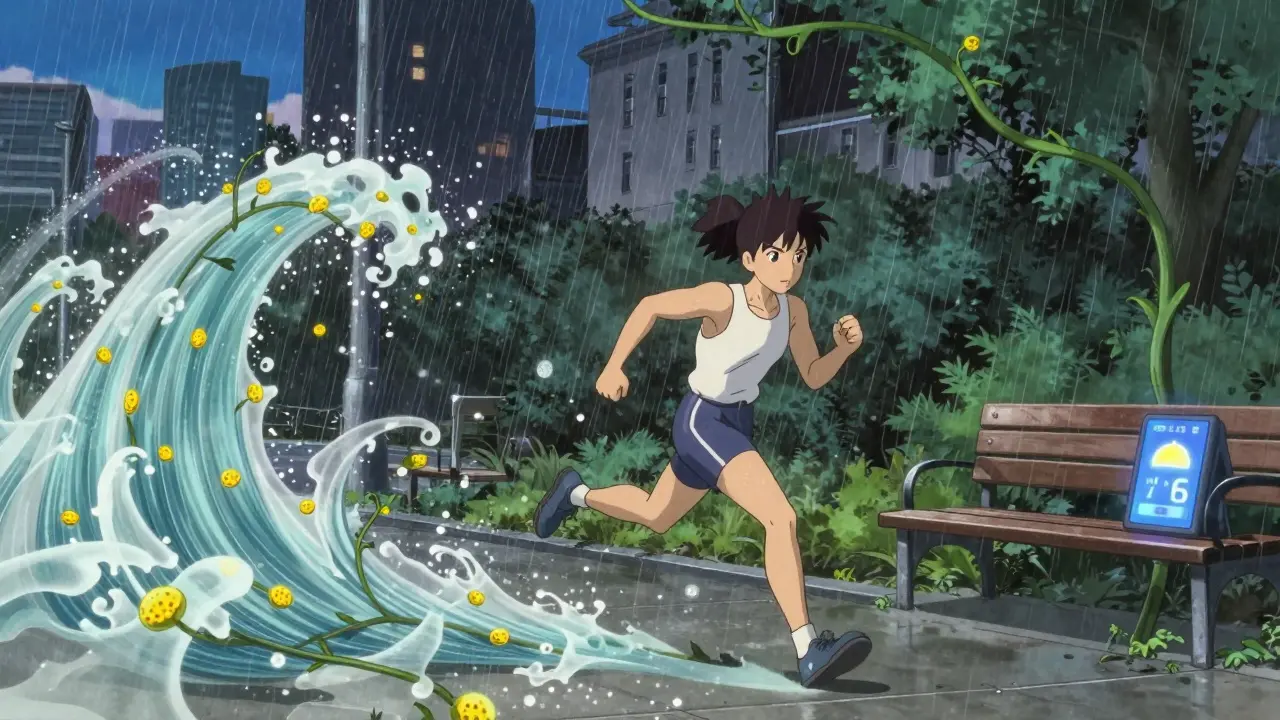
So what’s the sweet spot? Early morning (5-7 a.m.) and evening (7-9 p.m.) are your best windows. Pollen counts are often 30-50% lower during these hours. Runners who shifted their training to 7-9 a.m. during grass season reported 45% fewer symptoms, according to Dr. Amit Momaya’s 2021 research.
Rain helps, too. A light shower - even just 0.1 inch - can knock pollen counts down by 30-50% within two hours. But wait: after the rain stops, pollen can surge again if the wind picks up. So the best time to go out? Right after a rain, but before the wind returns.
How to Use Pollen Forecasts Like a Pro
Using a forecast isn’t just about opening an app. It’s about combining data with your own experience.- Check two sources. One app might miss your neighborhood. The American College of Allergy recommends cross-checking at least two services. BreezoMeter offers 1.5km resolution - great for cities. Pollen.com is free but only gives 10km accuracy.
- Know your local allergens. 37% of users track the wrong pollen type. If you live in Texas, cedar is your enemy in winter. In New England, birch rules spring. In the Midwest, ragweed dominates fall. Google your region’s top pollen types.
- Time your outdoor time. Schedule yard work, dog walks, and kids’ playtime for early morning or evening. Avoid mowing the lawn on high-pollen days - stirring up grass clippings can send pollen flying.
- Pair it with symptom tracking. If you notice your nose runs every Thursday, even when the forecast says “low,” your body might be reacting to something the app missed - like mold or pollution. Keep a simple log: date, forecast, symptoms, meds taken.
- Use weather apps too. Wind direction matters. If the forecast says “north wind at 12 mph,” and your city is downwind from a big field of ragweed? Even a “low” pollen day can turn bad fast.
People who follow these steps report fewer symptoms and 63% less medication use, according to a 2023 BreezoMeter survey. One Reddit user, u/AllergyWarrior89, cut antihistamine use in half by moving runs to early evening. Another in Austin said a cedar pollen alert saved her from a three-day sinus headache.
What Pollen Forecasts Can’t Do - And What to Watch Out For
Pollen forecasts are powerful, but they’re not magic. Here’s where they fall short:- Thunderstorm asthma. This rare but dangerous event happens when a storm breaks apart pollen grains into tiny particles that get sucked deep into the lungs. Pollen counts might be “moderate,” but within 30 minutes, symptoms can spike 300%. Melbourne, Australia, had a deadly outbreak in 2016. No forecast system can predict this yet.
- Urban microclimates. Pollen levels can vary by 300% between a city park and a downtown sidewalk. Only BreezoMeter and WeatherBug account for this. Most free apps don’t.
- Weed pollen gaps. Only 12% of forecasting models accurately track ragweed. If you’re allergic to weeds, treat any “moderate” forecast as a warning.
- Regional blind spots. Most systems work well in North America and Europe. In Southeast Asia, where pollen is year-round, accuracy drops to 65%. In places without monitoring stations - 47% of countries - forecasts are just educated guesses.
Also, forecasts rely on weather predictions. If the weather app gets the temperature wrong by 10%, your pollen forecast could be off by 15-18%. So don’t treat it like a medical device - treat it like a smart tool.
Who’s Using This - And Why It’s Getting Better
It’s not just allergy sufferers using pollen forecasts. Runners, parents, coaches, and even pro sports teams are in.The New England Patriots and Manchester United track pollen levels to adjust outdoor training. Twenty-two U.S. school districts now delay recess or cancel field trips based on forecasts. Parents of allergic kids use it to plan playdates and camping trips.
Technology is catching up fast. In 2023, BreezoMeter partnered with Apple Health to link pollen exposure with heart rate and sleep data - meaning your phone might soon tell you, “Your pollen exposure yesterday was high, and your sleep suffered.” The European Space Agency plans to launch PollenSat in 2025 - a satellite that will map pollen types from space. And the NIH just funded $2.4 million to build AI models that predict thunderstorm asthma.
Climate change is making this even more important. Since 1990, the U.S. pollen season has grown by over 20 days, and pollen concentrations have jumped 21%. More people are affected. More data is needed. And more tools are being built.
Bottom Line: You Don’t Have to Miss Out
You don’t need to hide inside all spring and summer. With a few minutes a day to check a reliable forecast, you can reclaim your outdoor time. Plan your walks for dawn. Wait until after rain to mow. Avoid midday runs in May. Use apps that show hyperlocal data. Track your own symptoms. You’ll be surprised how much better you feel.It’s not about avoiding the outdoors. It’s about choosing the right day - and the right time - to be in it. That’s what pollen forecasting gives you: control.
How accurate are pollen forecasts?
Most modern pollen forecasts are 80-89% accurate for 1-2 day predictions. Five-day forecasts drop to 65-75% accuracy. Accuracy depends on your location, the pollen type, and whether the system uses hyperlocal data. Apps like BreezoMeter and Copernicus CAMS are among the most reliable. Free apps like Pollen.com are less precise but still useful for general planning.
What time of day has the lowest pollen count?
Pollen counts are usually lowest between 5 a.m. and 7 a.m., and again from 7 p.m. to 9 p.m. This is because temperatures are cooler, winds are calmer, and dew has settled the particles. Avoid midday (10 a.m.-4 p.m.), especially on dry, windy days, when counts peak for grass and weeds.
Should I rely on one app or check multiple sources?
Always check at least two sources. One app might miss your neighborhood or use outdated data. BreezoMeter offers high resolution but costs money. Pollen.com is free but less precise. WeatherBug and the National Allergy Bureau (NAB) are good backups. Cross-referencing helps you spot inconsistencies and avoid false lows.
Can rain really help with pollen allergies?
Yes - but only temporarily. A light rain (0.1 inch or more) can wash pollen out of the air and reduce counts by 30-50% within two hours. But if the wind picks up after the rain stops, pollen can return quickly. Avoid going out right after a storm if it’s windy. Wait until the air settles.
Why do I still have symptoms on a "low" pollen day?
Pollen isn’t the only trigger. Mold, pollution, smoke, and even strong scents can cause similar symptoms. Also, some forecasts don’t track all pollen types - especially ragweed or lesser-known weeds. Your body might be reacting to something the app doesn’t measure. Keep a symptom journal to spot patterns beyond the forecast.
Are pollen forecasts useful for kids and athletes?
Absolutely. Parents of allergic children use forecasts to plan school activities and playdates. Athletes, especially runners and soccer players, time training around low-pollen windows to avoid breathing issues. Studies show athletes who train in early morning during peak season have up to 45% fewer symptoms. Schools and sports teams are now using forecasts to adjust schedules.
Babe Addict
December 29, 2025 AT 06:08Okay but have you seen the data on ragweed in the Midwest? The models are garbage. I tracked my symptoms against BreezoMeter for six months and found out their ‘high’ days were actually low for me, but their ‘low’ days? Total nightmare. Turns out their algorithm doesn’t account for microbursts from abandoned fields. I live next to a 40-acre patch of Ambrosia and no app in the world tells you when the wind shifts just right to turn your porch into a pollen tornado. You’re not getting accurate data-you’re getting marketing.
Anna Weitz
December 30, 2025 AT 21:00It’s not about forecasting it’s about surrendering to the rhythm of the earth you think you can control it with apps but pollen doesn’t care about your schedule or your precision it just rises when it wants to and your body remembers every sneeze every tear every choked breath you think you’re managing it but you’re just delaying the inevitable
Nikki Thames
December 31, 2025 AT 13:09While I appreciate the attempt to systematize allergen exposure, the fundamental flaw in this approach lies in its reductionist epistemology. Pollen is not merely a quantifiable variable; it is a bio-physical phenomenon embedded within a complex ecological matrix. To reduce human suffering to algorithmic outputs derived from satellite imagery and wind models is to commit a category error of the highest order. One cannot optimize allergy management through data visualization alone-this is a metaphysical problem disguised as a technological solution.
Liz Tanner
December 31, 2025 AT 14:29For anyone new to this-start with the National Allergy Bureau. It’s free, it’s run by allergists, and it’s the only source that actually counts real pollen in your area using actual sticky rods (not just models). I used to rely on apps until I tracked my symptoms for a month and realized my ‘low’ days were actually high. NAB told me the truth. Also-don’t forget to shower after being outside. Pollen sticks to your hair and clothes like glitter. I learned that the hard way.
Todd Scott
December 31, 2025 AT 15:40As someone who’s lived in six different U.S. regions and trained as a public health researcher, I’ve seen how wildly pollen behavior varies. In Houston, it’s mold and grass year-round. In Denver, it’s sagebrush and juniper. In Maine, birch is the villain. The key isn’t just checking an app-it’s knowing your local flora. I teach my students to Google ‘[your city] dominant pollen types’ and cross-reference with the American Academy of Allergy’s regional maps. Also-don’t ignore humidity. High humidity can make pollen heavier and less airborne, but it also encourages mold, which mimics pollen symptoms. It’s not just one thing-it’s a layered puzzle. And yes, thunderstorm asthma is terrifyingly real. I’ve seen patients in ER with no history of asthma suddenly gasping because a storm broke apart ragweed grains into respirable fragments. No app predicts that. Only experience and awareness do.
Chris Garcia
January 1, 2026 AT 08:11In Lagos, we don’t have pollen forecasts-we have survival instincts. The air here is thick with dust, exhaust, and something we call ‘dry season ghost pollen’-no one knows what it is, but your eyes swell and your throat closes. We don’t need an app. We know when the Harmattan winds blow. We stay inside. We wear scarves. We drink ginger tea. Technology is beautiful, but sometimes wisdom is older than algorithms. In Africa, we don’t wait for satellites to tell us when to breathe-we learn from our grandmothers. Maybe the West needs to listen instead of just measuring.
James Bowers
January 1, 2026 AT 16:35The assertion that pollen forecasting is ‘82% accurate’ is statistically misleading. The cited accuracy metrics are derived from correlation coefficients between predicted and observed counts at regional monitoring stations-not individual exposure levels. Moreover, the study referenced (BreezoMeter, 2023) fails to disclose its validation cohort size, confidence intervals, or geographic bias toward urban centers. Without transparent peer-reviewed methodology, such claims constitute pseudoscientific marketing. One cannot responsibly advise the public on health behavior based on proprietary algorithms with undisclosed error margins.
Will Neitzer
January 2, 2026 AT 16:01I want to say thank you. Not just for the information, but for acknowledging that this isn’t just about convenience-it’s about dignity. I’m a parent of a 7-year-old with severe ragweed allergies. For years, I felt guilty for saying ‘no’ to the park, to soccer, to birthday parties in the backyard. Then I found BreezoMeter and started tracking her symptoms alongside the forecast. Now we go for walks at 6 a.m. We have picnics after rain. We’ve cut her meds by 70%. She’s laughing again. This isn’t just science-it’s reclaiming childhood. If you’re reading this and you’re tired of feeling like you’re failing your kid-don’t give up. There’s a way. And you’re not alone.