
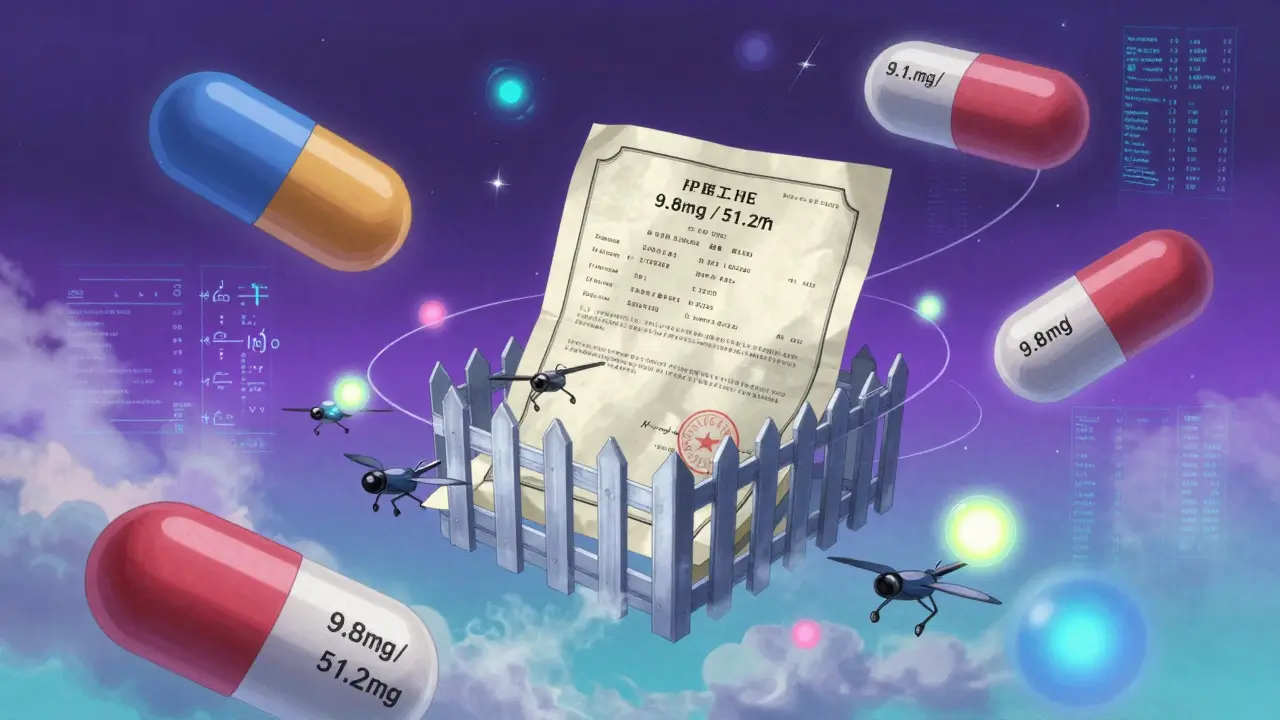
When a blockbuster drug’s core patent expires, generics can legally copy it. But in many cases, they don’t. Why? Because the original brand didn’t just patent the active ingredients-they patented how those ingredients are combined. These are called formulation patents on drug combinations, and they’re one of the most powerful tools pharmaceutical companies use to delay generic competition. It’s not about inventing something new-it’s about reconfiguring what already exists in a way that’s legally protected.
What Exactly Is a Formulation Patent?
A formulation patent doesn’t cover the drugs themselves. It protects the specific way they’re mixed together: the exact milligram ratios, the type of tablet coating, the delivery method (like a subcutaneous injection instead of an IV), or even the timing of when doses are given. For example, a patent might claim: “A pharmaceutical composition comprising 9.8 mg of Drug A and 51.2 mg of Drug B in a pH-sensitive capsule designed for once-daily oral administration.” That’s not a new drug. It’s a new package. But under U.S. patent law, that’s enough to block generics from selling the same combination in the same form.Why Do Companies Do This?
Developing a new drug costs an average of $2.6 billion and takes 10 to 15 years. Once the main patent expires, sales can drop by 80% within a year as generics flood the market. Formulation patents are a way to slow that drop. By filing multiple secondary patents-covering different versions of the same combination-companies create a “picket fence” around their product. When one patent expires, another kicks in. This can extend market exclusivity by 3 to 16 years beyond the original patent, according to the USPTO’s 2024 Drug Patent and Exclusivity Study Report. Take Roche’s Phesgo®. It combines two cancer drugs-trastuzumab and pertuzumab-into a single subcutaneous injection. The original IV versions had already lost patent protection. But Phesgo’s new delivery method, approved in 2020, was patented separately. Patients didn’t need to sit for hours getting an IV drip anymore. They got a quick shot. That convenience became a patentable innovation. And because no generic could copy that exact combination and delivery system, Roche kept pricing power for years longer than expected.How Do These Patents Get Approved?
It’s not easy. The U.S. Patent Office doesn’t just rubber-stamp these applications. Under the 2007 KSR v. Teleflex ruling, combining two known drugs for a known purpose is presumed obvious. To get approval, companies must prove their combination does something unexpected. That means showing statistically significant improvements in safety, effectiveness, or patient compliance. For example, if Drug A causes nausea and Drug B causes dizziness, but together they cause less of both, that’s a strong case. If the new formulation allows once-daily dosing instead of three times a day, and patients actually take it as prescribed, that’s another win. The data has to be solid-p-values under 0.01, head-to-head trials against existing versions. The FDA requires proof of “new clinical investigation” for 3-year exclusivity, which means running new trials. That costs $15 to $25 million.
What’s in the Orange Book?
The FDA’s Orange Book is the official list of approved drug products with patent and exclusivity information. It tracks three types of patents relevant to combinations:- Composition-of-matter patents (the original, covering the drug molecule itself)
- Formulation patents (covering how the drug is made-capsules, tablets, injections)
- Method-of-use patents (covering how the drug is used-e.g., “for treating metastatic breast cancer”)
The Dark Side: Evergreening and Product Hopping
Critics call this strategy “evergreening.” They argue that many formulation patents protect trivial changes-like switching from a white tablet to a blue one, or changing an excipient with no clinical impact. The FDA found that 31% of combination patents filed between 2015 and 2022 covered such minor modifications. Even worse is “product hopping.” That’s when a company discontinues the original version of a drug and pushes doctors and patients toward the new patented version. The old version disappears from the market, so generics can’t easily copy it-even if the active ingredients are the same. The FTC has 17 active investigations into this practice as of September 2024. One notorious case involved oxaliplatin, where the brand switched from a liquid formulation to a solid one and pulled the original off shelves. Generics couldn’t compete because there was no original product left to copy. Harvard’s Dr. Aaron Kesselheim called this “patent privateering”-using the patent system not to innovate, but to block competition. The Federal Trade Commission estimates these practices raise U.S. drug prices by 17% to 23% beyond what true innovation justifies.Why Some Formulation Patents Fail
Not every attempt works. About 38% of formulation patents get invalidated in court-higher than the 22% rate for primary patents. Why? Because generics challenge them under Paragraph IV certifications. These are legal notices filed by generic companies saying, “Your patent is invalid.” In 2021, Mylan won a case against Celgene over Revlimid®. The original patent covered the drug for multiple myeloma. Mylan didn’t copy the exact formulation-they made a version for a different, non-patented use. The court said that was legal. The patent didn’t cover all uses, just one. So Mylan could sell the same pill for a different condition. Another failure came from Amgen. They patented a subcutaneous injector for Enbrel®, claiming it was a new delivery system. The court ruled it was just automation of a manual process-obvious. The legal bill? $147 million. And they lost.
Who Succeeds? And How?
Top companies like Pfizer, Novartis, and AstraZeneca don’t just file patents-they build portfolios. Merck’s IP director said successful strategies require $28 to $42 million in extra R&D to generate the kind of data that survives patent office scrutiny. AstraZeneca’s Nexium® extension, for example, involved seven years of clinical development on new formulations. The result? $189 billion in cumulative revenue. The most effective patents are precise. Reddit discussions among patent attorneys show that claims like “10mg/50mg” often get rejected, but “9.8mg/51.2mg” might get approved. Why? Because the narrower the claim, the harder it is to prove it was obvious. It looks intentional, not random.What’s Changing?
Regulators are pushing back. In May 2024, the FDA proposed a new rule: to qualify for 3-year exclusivity, a new formulation must show “clinical superiority.” No more just changing the color or capsule size. That could invalidate nearly 28% of current formulation patents, according to the Congressional Research Service. Congress is also considering the Preserve Access to Affordable Generics Act, which would limit secondary patents to those that demonstrate “meaningful clinical benefit.” If passed, it would be a major blow to evergreening. Meanwhile, generic companies are getting smarter. In 2023, they filed 842 Paragraph IV challenges-up from 517 in 2020. Their success rate? 45%. Courts are applying stricter obviousness standards post-KSR. The days of easy patent extensions are fading.What’s Next?
The future of formulation patents isn’t dead-it’s evolving. Companies are moving toward more complex combinations: fixed-dose pills with pH-sensitive release, dual-action injectables, or even AI-optimized dosing schedules. Roche’s 2023 patent for a trastuzumab-deruxtecan combo with pH-controlled release is a prime example. It required 2.3 years of extra development but could extend exclusivity by 8.5 years. IQVIA projects that by 2030, formulation patents will still protect 65% to 70% of top-selling drugs’ revenue. But the average extension will shrink-from 5.3 years (2020-2023) to just 3.8 years. The era of easy evergreening is ending. But for now, if you’re a brand with a successful drug, the smart move is still to build your picket fence. Just make sure each slat is solid.Can generic drugmakers copy a formulation patent?
No, not if they copy the exact combination, ratio, delivery method, or dosage form covered by the patent. But they can design around it by changing the ratio, switching from a tablet to a liquid, or targeting a non-patented medical use. Courts often allow this if the generic product is different enough to avoid infringement.
How long do formulation patents last?
Formulation patents last 20 years from the filing date, like all utility patents. But because they’re often filed years after the original drug approval, the effective market exclusivity is usually shorter. The Hatch-Waxman Act allows up to 5 years of patent term extension, but the total exclusivity after FDA approval can’t exceed 14 years.
Are formulation patents ethical?
It depends. If the new formulation improves patient outcomes-like reducing side effects, making dosing easier, or improving absorption-then yes, it’s a legitimate innovation. But if it’s just a cosmetic change designed to block generics without clinical benefit, many regulators and public health experts consider it unethical. The FTC and FDA are increasingly targeting these cases.
Why are oncology drugs targeted more for formulation patents?
Oncology drugs often involve complex combinations with narrow therapeutic windows. Small changes in dosage or delivery can significantly impact safety and effectiveness. That makes it easier to argue “unexpected results.” Also, patients and providers are more willing to accept higher prices for cancer treatments, making the financial incentive stronger. The FDA approves 78% of oncology formulation patents, compared to just 43% for CNS drugs.
What’s the difference between a patent and regulatory exclusivity?
A patent is a legal right granted by the USPTO to prevent others from making, using, or selling the invention. Regulatory exclusivity is a separate protection granted by the FDA that blocks generics from even applying for approval for a set period-even if no patent exists. For example, a new chemical entity gets 5 years of exclusivity. A new formulation gets 3 years. These can stack on top of patents.
Sonal Guha
January 12, 2026 AT 06:07Formulation patents are just legal loophole bingo
gary ysturiz
January 13, 2026 AT 11:44This is such an important topic. Patients deserve affordable meds and companies should earn their profits through real innovation, not tiny tweaks. The system is broken but we can fix it with smarter laws.
laura manning
January 14, 2026 AT 11:19It is, however, imperative to note that the United States Patent and Trademark Office, in accordance with the statutory framework established by the Hatch-Waxman Act, as amended by the Medicare Modernization Act of 2003, permits the issuance of secondary patents only when they satisfy the criteria of non-obviousness, utility, and novelty-each of which must be rigorously substantiated by empirical data.
Furthermore, the FDA’s Orange Book serves as a critical public repository, ensuring transparency in the linkage between patented claims and approved drug products-thereby enabling generic manufacturers to navigate the legal landscape with precision.
It is not, therefore, a matter of rubber-stamping-but of evidentiary burden.
Lawrence Jung
January 16, 2026 AT 02:51So what are we really talking about here. Capitalism. Pharma is a business. They don’t care about you. They care about profit. The patent system is designed to reward innovation but it’s been hijacked by lawyers with spreadsheets. The real crime is that we let them get away with it. We’re all complicit because we keep buying the expensive stuff. Fix the system or stop complaining.
Alice Elanora Shepherd
January 17, 2026 AT 09:29It’s fascinating how the data shows that nearly two-thirds of secondary patents are formulation or method-of-use patents-not composition. This suggests that innovation in delivery systems and dosing regimens is where the industry is investing, even if the core molecule is generic. The key is whether those changes improve patient outcomes. When they do, it’s worth it. When they don’t, it’s exploitation. We need clearer thresholds for what counts as ‘clinical superiority’.
And I’d add: patients with chronic conditions often rely on these formulations for adherence. A once-daily pill that reduces nausea isn’t trivial-it’s life-changing. The challenge is distinguishing meaningful innovation from cosmetic rebranding.
Christina Widodo
January 17, 2026 AT 15:00Wait so if a company changes the tablet color and calls it a new formulation, is that really patentable? That seems ridiculous. And how do generics even know what to avoid? The Orange Book is a maze. I read a study that said 31% of these patents are just cosmetic changes. That’s insane. Why does the patent office even approve this?
Prachi Chauhan
January 19, 2026 AT 06:09It’s like when you buy a phone and they release a new color every year and call it a ‘new model’. Same chip, same screen, just different hue. Pharma’s doing the same thing. They don’t need to invent a new drug. Just tweak the pill. Make it blue. Make it slow-release. Make it a shot instead of a pill. Charge $5000. Patients don’t care. They just want to live. And doctors? They’re used to the new version. The system is rigged. But it’s not evil. It’s just… capitalism. We built this.
Katherine Carlock
January 19, 2026 AT 11:53I used to work in a hospital pharmacy. We had this one drug-generic version was $20. The branded version with the fancy new capsule? $1,200. Same active ingredients. Same effect. But the new one didn’t cause stomach upset. Patients loved it. We kept both on the shelf. I didn’t know it was a patent trick until I read this. It’s not always bad. Sometimes the ‘trick’ actually helps people. The problem is when it doesn’t.
Lelia Battle
January 20, 2026 AT 05:17There is a profound tension here between innovation and access. The pharmaceutical industry operates within a legal architecture designed to incentivize development, yet the unintended consequence is the systematic delay of affordability. One might argue that without the promise of extended exclusivity, the capital required to develop even minor improvements would not be forthcoming. Yet, when those improvements yield no measurable clinical benefit, the moral calculus shifts. We must ask: who is the patent system truly serving?
Rinky Tandon
January 21, 2026 AT 23:36OMG this is why my insulin costs $500 a vial. It’s not the science. It’s the BLUE CAPSULE. They switched from white to blue and called it a ‘new delivery system’ and now I can’t get the cheap one anymore. My doctor says ‘it’s better’ but I know it’s the same stuff. I’ve been on it for 12 years. I can feel the difference. I can feel the corporate greed. This is criminal. The FDA is asleep at the wheel. Someone needs to sue these monsters.
Ben Kono
January 22, 2026 AT 16:46My cousin works at a generic company. They spend millions designing around these patents. Sometimes they win. Sometimes they lose. But the real cost? The delay. Patients wait years for affordable meds. And the lawyers? They get rich. The system is rigged. And nobody’s doing anything about it