
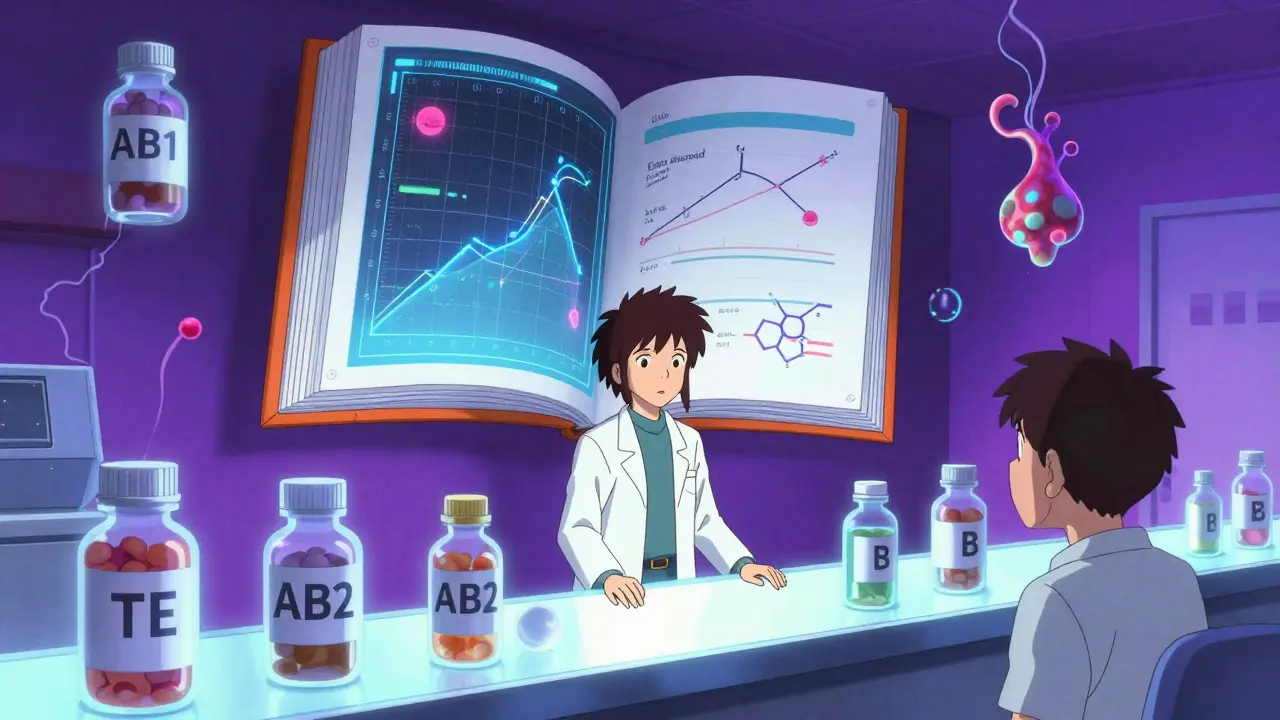
When a pharmacist fills a prescription for a generic drug, they’re not just picking a cheaper option-they’re relying on a federal standard to ensure it works exactly like the brand-name version. That standard comes from the FDA Orange Book, the official government database that tells you which generics are truly interchangeable with brand drugs. If you’re a healthcare provider, pharmacist, or even a patient trying to understand why your medication changed, knowing how to use this tool isn’t optional-it’s essential.
What the FDA Orange Book Actually Does
The FDA’s Approved Drug Products with Therapeutic Equivalence Evaluations, commonly called the Orange Book, isn’t just a list of drugs. It’s the legal backbone of generic substitution in the U.S. Created under the Hatch-Waxman Act of 1984, it answers one critical question: Can this generic drug be swapped for the brand without risking your health? The answer is encoded in a simple two-letter rating, but behind that code lies years of science, testing, and regulatory oversight.Every prescription drug in the U.S. that’s been approved by the FDA appears here. As of September 2023, the Orange Book lists over 16,000 approved products. But not all of them have therapeutic equivalence ratings. Over-the-counter (OTC) drugs are excluded. Discontinued drugs are listed separately. Only prescription drugs with proven bioequivalence get a rating-and that’s what matters for substitution.
The TE Code: Your Shortcut to Equivalence
The key to everything is the Therapeutic Equivalence (TE) code. You’ll find it in the last column of every search result in the Electronic Orange Book. Here’s what the codes mean:- A = Therapeutically equivalent. This is the green light.
- B = Not equivalent. Avoid substitution. This could mean the drug doesn’t absorb the same way, or the formulation has issues.
- AB = The most common and important rating. It means the generic has been tested and approved as bioequivalent to the brand-name drug.
- AB1, AB2, AB3 = These tell you which specific brand the generic matches. If a drug has multiple reference listed drugs (RLDs), each gets its own number. Mixing AB1 and AB2 can lead to problems.
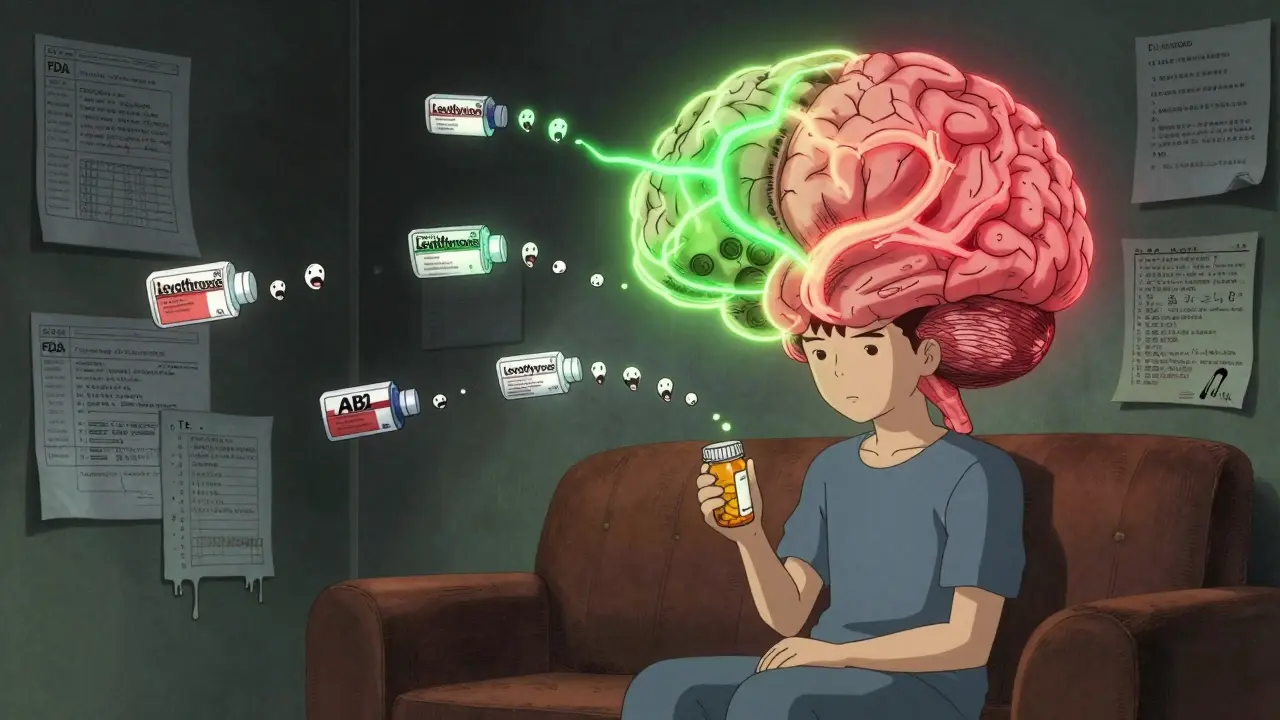
For example, if you’re looking at levothyroxine (Synthroid), you might see five different generic versions, all rated AB1. That means they’re all equivalent to the same original brand. But if one is AB2, it’s equivalent to a different brand-possibly with slightly different inactive ingredients. That difference matters for patients with thyroid conditions, where even tiny changes can affect hormone levels.
Step-by-Step: How to Verify a Generic in the Orange Book
Verifying equivalence takes less than five minutes once you know the steps. Here’s how to do it right:
- Go to the Electronic Orange Book at the FDA’s official website. Don’t rely on third-party sites like Drugs.com-they update 24 to 72 hours later. The FDA updates daily.
- Search by brand name. Type in the brand name (e.g., “Lipitor”) in the search bar. The system will show you the active ingredient (atorvastatin), dosage form (tablet), and route (oral).
- Find the Reference Listed Drug (RLD). Look for the column labeled “RLD.” The brand-name drug will say “Yes.” All generics say “No.” This is your baseline.
- Check the TE code. Every generic in the same dosage form will have a TE code. If it says “AB” or “AB1,” it’s approved for substitution. If it’s blank, the product is discontinued or not evaluated. If it says “B,” don’t substitute.
- Confirm the active ingredient matches. Sometimes, generics have the same name but different salts or esters (e.g., hydrochloride vs. sulfate). Make sure the active ingredient is identical down to the chemical form.
Pro tip: If you’re unsure, search by active ingredient instead. Type “atorvastatin” and filter by dosage form. This shows you every approved product, brand and generic, in one list. It’s faster when you’re comparing multiple options.
What the Orange Book Doesn’t Tell You
The Orange Book is authoritative-but it’s not the whole story. The FDA says an AB-rated drug is expected to have the same clinical effect. But that doesn’t mean it works the same for everyone.
For drugs with a narrow therapeutic index-like warfarin, lithium, or levothyroxine-even small differences in absorption can cause serious side effects. Many states require physician approval before substituting these, even if the Orange Book says AB. Pharmacists often see patients who had a bad reaction after switching, even though the generic was technically “equivalent.”
Also, the Orange Book doesn’t show patent disputes. A generic might be AB-rated, but if the brand is still under exclusivity (like 180-day market exclusivity for first filers), it won’t be on the market yet. The patent info is listed, but it’s easy to miss. Always check both the TE code and the patent/exclusivity dates.
Common Mistakes and How to Avoid Them
Even experienced pharmacists make errors. Here are the top three:
- Mixing up AB1 and AB2. If a drug has two different reference brands (e.g., one from Pfizer, one from Roche), the generics are rated separately. Substituting an AB1 generic for an AB2 brand could lead to inconsistent dosing.
- Assuming OTC drugs are rated. The Orange Book doesn’t evaluate OTC products. If you’re checking a generic antacid, don’t expect a TE code. That doesn’t mean it’s unsafe-it just means the FDA doesn’t regulate substitution for these.
- Confusing patent expiration with market exclusivity. A patent might expire in 2024, but if the brand has 180-day exclusivity, no generic can launch until after that. The Orange Book lists both, but you have to read carefully.
Another trap: discontinued products. These still appear in search results but have no TE code and no RLD. They’re not available anymore. If you see a generic that’s been on the market for years suddenly missing, check the Discontinued Drug Product List.
Real-World Impact: Why This Matters
In 2022, 90% of all prescriptions filled in the U.S. were for generics. That’s over 4 billion prescriptions. The Orange Book is what makes that possible. Without it, pharmacies wouldn’t have a clear standard to follow. Insurers wouldn’t know which generics to cover. Patients wouldn’t know if their cheaper pill was truly interchangeable.
But it’s not perfect. A 2023 Government Accountability Office report found that 31% of pharmacists struggled with products that had multiple RLDs. And 42% of pharmacists said they found it hard to interpret TE codes for complex delivery systems-like inhalers or topical creams-where bioequivalence is harder to prove.
That’s why the FDA offers free training: a 12-page Quick Reference Guide, monthly webinars, and email support ([email protected]). Most people who use it regularly say they get comfortable after 5-7 searches. Start with one drug you’re unsure about. Go through the steps. You’ll quickly learn how to spot the red flags.
Tools and Resources
You don’t need to memorize the system. Use these tools to make it easier:
- Electronic Orange Book (FDA.gov) - The only official source. Updated daily.
- Drug Info Rounds (FDA YouTube) - Short videos explaining TE codes, RLDs, and common errors. Watch the 2021 overview if you’re new.
- Quick Reference Guide (PDF) - Download the 12-page guide from the FDA site. Print it. Keep it by your desk.
- Third-party tools (IBM Micromedex, Epocrates) - Useful for quick checks, but always verify against the FDA site if substitution is critical.
Remember: if you’re making a substitution decision for a high-risk drug-like epilepsy meds, blood thinners, or thyroid hormones-always double-check the TE code, the RLD, and your state’s substitution laws. The Orange Book gives you the federal standard. Your state law might add more rules.
What does an AB rating mean in the FDA Orange Book?
An AB rating means the generic drug has been determined by the FDA to be therapeutically equivalent to the brand-name reference drug. It has the same active ingredient, dosage form, strength, and route of administration, and has been proven bioequivalent through testing. This rating allows pharmacists to substitute the generic for the brand without needing a new prescription, unless state law restricts it.
Can I trust third-party websites like Drugs.com for Orange Book data?
Third-party sites like Drugs.com or IBM Micromedex can be helpful for quick lookups, but they are not official sources. The FDA updates the Electronic Orange Book daily, and these third-party sites may lag by 24 to 72 hours. For critical decisions-especially with narrow therapeutic index drugs-always verify against the FDA’s official site to ensure you’re using the most current data.
Why are some generics not rated in the Orange Book?
Some generics aren’t rated because they’re either over-the-counter (OTC) products-which the FDA doesn’t evaluate for therapeutic equivalence-or they’ve been discontinued. Others may have incomplete bioequivalence data, or they’re still under review. If a product has no TE code, it’s not approved for automatic substitution. Always check the RLD and TE code columns together.
Do all states allow substitution of AB-rated generics?
No. While the FDA determines therapeutic equivalence, each state has its own pharmacy laws. Some states require physician approval before substituting certain drugs-even if they’re AB-rated. This is especially true for drugs with a narrow therapeutic index, like levothyroxine or warfarin. Always check your state’s substitution laws before switching a patient’s medication.
How often is the FDA Orange Book updated?
The Electronic Orange Book is updated daily with new approvals, patent changes, and discontinuations. Major revisions, like new TE codes or structural changes, happen monthly. The FDA recommends checking the site every time you verify a drug, especially if a patient has had a reaction after a recent switch.
What to Do Next
If you’re new to using the Orange Book, start small. Pick one generic drug you’ve been unsure about. Go to the FDA’s site. Search by the brand name. Find the RLD. Check the TE code. Look at the active ingredient. Compare it to what’s on the label. You’ll be surprised how clear it becomes after one try.
And if you’re still confused? Email the FDA: [email protected]. They respond to 95% of inquiries within two business days. No jargon. No fluff. Just clear answers.
The Orange Book isn’t magic. It’s science, codified. And when you know how to read it, you’re not just verifying a drug-you’re protecting patient safety.