
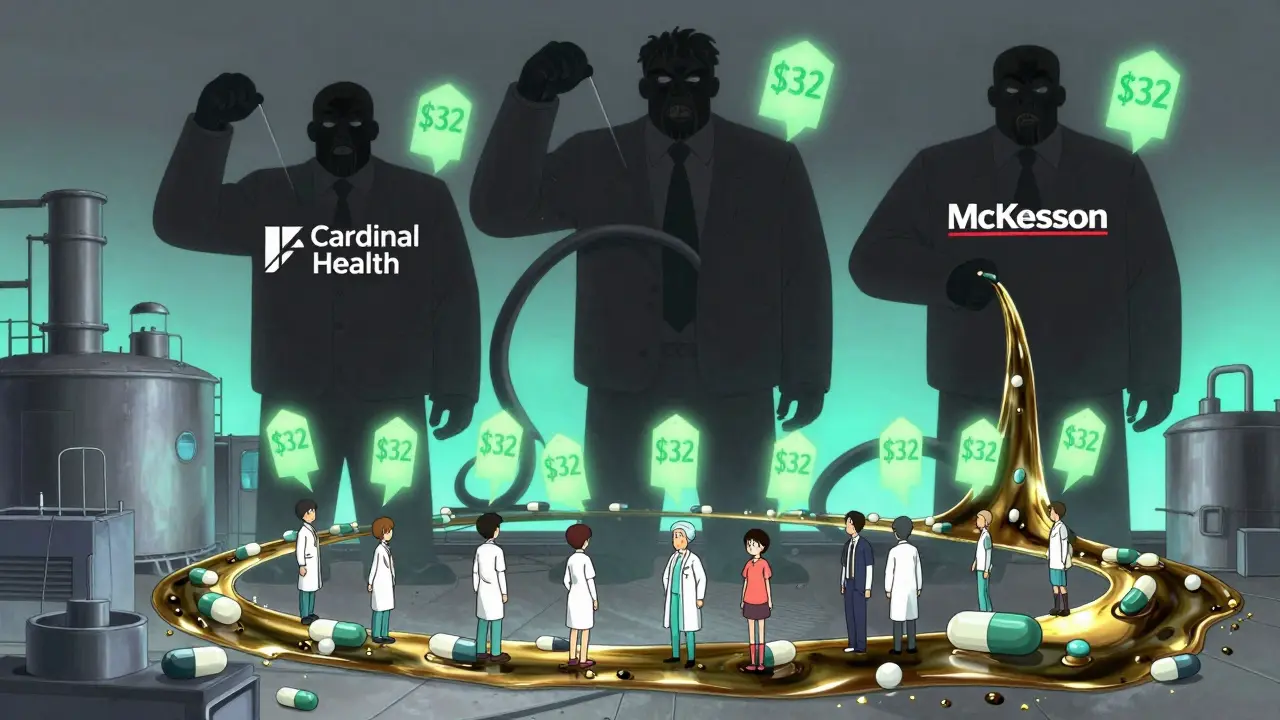
When you pick up a prescription for a generic drug at your local pharmacy, you probably don’t think about who moved it from the factory to your hands. But behind that $5 pill is a complex, high-stakes system where profits are flipped on their head. Generic drugs make up over 90% of prescriptions in the U.S., yet they account for just 20% of total drug spending. That’s not because they’re cheap-it’s because the money flows differently. And the real winners aren’t the makers. They’re the middlemen.
The Three-Tier System No One Talks About
The path of a generic drug from factory to pharmacy follows a strict, decades-old structure: manufacturer → wholesaler → pharmacy. It sounds simple, but the economics are anything but. This system was formalized in 1987 with the Prescription Drug Marketing Act, designed to stop counterfeit drugs and track supply chains. Today, it’s less about safety and more about profit distribution.Three companies-AmerisourceBergen, Cardinal Health, and McKesson-control about 85% of the U.S. pharmaceutical wholesale market. That kind of concentration gives them massive power. They don’t just move drugs; they set prices. And when it comes to generics, they make far more money than anyone else in the chain.
Why Generics Are a Gold Mine for Wholesalers
You’d think branded drugs, with their $100-a-pill price tags, would be the big earners. But the opposite is true. In 2009, generics made up only 9% of wholesale revenue-but generated 56% of their gross profits. That’s not a typo. Wholesalers made eleven times more profit per unit on generics than on branded drugs: $32 vs. $3. Pharmacies made nearly the same-$32 vs. $3.Why? Because generic manufacturers are desperate to get their products on the shelves. With dozens of companies making the same drug, they compete on price. They slash their margins to win contracts with the Big Three. In return, wholesalers get to mark up these low-cost drugs aggressively. Meanwhile, brand-name manufacturers still hold tight to 76% gross margins. But they’re fighting a losing battle. The real money isn’t in the brand-it’s in the copy.
How Pricing Actually Works
Wholesalers don’t just slap on a flat markup. They use tiered pricing to push volume. If you order fewer than 100 units, you might pay $10 per pill. Order 100-500? Price drops to $8. Order over 500? It’s $6.50. This isn’t charity. It’s strategy. The more you buy, the more they profit-even if the per-unit margin shrinks. Volume makes up the difference.Cost-plus pricing is common too. If a generic pill costs $1 to make and $2 to ship, the wholesaler might price it at $1.80 to cover costs and leave a 20% margin. But they’re not always that transparent. Market-based pricing dominates: they watch what competitors charge and match or undercut. Value-based pricing? Rare. No one’s paying extra because a generic pill helps someone with diabetes. They’re paying because it’s the cheapest option.
And shipping? Often hidden. If your COGS (cost of goods sold) is $10 and shipping is $2 per unit, the real cost is $12. But many wholesalers still list $10 as the price and bury shipping in fees. That’s how margins stay inflated.
The Profit Flip: Who Makes What
Here’s the breakdown, based on 2009 data from the USC Schaeffer Center:- Manufacturer (generic): 49.8% gross margin, $18 profit per unit
- Wholesaler: 26.3% net margin, $32 profit per unit
- Pharmacy: 42.7% gross margin, $32 profit per unit
Compare that to branded drugs:
- Manufacturer (branded): 76.3% gross margin, $58 profit per unit
- Wholesaler: $3 profit per unit
- Pharmacy: $3 profit per unit
That’s the inversion. The makers of branded drugs make three times more profit than generic makers. But the middlemen make eleven times more profit on generics. The system is designed so that when a drug goes generic, the profits shift-from the manufacturer to the distributors.
Why This System Is Unstable
This model works fine when there’s plenty of supply. But when a generic drug goes into shortage-because a factory shuts down, or a regulator flags contamination-the whole thing cracks. In 2023, after years of deflation, pockets of inflation returned. A single shortage in a common blood pressure drug could spike prices 300% overnight. Wholesalers, with their tight control over distribution, can hold back stock to drive up prices. And no one can easily replace them.The Commonwealth Fund found that wholesalers influence shortages in four ways: setting prices, pushing list price hikes, competing for specialty drugs, and controlling access. That’s not accidental. It’s structural. With only three players controlling 85% of the market, competition is a myth. If one wholesaler stops carrying a generic, pharmacies have nowhere else to turn.
What’s Changing-and What’s Not
The trend since 2021 has been deflation: prices dropping as more generic manufacturers enter the market. But 2023 flipped that. Drug shortages, supply chain gaps, and rising production costs reversed the slide. Some generics are now more expensive than they were five years ago.Regulators are watching. The USC Schaeffer Center’s Neeraj Sood said back in 2006: “Greater scrutiny of pricing policies… is warranted.” That’s still true today. But there’s no real pressure to change. Pharmacies need the drugs. Patients need the drugs. And the Big Three? They’re making more money on generics than ever.
Smaller wholesalers are disappearing. The margins are too thin. The barriers to entry are too high. The only way to compete is to be bought out-or to specialize in niche, high-demand generics. But that’s not a fix. It’s just a reshuffling of power.
What This Means for Patients and Providers
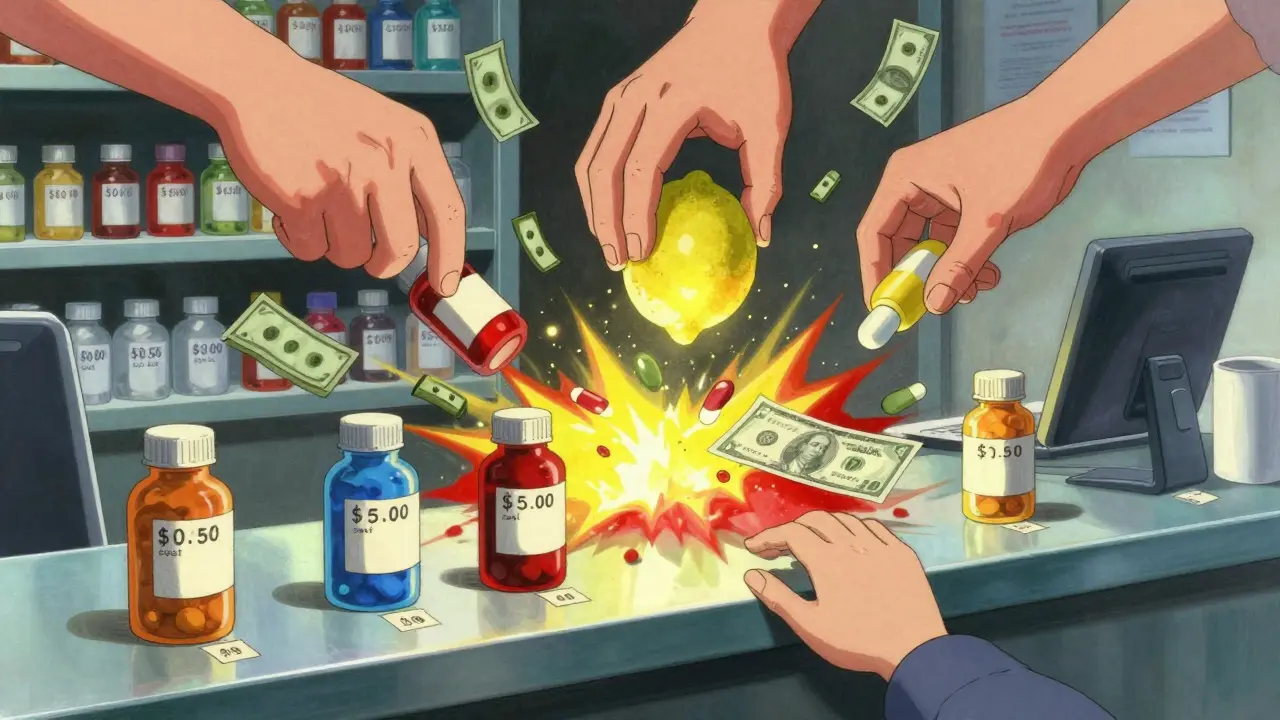
You might think generics save money. And they do-compared to brand names. But the savings aren’t going where you’d expect. They’re not flowing to patients. They’re not flowing to pharmacies. They’re flowing to a handful of companies that sit between the factory and the counter.Pharmacies still make good margins on generics. But they’re stuck. They can’t negotiate better prices because the wholesalers won’t budge. Patients pay what’s listed. Insurance companies pay what’s listed. And no one questions why a $0.50 pill costs $5 at the counter.
Until the distribution system is opened up-until more players can enter, until pricing becomes transparent, until we stop letting three companies control the flow of medicine-this imbalance will stay. Generics are supposed to lower costs. Instead, they’ve become a profit engine for the middlemen.
Why are generic drugs cheaper for patients but more profitable for wholesalers?
Generic drugs are cheaper for patients because manufacturers slash prices to win contracts. But wholesalers buy them in bulk at rock-bottom rates, then mark them up aggressively. Since they handle massive volumes, even a small per-unit profit adds up. Wholesalers make eleven times more profit per unit on generics than on branded drugs-not because the price is high, but because the cost is ultra-low and the volume is huge.
Do pharmacies benefit more from selling generics or branded drugs?
Pharmacies make nearly the same profit per unit on generics and branded drugs-around $32 vs. $3-but they sell far more generics. So overall, generics drive most of their revenue and profit. The difference is that branded drugs rely on insurance reimbursements and complex pricing deals. Generics are straightforward: buy low, sell high, repeat.
Why do generic drug prices suddenly spike?
Price spikes happen when a manufacturer shuts down or faces regulatory issues, causing a shortage. With only three major wholesalers controlling most of the supply, they can restrict distribution or delay shipments. Demand stays high, supply drops, and prices surge. This happened in 2023 with several common generics, reversing years of falling prices.
Can patients negotiate lower prices on generic drugs?
Individually, no. But patients can use cash prices at pharmacies that participate in discount programs like GoodRx. These programs bypass the wholesale system entirely by negotiating directly with manufacturers or large pharmacy chains. In some cases, a generic drug can cost less than $5 out-of-pocket-far below the insurance-listed price.
Is there a better way to distribute generic drugs?
Yes-more competition. If smaller wholesalers could enter the market, or if pharmacies could buy directly from manufacturers, prices would drop. Some states are experimenting with state-run distribution for essential generics. Others are pushing for transparency laws that require wholesalers to disclose their markups. But without breaking the Big Three’s grip, real change won’t happen.
Dave Alponvyr
December 16, 2025 AT 21:08So the real drug barons aren’t the pharma CEOs-they’re the guys driving the trucks.
Classic capitalism: make money off the thing everyone needs, but no one thinks about.
Kitty Price
December 17, 2025 AT 15:36This is wild. I’ve been using GoodRx for years and never connected the dots.
Turns out my $3 pill isn’t cheap-it’s just being hidden from the system.
😭
Kim Hines
December 18, 2025 AT 21:28Wholesalers are basically the middlemen who got lucky because no one regulated them
Manufacturers compete on price so they get squeezed
Pharmacies just take what’s handed to them
And patients? They’re the ones paying for all the invisible markup
It’s not broken-it’s designed this way
sue spark
December 19, 2025 AT 09:58I work in a rural pharmacy and this is 100% true
We get hit with price hikes from the big guys and have zero leverage
Patients ask why their insulin went from $15 to $45 and we just shrug
It’s not us it’s the system
We’re just the last stop
Billy Poling
December 19, 2025 AT 15:05It is imperative to recognize that the structural inefficiencies inherent in the current pharmaceutical distribution model are not merely economic anomalies but systemic failures rooted in regulatory capture and market consolidation.
One must consider the historical context of the Prescription Drug Marketing Act of 1987, which, while ostensibly designed to ensure product integrity, has been co-opted by oligopolistic entities to entrench their dominance.
Furthermore, the absence of price transparency mechanisms and the suppression of competitive entry by smaller distributors represent a violation of fundamental market principles.
It is not merely a matter of profit margins but of public health equity.
Without legislative intervention to mandate markup disclosure and to facilitate direct manufacturer-to-pharmacy distribution, the current paradigm will continue to extract wealth from vulnerable populations under the guise of efficiency.
One might even argue that this constitutes a form of institutionalized economic coercion.
Policy makers must act with urgency, as the lives of millions depend on the accessibility of essential medications.
It is not hyperbole to state that the current system is morally indefensible.
And yet, the silence from the public and the complicity of elected officials perpetuate this injustice.
Let us not mistake affordability for accessibility.
They are not synonymous.
And until we dismantle the three-tiered cartel, we are merely rearranging deck chairs on the Titanic.
Josias Ariel Mahlangu
December 20, 2025 AT 18:57People act like they’re shocked by this but it’s always been like this.
Same with food, same with housing, same with everything else.
We let corporations run the show and then wonder why we’re broke.
It’s not a bug, it’s a feature.
Colleen Bigelow
December 21, 2025 AT 03:54Who owns the Big Three? Hint: it’s not who you think.
Private equity firms bought them out in the 2000s and turned them into profit machines.
They don’t care if you get your meds.
They care if the quarterly report looks good.
And guess who’s on the board? Former FDA officials.
You think that’s a coincidence?
It’s a revolving door designed to keep you paying.
Next they’ll be charging you to breathe.
And don’t tell me ‘free market’-this is a rigged game.
They’re not competitors-they’re a cartel with lobbyists.
And you’re the sucker who pays for it every month.
Dylan Smith
December 22, 2025 AT 01:39Wait so if wholesalers make more profit on generics than branded drugs why don’t they just stop carrying branded ones
They’d make even more money right
Or is it because they need the branded drugs to keep the pharmacy relationships going
And generics are just the cash cow they use to fund everything else
That makes sense
But why hasn’t anyone tried to cut them out
Like why can’t CVS just buy directly from the factory
Is it legal or just too hard
Someone explain this please
Because this feels like a loophole that should’ve been closed decades ago
Randolph Rickman
December 22, 2025 AT 15:25Look I know this sounds grim but there’s hope.
Some states are already testing direct-buy programs for essential generics.
And GoodRx, SingleCare, and other cash-price platforms are proving that bypassing the middleman works.
Patients are waking up.
Pharmacists are fed up.
And the more people demand transparency, the more pressure builds.
It’s not going to change overnight.
But it’s changing.
And you-yes you reading this-can help.
Ask your pharmacist where your meds come from.
Use cash-price apps.
Call your rep.
Small actions add up.
We’ve fixed worse.
We can fix this too.