

When your pharmacist hands you a pill bottle with a different name than what your doctor prescribed, you might wonder: is this really the same thing? The answer lies in a quiet but powerful system the FDA uses to decide which generic drugs can be swapped for brand-name ones - therapeutic equivalence codes.
What therapeutic equivalence really means
Therapeutic equivalence doesn’t just mean two drugs have the same active ingredient. It means they work the same way in your body, produce the same results, and carry the same safety profile. The FDA doesn’t guess at this. They test it - rigorously. For a generic drug to get an ‘A’ rating, it must pass three checks:- It has the same active ingredient, strength, dosage form, and route of administration as the brand-name drug (that’s pharmaceutical equivalence).
- It’s bioequivalent - meaning your body absorbs it at the same rate and to the same extent as the original.
- There’s no evidence it behaves differently in real-world use.
The Orange Book: the FDA’s secret weapon
The system lives in a document called the Approved Drug Products with Therapeutic Equivalence Evaluations - better known as the Orange Book. First published in 1980, it’s updated monthly and lists every approved drug in the U.S. with its therapeutic equivalence code. You won’t find it on pharmacy shelves, but pharmacists check it daily. In 2023, the Orange Book website got over 1.7 million visits in just one quarter. That’s not patients searching - that’s pharmacists, doctors, and health systems relying on it to make safe decisions. The Orange Book doesn’t rate every drug. Only multisource prescription drugs - those with multiple manufacturers - get codes. Brand-name drugs without generics? They’re listed as Reference Listed Drugs (RLDs). Over-the-counter medicines? Not rated at all. The system is built for prescriptions where substitution matters most.Decoding the letters: A, B, and what they really mean
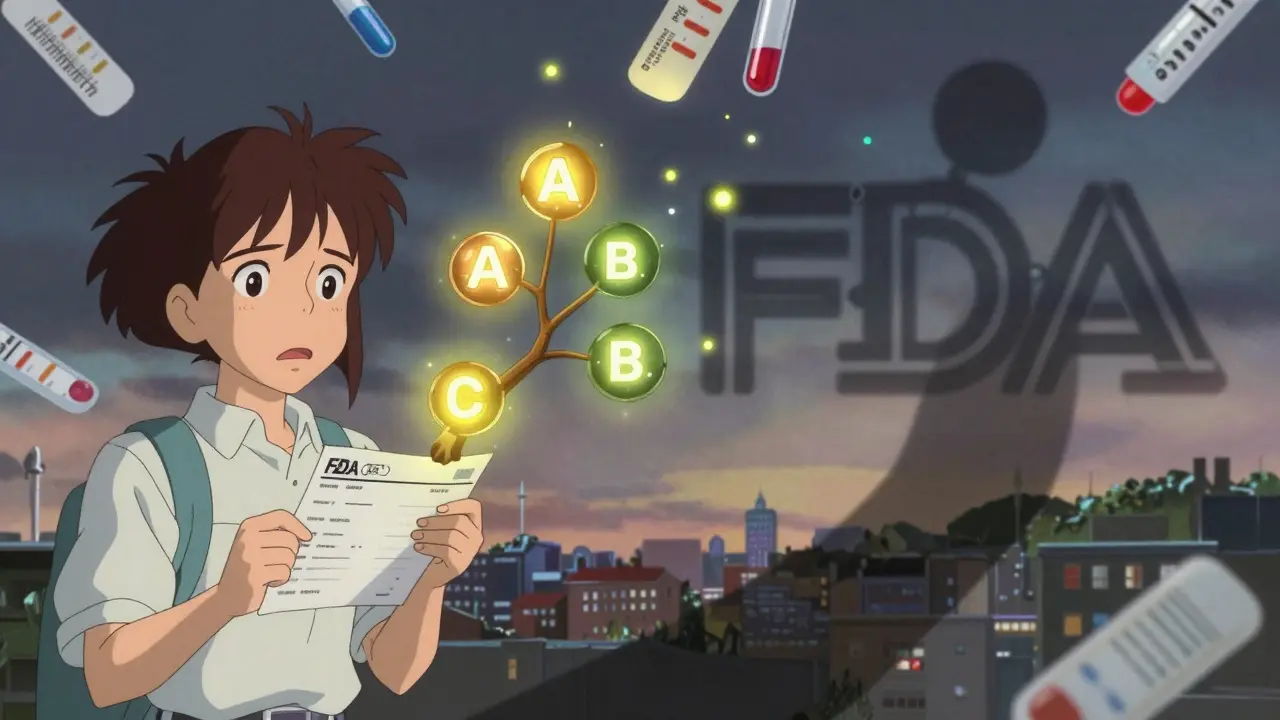
The codes are simple on the surface but packed with meaning. The first letter tells you everything:- A = Therapeutically equivalent. You can swap it without worry.
- B = Not rated as equivalent. Don’t substitute unless your doctor says so.
- AB = Meets bioequivalence standards. This is the most common code - over 90% of generics fall here.
- AB1, AB2, AB3, AB4 = Used when multiple brand-name versions exist. For example, if three different brands of metformin are approved, each generic version gets an AB code tied to the specific brand it matches.
- BC = Extended-release tablets or capsules with unclear bioequivalence
- BT = Topical creams or ointments where absorption is hard to measure
- BN = Inhalers or nebulizer products
- BX = Not enough data to judge - often new or complex generics
Why some generics get ‘B’ ratings - and why it matters
You might think a generic with a ‘B’ rating is inferior. It’s not. Often, it’s just harder to prove. Take topical corticosteroid creams. Two creams might have the same active ingredient and concentration. But if one absorbs slightly differently into the skin, the effect on inflammation could vary. Standard blood tests can’t measure that. The FDA doesn’t have a reliable method yet - so they give it a ‘BT’ code. The same goes for inhalers, injectables, and complex formulations. The science to prove they’re equivalent is still evolving. The FDA admits this. In their 2022 draft guidance, they acknowledged that current bioequivalence tests often fail for these products. This creates a real problem. Pharmacists may refuse to substitute a ‘B’-rated drug - even if the doctor thinks it’s fine. A 2022 AMA survey found 42% of physicians were confused by ‘B’ codes. Some pharmacists over-cautiously block substitutions. Others, unaware of the nuances, swap them anyway. Both can hurt patients.How this system saves money - and why it’s trusted
The U.S. spends $370 billion a year on prescription drugs. Generics make up 90% of prescriptions but only 23% of costs. That’s because of therapeutic equivalence codes. Without them, pharmacists couldn’t legally swap drugs. Insurance companies wouldn’t push generics. Patients would pay more. The system works because it’s backed by science - not just policy. Pharmacists spend an average of 2.7 minutes per prescription checking the Orange Book. That adds up. But it saves $1.2 billion a year in avoided brand-name costs. And here’s something remarkable: since the system started in 1984, there’s never been a documented case of a patient harmed by an FDA-approved generic substitution. That’s not luck. It’s the result of strict standards.
What you should do as a patient
You don’t need to memorize AB1 vs BT. But you should know this:- If your prescription says ‘substitution permitted’ and you get a different name - that’s normal. The system is working.
- If you get a generic and feel different - tell your doctor. It’s rare, but possible.
- If your doctor writes ‘dispense as written’ or ‘no substitution’ - that overrides the code. Always follow their instructions.
- If you see a ‘B’ code on your bottle and you’re unsure - ask your pharmacist. They’re trained to explain it.
The future of therapeutic equivalence
The FDA isn’t standing still. They’re working on new ways to evaluate complex drugs - especially inhalers, topical products, and injectables. Their 2023-2027 plan aims to cut ‘B’ ratings for these products by 30% by 2027. How? By using real-world data - not just lab tests. If thousands of patients use a generic inhaler and get the same results as the brand, that counts. The FDA is starting to accept this kind of evidence. They’re also expanding their Product-Specific Guidelines to over 1,850 drugs. These are detailed roadmaps for manufacturers to prove bioequivalence - making it easier to get ‘A’ ratings. The goal? More generics. Lower prices. No compromise on safety.What does an AB code mean on a generic drug?
An AB code means the generic drug is therapeutically equivalent to the brand-name drug. It has the same active ingredient, strength, dosage form, and has passed bioequivalence testing - meaning your body absorbs it the same way. Pharmacists can legally substitute it without asking your doctor.
Can I request a brand-name drug even if a generic has an A rating?
Yes. Even if a generic has an A rating, you can ask your pharmacist to dispense the brand-name version. Your doctor can also write ‘dispense as written’ on the prescription to prevent substitution. Insurance may charge you more, but you have the right to choose.
Why do some generics have B codes if they’re the same drug?
A B code doesn’t mean the drug is inferior - it means the FDA doesn’t have enough evidence to confirm it works exactly like the brand. This often happens with complex products like inhalers, creams, or extended-release pills, where standard tests can’t fully measure how the body responds. The drug may still be safe and effective, but substitution isn’t automatically approved.
Do all states allow pharmacists to substitute A-rated generics?
Yes - 49 out of 50 U.S. states allow pharmacists to substitute A-rated generics without the prescriber’s permission. The only exception is New York, which requires patient consent. State laws are built around the FDA’s Orange Book codes, so if a drug has an A rating, substitution is generally legal and common.
Are over-the-counter drugs rated with therapeutic equivalence codes?
No. The FDA only assigns therapeutic equivalence codes to prescription drugs with multiple manufacturers. Over-the-counter medicines like ibuprofen or antacids are not rated in the Orange Book. Substitution of OTC drugs is based on label matching, not FDA therapeutic equivalence evaluations.
Henriette Barrows
December 29, 2025 AT 11:22Really appreciate this breakdown. I’ve been on a generic for years and never knew how much science went into those little codes. It’s wild to think pharmacists check the Orange Book every single time.
Alex Ronald
December 29, 2025 AT 17:24My dad used to refuse generics until he saw the data. Now he asks his pharmacist to check the Orange Book before filling anything. Smart move. The system’s not perfect, but it’s saved us thousands.
Jim Rice
December 31, 2025 AT 05:24Stop pretending this system is flawless. I’ve had generics that made me feel like crap, and the FDA just shrugs because ‘bioequivalence’ passed in a lab. Real people aren’t test tubes. You think your body reacts the same way as someone else’s? Wake up.
Teresa Rodriguez leon
December 31, 2025 AT 21:13People like you who complain about generics are the reason drug prices stay high. If you can’t afford the brand, stop being dramatic and take the generic. Your ‘feelings’ don’t override science.
Nicole K.
January 2, 2026 AT 20:00So you’re saying it’s okay for Big Pharma to trick people into thinking generics are the same? This is why America is falling apart. No one cares about safety anymore.
Fabian Riewe
January 4, 2026 AT 16:50Love how the Orange Book is basically the OG drug database. I used to work in a pharmacy and we’d print out the latest updates every month. Still weird to think a 40-year-old document keeps millions of people safe.
Amy Cannon
January 6, 2026 AT 14:25It is truly fascinateing to observe how the FDA's therapeautic equivalence framework has evolved over the decades, particuarly with the inclusion of real-world evidence. The shift from purely pharmacokinetic data to patient-outcome metrics represents a monumental leap in regulatory science. One must acknowledge the immense logistical burden placed upon pharmacists, who serve as the final arbiters of therapeutic safety, yet operate under a system that is both elegant and profoundly underappreciated.
Himanshu Singh
January 8, 2026 AT 05:32Great post! I'm from India and we dont have this system, so i never knew how much work goes into generics in US. We just get cheaper pills and hope for the best. This makes me respect the FDA more.
Sharleen Luciano
January 9, 2026 AT 10:41Let’s be real - if you’re taking a generic with a B code, you’re essentially gambling with your health. Anyone who says ‘it’s probably fine’ is either a pharma shill or dangerously naive. This isn’t about cost savings - it’s about patient safety, and the FDA is clearly out of its depth with complex formulations.
Samar Khan
January 10, 2026 AT 14:59Ugh. Another ‘trust the system’ post. 😒 I’ve had 3 different generics for my thyroid med and each one gave me a different heart rate. The FDA doesn’t care. They just want you to shut up and take the cheap pill. 🤡