
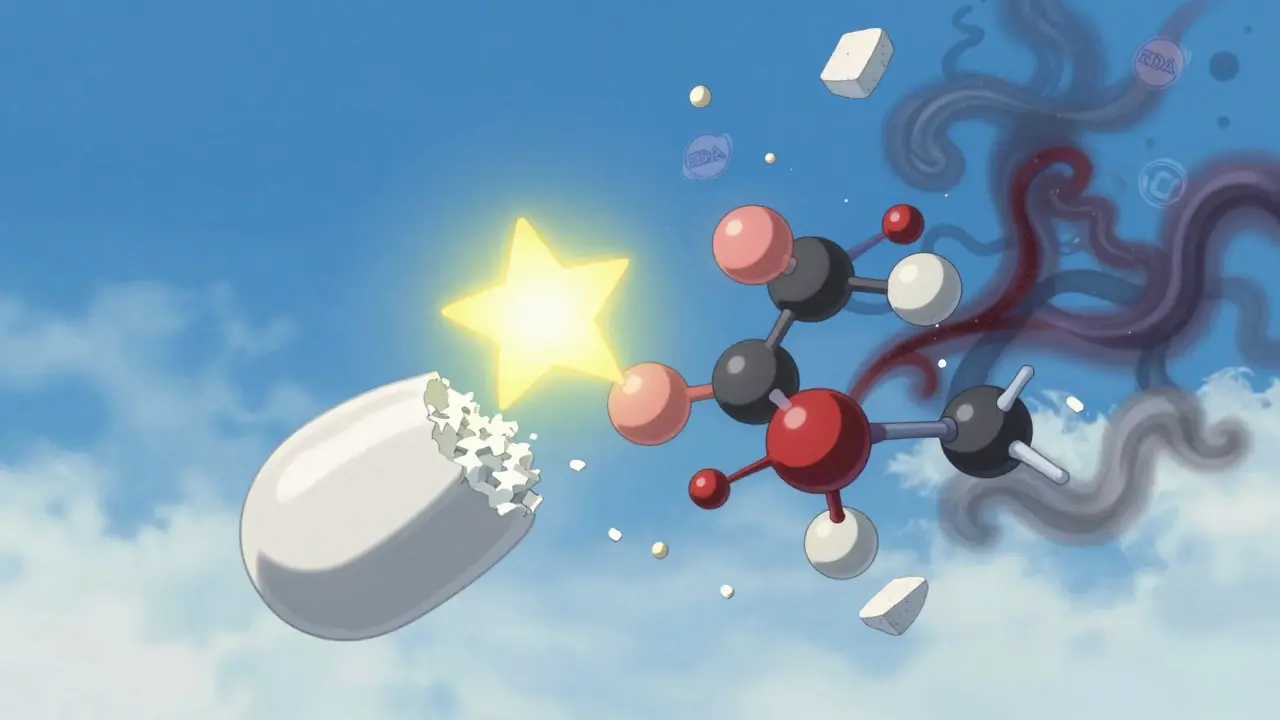
When you pick up a pill, you might think it’s just one thing: the medicine. But that little tablet or capsule is actually made of two very different kinds of ingredients. One gets all the attention-the active ingredient. The other? It’s called inactive ingredient, and it’s everywhere. You don’t hear about it. You don’t read about it on the box. But it’s there. And sometimes, it’s the reason your medicine doesn’t work-or gives you a stomachache.
What exactly is an active ingredient?
The active ingredient is the part of the drug that actually does the job. It’s the molecule that talks to your body and changes how things work. In Tylenol, that’s acetaminophen. In Advil, it’s ibuprofen. In Lipitor, it’s atorvastatin. These are the only parts of the medicine that the FDA requires to prove they’re safe and effective before they can be sold.
That means every active ingredient goes through years of testing. Clinical trials. Dose studies. Side effect reports. If it doesn’t work better than a sugar pill, it doesn’t get approved. And even then, if new risks show up later, the FDA can pull it off the market. That’s why you see warnings on the label. That’s why some drugs get black box warnings.
But here’s the thing: the active ingredient doesn’t work alone. It needs help.
What are inactive ingredients-and why are they in your pill?
Inactive ingredients, also called excipients, are everything else in the pill. They don’t treat your condition. But they make the medicine possible.
Think of them like the frame of a house. You don’t live in the frame. But without it, the house falls apart.
Some inactive ingredients are fillers. If the active ingredient is only 5 milligrams, but the pill needs to be big enough to swallow, you need something to bulk it up. That’s where lactose or microcrystalline cellulose comes in. They make up 50 to 90% of the tablet’s weight.
Others hold things together. Gelatin, acacia, or starch act as binders. Without them, your pill would crumble in your pocket.
Then there are lubricants like magnesium stearate. They keep the medicine from sticking to the machines that make it. Coatings like hydroxypropyl methylcellulose make pills easier to swallow. Flavorings and colors make them look and taste better-especially for kids.
And don’t forget preservatives. Parabens or benzyl alcohol stop bacteria and mold from growing in liquid medicines or multi-dose injectables. Without them, your medicine could become dangerous before you even take it.
The FDA says these ingredients are generally recognized as safe (GRAS). But that doesn’t mean they’re harmless for everyone.
Why ‘inactive’ doesn’t always mean ‘harmless’
For decades, scientists assumed these ingredients were biologically silent. Just fillers. No effect. No interaction.
Then, in 2021, a study from the University of California, San Francisco, and Novartis changed that.
Researchers tested 639 FDA-approved inactive ingredients against over 3,000 human proteins. They found that 14% of them-about 89 compounds-had unexpected biological activity. That means they weren’t just sitting there. They were binding to proteins in your body. Some of them, like D&C Red 7 calcium lake (a red dye) and propyl gallate (a preservative), showed strong binding at very low doses.
This isn’t just theory. In real life, lactose causes problems for 65% of the global population who can’t digest it. If you’re lactose intolerant and your pill contains lactose, you could get bloating, cramps, or diarrhea-even if the active ingredient is perfectly fine.
Same with gluten. About 1 in 7 people have celiac disease or gluten sensitivity. Some pills use wheat starch as a filler. That’s enough to trigger symptoms in sensitive people.
And sulfites? Used in some injectables, they can cause breathing problems in people with asthma. The FDA says only 0.5% of adverse drug reactions come from inactive ingredients. But that’s still thousands of people every year.
How inactive ingredients affect how well your medicine works
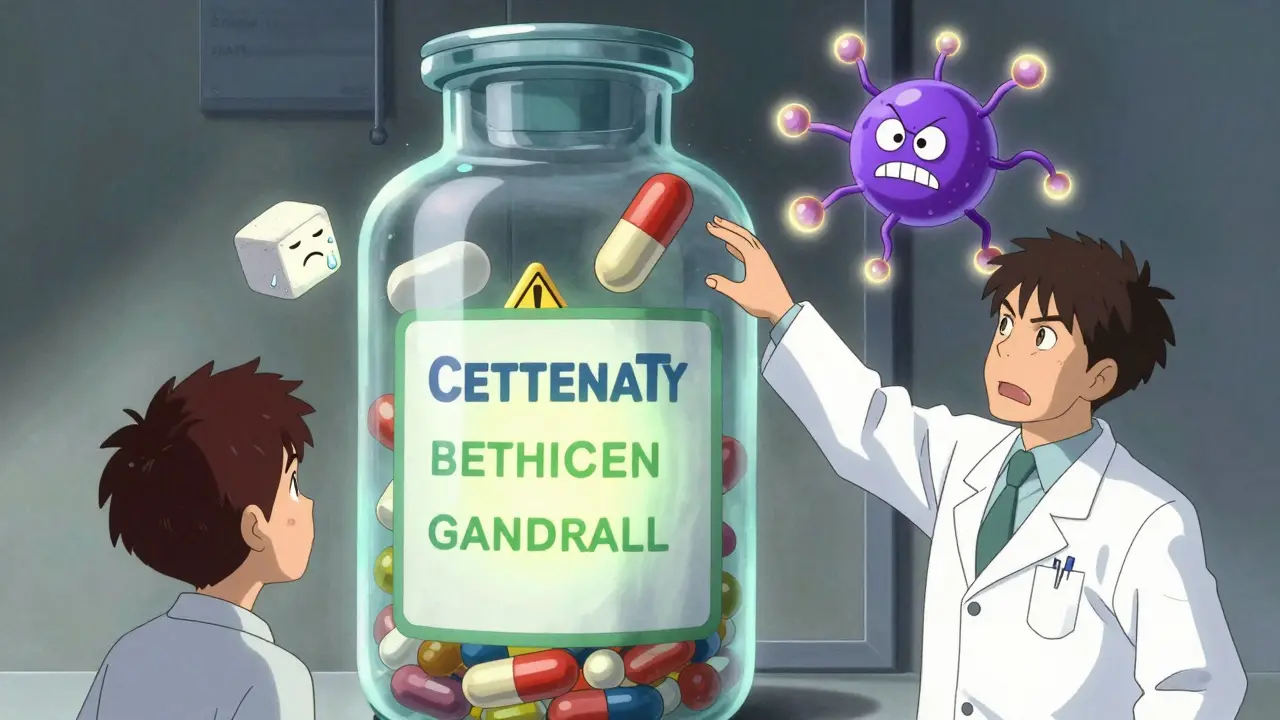
It’s not just about side effects. Inactive ingredients can change how much of the active ingredient your body actually absorbs.
Take fenofibrate, a cholesterol drug. Older versions didn’t work well because the active ingredient didn’t dissolve easily in the gut. Newer versions added special surfactants-inactive ingredients that help the medicine dissolve faster. The result? A 35% increase in absorption. Same active ingredient. Different inactive ingredients. Big difference in effectiveness.
That’s why generic drugs sometimes feel different-even though they contain the same active ingredient. The fillers, coatings, and binders might be different. And that can change how quickly the medicine enters your bloodstream.
Some people notice this. They switch from brand to generic and feel like it’s not working as well. It’s not in their head. It’s in the formulation.
What you should do as a patient
You don’t need to memorize every ingredient on the label. But you should know how to read it.
On over-the-counter medicines, both active and inactive ingredients are listed on the back of the box. For prescriptions, they’re in the package insert. If you’re not sure, ask your pharmacist. They have access to the FDA’s Inactive Ingredient Database, which tells them safe levels for each ingredient based on how the medicine is taken-oral, injectable, topical, etc.
If you have allergies, intolerances, or sensitivities, make sure your pharmacist knows. Lactose? Gluten? Sulfites? Dyes? Tell them. They can often find a version of the medicine without it.
And if you’ve had a bad reaction to a pill before, don’t assume it was the active ingredient. It might have been the dye, the preservative, or the filler. Keep track. Bring the pill bottle to your doctor. Ask: "Could this be an inactive ingredient?"
Pharmacists are now switching medications for inactive ingredient reasons more often than you’d think. In 2022, 22% of medication changes in U.S. health systems were because of excipient concerns-not because the active ingredient wasn’t working.
The future of drug ingredients
The FDA is starting to take this seriously. In 2022, they launched the Excipient Safety Initiative, spending $4.2 million to study whether commonly used ingredients might have hidden effects.
Major drug companies are now screening excipients like they screen new drugs. Using computer models, they test inactive ingredients against human proteins before they even put them in a pill. Sixty-eight of the top 100 pharmaceutical companies now do this.
Some experts want to stop calling them "inactive" altogether. Maybe "functional excipients" or "biologically assessed additives" would be better. Because the line between active and inactive is blurring.
One day, your prescription might come with a note: "Contains propyl gallate-may affect serotonin receptors." Or: "Avoid if you have histamine sensitivity-contains citric acid."
Until then, your best tool is awareness. Don’t assume that just because something isn’t the "medicine," it doesn’t matter.
What to ask your pharmacist
- "Is this medication free of lactose?"
- "Does it contain gluten or wheat starch?"
- "Is there a dye or artificial color in this?"
- "Can you find a version without benzyl alcohol?"
- "Why does this generic feel different from the brand?"
Pharmacists are trained to answer these questions. They see these issues every day. Don’t be shy. Your health depends on knowing what’s really in your pill.
vivek kumar
January 16, 2026 AT 21:52The FDA’s GRAS list is a joke. Just because something is ‘generally recognized as safe’ doesn’t mean it’s safe for *you*. I’ve had migraines from red dye #40 in generic ibuprofen. No one tells you this. No one checks. And when you complain, they say ‘it’s just a filler.’ Fillers that bind to serotonin receptors? Yeah, right. This isn’t science-it’s corporate laziness wrapped in regulatory bureaucracy.
Riya Katyal
January 17, 2026 AT 05:16So let me get this straight-we’re supposed to be terrified of lactose in pills but fine with 40 grams of sugar in our morning coffee? 🙄
Henry Ip
January 17, 2026 AT 09:38This is actually super important info most people never hear. I used to think generics were just cheaper versions of the same thing. Turns out they’re like different recipes for the same dish-same main ingredient, totally different flavor and texture. Talk to your pharmacist. It’s not weird. It’s smart.
kanchan tiwari
January 17, 2026 AT 16:37THEY’RE HIDING THINGS FROM US. AGAIN. DYES BINDING TO PROTEINS? PRESERVATIVES ACTING LIKE DRUGS? THIS ISN’T MEDICINE-IT’S A LAB EXPERIMENT ON YOUR BODY AND NO ONE TOLD YOU. THEY’RE USING YOUR BODY AS A TESTING GROUND FOR CHEAP FILLERS AND YOU’RE TOO BUSY SCROLLING TO NOTICE. THE PHARMA INDUSTRY IS A MONSTER. I SWEAR TO GOD I’M GOING TO START READING EVERY INGREDIENT ON EVERY PILLS I TAKE. EVEN IF I HAVE TO BUY A MICROSCOPE.
Bobbi-Marie Nova
January 18, 2026 AT 03:27My grandma switched from brand to generic lisinopril and started feeling like a zombie. Turns out the generic had titanium dioxide and corn starch-she’s allergic to both. Took her pharmacist 3 weeks to find a clean version. Don’t assume ‘same active ingredient’ = same experience. Ask questions. Even if you feel dumb. Your body will thank you.
Samyak Shertok
January 18, 2026 AT 23:22So if inactive ingredients are biologically active, then technically, they’re active. Which means the whole paradigm is broken. We’re naming things based on outdated assumptions. It’s like calling a tree ‘inactive’ because it doesn’t pay taxes. Language is a prison. And we’re all locked inside it, swallowing pills with hidden agendas.
Stephen Tulloch
January 20, 2026 AT 07:30Lmao so now we’re worried about propyl gallate but not the fact that Big Pharma pumps 300mg of sodium into every blood pressure pill? 🤡 Priorities. Also, ‘functional excipients’? Sounds like a startup name for a crypto token. Just call them ‘hidden variables’ and move on.
evelyn wellding
January 21, 2026 AT 22:44Y’all are overthinking this 😊 But seriously-ask your pharmacist! They’re the real heroes. I used to hate going to the pharmacy until I realized they can swap out dyes and fillers like magic. My kid’s ADHD med used to make him itchy-switched to a dye-free version and boom. No more rashes. Small change. Huge difference.
Chelsea Harton
January 22, 2026 AT 21:18gluten in pills? i had no idea. i thought only bread had it. my stomach has been acting up for months. maybe its not the stress. maybe its the pills.
Corey Chrisinger
January 23, 2026 AT 09:12If we’re redefining ‘inactive’ ingredients, then we’re also redefining what medicine is. Is a pill just a delivery system for molecules-or is it an ecosystem of chemical interactions we barely understand? Maybe the real active ingredient isn’t the molecule you think it is. Maybe it’s the *context*-the filler, the coating, the dye, the timing, the belief. We’re not just taking drugs. We’re performing biology.