
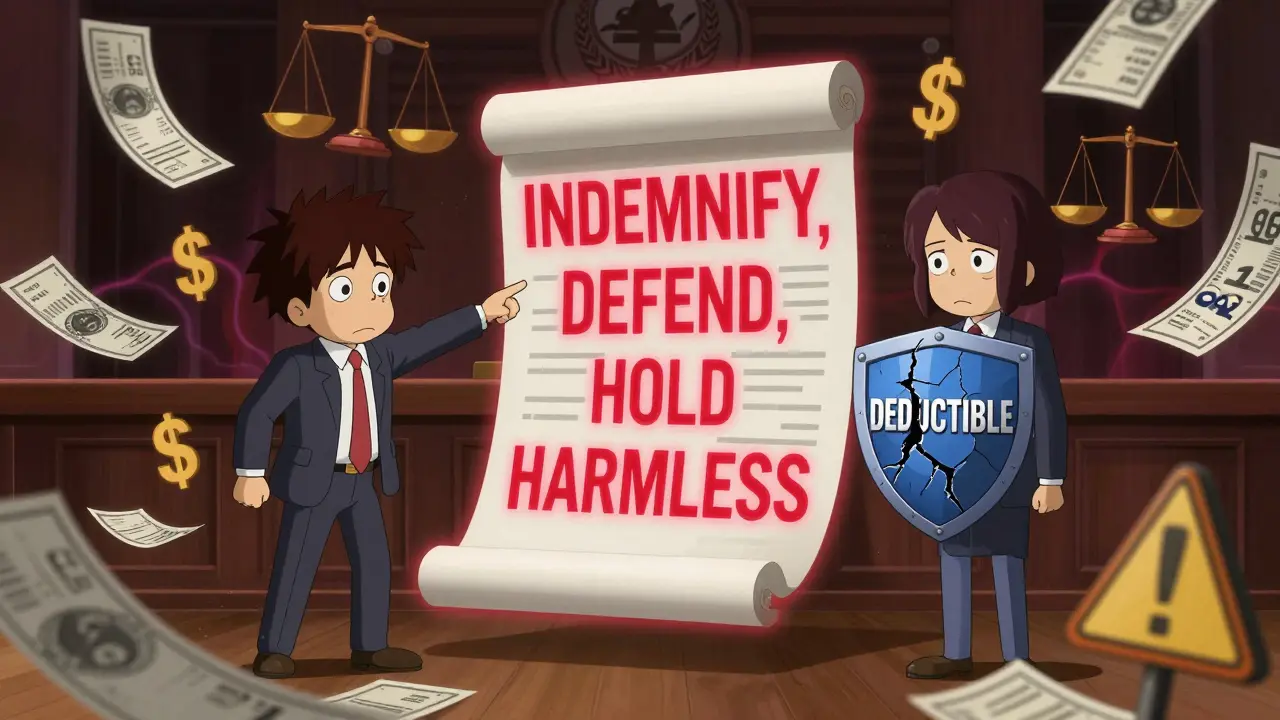
When two parties sign a contract, they’re not just agreeing on price or delivery dates. They’re also deciding who will pay if things go wrong. That’s where liability and indemnification come in. These aren’t fancy legal buzzwords-they’re practical tools that determine who gets stuck with the bill when a deal goes sideways. Whether you’re buying a company, licensing software, or hiring a contractor, understanding these clauses can save you thousands-or even millions.
What Indemnification Actually Means
Indemnification isn’t about blame. It’s about money. If one party causes a problem-say, a software vendor’s product triggers a data breach-the indemnifying party (usually the vendor) must cover the other party’s losses. That includes legal fees, settlement costs, regulatory fines, and even notification expenses for affected customers.
Think of it like insurance you build into the contract. You don’t need to file a claim with an insurer. You just point to the agreement and say: “You promised to cover this.” The legal definition is simple: to indemnify means to pay for losses the other party suffers because of a specified event. According to California courts, it’s not about apologizing-it’s about reimbursing.
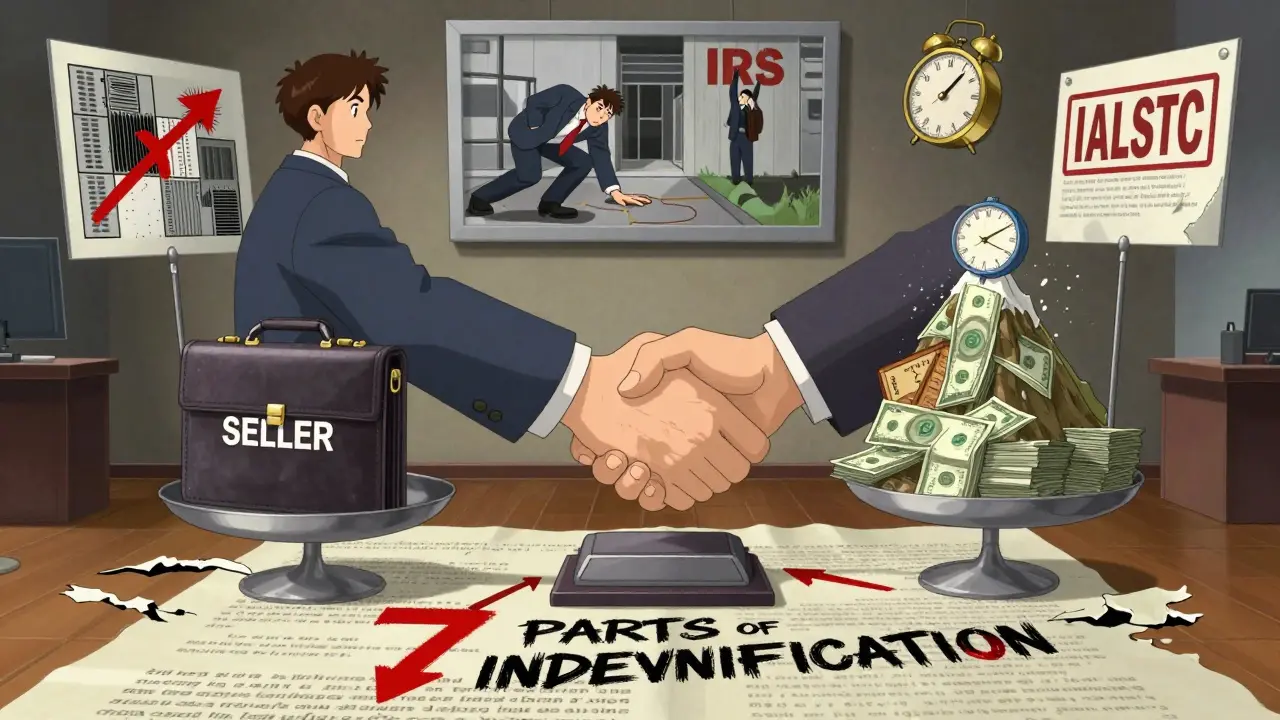
The Seven Parts of a Solid Indemnification Clause
A weak indemnification clause is worse than no clause at all. It creates false confidence. A strong one has seven clear parts:
- Scope of Indemnification - What exactly is covered? Legal fees? Third-party lawsuits? Tax penalties? Vague language like “any losses” invites fights. Specificity matters. Example: “Indemnification covers all third-party claims alleging infringement of intellectual property rights arising from the delivered software.”
- Triggering Events - When does the obligation kick in? Breach of contract? Negligence? Misrepresentation? The clause must tie the payment to a concrete event, not just any bad outcome.
- Duration - How long does the protection last? Some clauses expire when the contract ends. Others survive for years. In M&A deals, fundamental representations (like ownership of assets) often survive 3-5 years. Non-fundamental ones (like employee benefits) might last 12-18 months.
- Limitations and Exclusions - There’s always a cap. No one wants unlimited liability. Common limits: “Indemnification is capped at 50% of the purchase price” or “No coverage for indirect or consequential damages.”
- Claim Procedures - You can’t just send a bill. Most agreements require written notice within 30 days, with details of the claim, supporting documents, and a deadline to respond. Missing the window? You lose your right.
- Insurance Requirements - Does the indemnifying party need to carry insurance? If so, what kind? General liability? Cyber liability? The policy limits should match the potential exposure. If they don’t, you’re relying on their bank account-and that’s risky.
- Governing Law and Jurisdiction - Where will disputes be resolved? New York? Texas? California? This determines which court hears the case and which state’s laws apply. A clause that says “governed by Delaware law” avoids messy jurisdiction battles.
Mutual vs. One-Sided Indemnification
Not all indemnification is the same. There are two main types:
- Mutual - Both sides promise to cover each other’s losses. Common in construction contracts, joint ventures, or partnerships where both parties have equal risk. Example: A contractor agrees to indemnify the owner for worker injuries, and the owner agrees to indemnify the contractor for delays caused by site access issues.
- Unilateral - Only one side pays. This is the norm in vendor-customer deals. Software companies indemnify buyers against IP infringement. Manufacturers indemnify retailers if their product causes harm. It’s not fair-it’s just how power works. The party with more leverage (usually the buyer) demands protection.
Be careful with mutual clauses. They sound balanced but can backfire. If both parties are indemnifying each other, you might end up paying for your own mistakes. Always read the fine print.
Indemnify, Defend, Hold Harmless: What’s the Difference?
These three terms are often thrown together-but they mean very different things:
- Indemnify = Pay for losses. If you get sued, I’ll cover the settlement.
- Defend = Pay for lawyers. If a third party sues you because of my product, I’ll hire and manage your defense.
- Hold Harmless = Don’t sue me back. Even if I’m not at fault, you can’t come after me for damages caused by your own actions.
Some contracts say “indemnify, defend, and hold harmless.” That’s redundant in many states. But it’s still used because lawyers want to cover every possible angle. If you’re the indemnified party, you want all three. If you’re the indemnifier, you want to limit it to just “indemnify.”
What Sellers Should Watch Out For
In sales or M&A deals, sellers are almost always on the hook. Buyers demand indemnification because they’re taking over a business with hidden risks. But sellers aren’t powerless.
Here’s how to protect yourself:
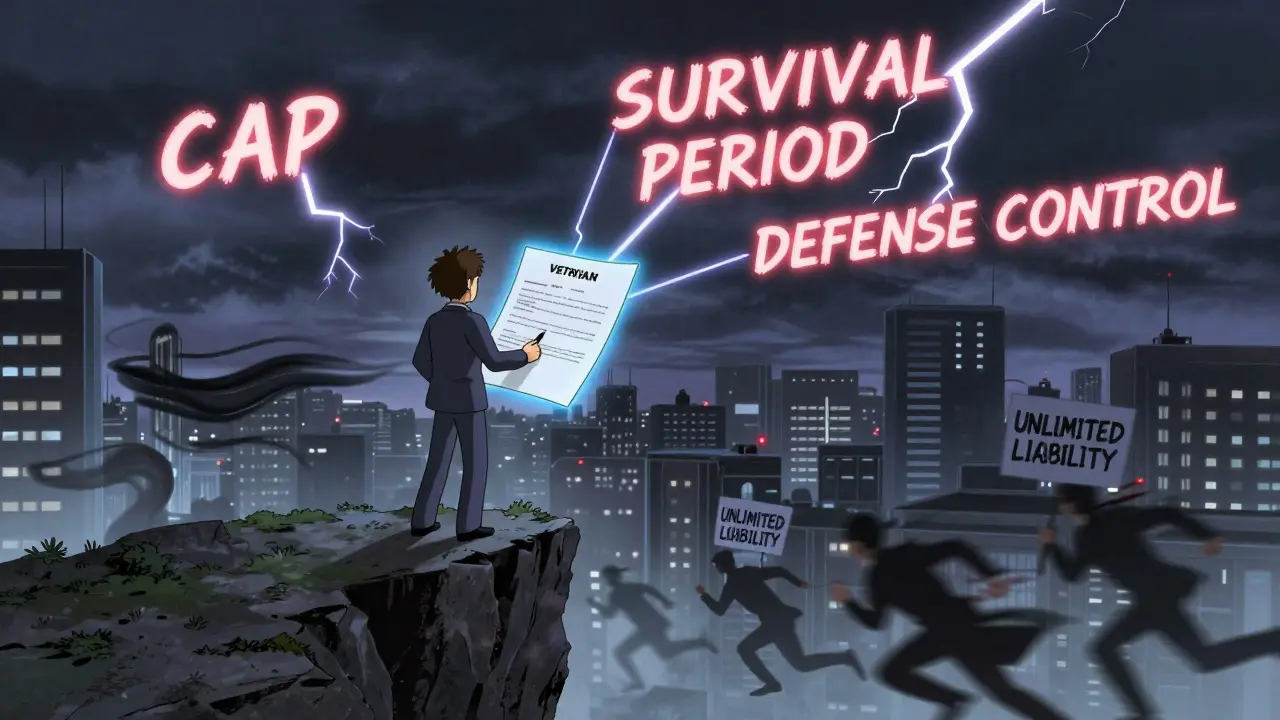
- Cap your liability - Don’t agree to unlimited exposure. A cap at 10-25% of the deal value is common. Anything higher is a red flag.
- Use a deductible (basket) - Require the buyer to absorb the first $50,000 in losses before you pay. This filters out small claims.
- Limit survival periods - Fundamental reps (like ownership of assets) can survive longer. But non-fundamental ones (like compliance with labor laws) should expire within a year.
- Exclude consequential damages - Lost profits, reputational harm, and business interruption are rarely covered. Push back if the buyer tries to include them.
- Control the defense - If the buyer gets sued, do they get to pick the lawyer? Or can you? If you’re paying, you should control the legal strategy. Otherwise, they might run up costs unnecessarily.
Real-World Examples
Here’s how this plays out in practice:
- A SaaS company sells its platform to a bank. The contract includes indemnification for IP infringement. Two years later, a third party sues the bank, claiming the software copied its code. The SaaS company must pay the bank’s legal fees, settlement, and any fines. That’s indemnification at work.
- A construction firm hires a subcontractor. The subcontractor fails to follow safety rules, and a worker gets injured. The subcontractor’s indemnification clause requires them to cover all medical costs, workers’ comp claims, and lawsuit expenses. Without it, the main contractor would be on the hook.
- A buyer acquires a small tech startup. After closing, the IRS audits the company and finds unreported income from five years ago. The seller’s indemnification clause covers tax liabilities from before the sale. The buyer gets reimbursed. The seller pays.
These aren’t hypotheticals. They happen every day. And they’re why indemnification clauses are among the most negotiated parts of any deal.
Why This Matters Now
With rising cyber risks, supply chain disruptions, and stricter regulations, indemnification isn’t optional anymore. A single data breach can cost over $4 million. A product liability lawsuit can bankrupt a small company. Contracts that don’t address these risks are ticking time bombs.
Modern contracts are moving away from boilerplate language. Lawyers now tailor indemnification to the specific deal: cybersecurity exposure for tech deals, environmental liabilities for manufacturing, regulatory fines for healthcare. One-size-fits-all clauses don’t cut it anymore.
If you’re signing a contract without understanding indemnification, you’re gambling. Not with money-your business.
What to Do Next
- Review every contract you sign. Don’t skip the indemnification section.
- Ask: “Who pays if this goes wrong?” If the answer isn’t clear, push for revisions.
- Never accept unlimited liability. Always negotiate a cap and a deductible.
- Insist on controlling the defense if you’re paying for it.
- Check insurance requirements. If the other party doesn’t carry adequate coverage, demand a bond or letter of credit.
Indemnification isn’t about trust. It’s about protection. And in business, protection is the only thing that lasts when things fall apart.
Kathryn Lenn
February 8, 2026 AT 00:05Oh great, another legal essay disguised as ‘practical advice.’ So let me get this straight-you’re telling me if my software gets sued for copyright infringement, I have to pay for the buyer’s lawyers, their PR firm, their emotional support paralegal, AND their therapist for trauma from ‘breach notifications’? Cool. I’ll just add that to my monthly ‘soul tax.’
And ‘mutual indemnification’? Yeah, right. Like two drunks at a bar both promising to pay for each other’s bar tabs. One of them ends up on the floor with a broken nose. Guess who’s still holding the bill? Spoiler: It’s not the guy who said ‘I got this.’
Ashlyn Ellison
February 8, 2026 AT 06:35My cousin’s startup got hit with a $2M IP lawsuit. Their contract had a ‘standard’ indemnity clause. No cap. No deductible. No insurance proof. They sold the company for $1.2M just to walk away. This isn’t theory. It’s survival.
Alex Ogle
February 8, 2026 AT 22:53Y’all are missing the real horror story: indemnification clauses that *don’t* cover regulatory fines. I worked with a health tech firm that indemnified a client for ‘damages from data breach’-but the FDA fine? Not covered. Client got slapped with $8.7M. They sued the vendor. Vendor’s lawyer said, ‘The clause says ‘damages,’ not ‘fines.’’
Guess what? Courts agreed. Now every contract I draft, I spell out: ‘including but not limited to fines, penalties, and administrative costs.’ No more ‘damages’ alone. It’s a trap.
Tasha Lake
February 10, 2026 AT 18:55Can we talk about the ‘defend’ part? I’ve seen so many vendors say ‘we’ll defend’ but then drag their feet for 11 months before hiring counsel. Meanwhile, the indemnified party is getting deposed, filing motions, and burning cash. The clause should require immediate counsel assignment within 10 business days of notice. No wiggle room. And no ‘best efforts.’ Just ‘shall.’
Brandon Osborne
February 10, 2026 AT 23:30Let me guess-you’re the type who thinks ‘cap at 25% of deal value’ is reasonable? That’s like saying ‘I’ll pay you back if you lose your house… but only 25% of what you paid for it.’
Here’s the truth: if you’re indemnifying someone, you’re taking full responsibility. If you can’t afford to cover the full loss, you shouldn’t be in the deal. This ‘negotiation’ culture is why small businesses die. It’s not about fairness. It’s about who has the power to bully.
Monica Warnick
February 11, 2026 AT 08:10Did you know that 83% of indemnification disputes happen because the clause was buried in Exhibit C, Section 4.2(a)(iii)? Nobody reads it. Lawyers don’t even explain it. They just say ‘it’s standard.’
And then you get a client who signs because they ‘trust’ the other side. Two years later, their CEO gets served. That’s not negligence. That’s systemic fraud. The whole legal industry is built on ignorance.
Frank Baumann
February 12, 2026 AT 19:00I once saw a contract where the indemnifying party had to cover ‘all losses, including emotional distress.’ Yes, you read that right. Emotional distress. From a software license. The buyer sued because their employees were ‘traumatized’ by a 404 error.
They won. $1.2M in therapy bills. The vendor had to pay. I still can’t believe it. This isn’t law. This is a horror movie written by a paralegal on Adderall.
John Watts
February 14, 2026 AT 07:34Look, I get it-contracts feel like legalese nightmares. But here’s the win: understanding indemnification isn’t about fear. It’s about power. When you know exactly what you’re protected for, you can negotiate with confidence. You can walk away from bad deals. You can sleep at night.
I’ve helped 12 small tech founders renegotiate their clauses. One of them turned a $500k liability into a $0 risk. Just by changing three sentences. You don’t need a law degree. You just need to ask: ‘Who pays if this blows up?’ And then insist on an answer. You’ve got this.
glenn mendoza
February 15, 2026 AT 11:11While the article provides a comprehensive breakdown of indemnification mechanics, I must emphasize the ethical dimension often overlooked: indemnification clauses, when used without reciprocity, perpetuate asymmetrical power dynamics that erode trust in commercial relationships. A truly equitable contract does not merely allocate risk-it fosters mutual accountability. The legal framework should not function as a shield for one party’s negligence, but as a scaffold for shared responsibility. In that light, the unilateral model, while common, is not merely asymmetrical-it is ethically suspect. We must demand more than transactional safety; we must cultivate contractual integrity.
MANI V
February 16, 2026 AT 18:13Indemnification? Please. This is just capitalism’s way of making the little guy pay for the big guy’s mistakes. You think these clauses are negotiated? They’re dictated. The buyer has a template. The seller signs or starves. It’s not law-it’s coercion dressed in Helvetica.
And don’t even get me started on ‘governing law.’ Delaware? Really? Because that’s where the rich hide their money. The system is rigged. You’re not protecting your business-you’re just feeding the machine.
Angie Datuin
February 16, 2026 AT 21:40Just want to say thanks for this. I read this after my company got hit with a $300k claim because we didn’t check the indemnity clause. Learned the hard way. Now I read every word. Even the footnotes.