
Why NTI Generics Are Different
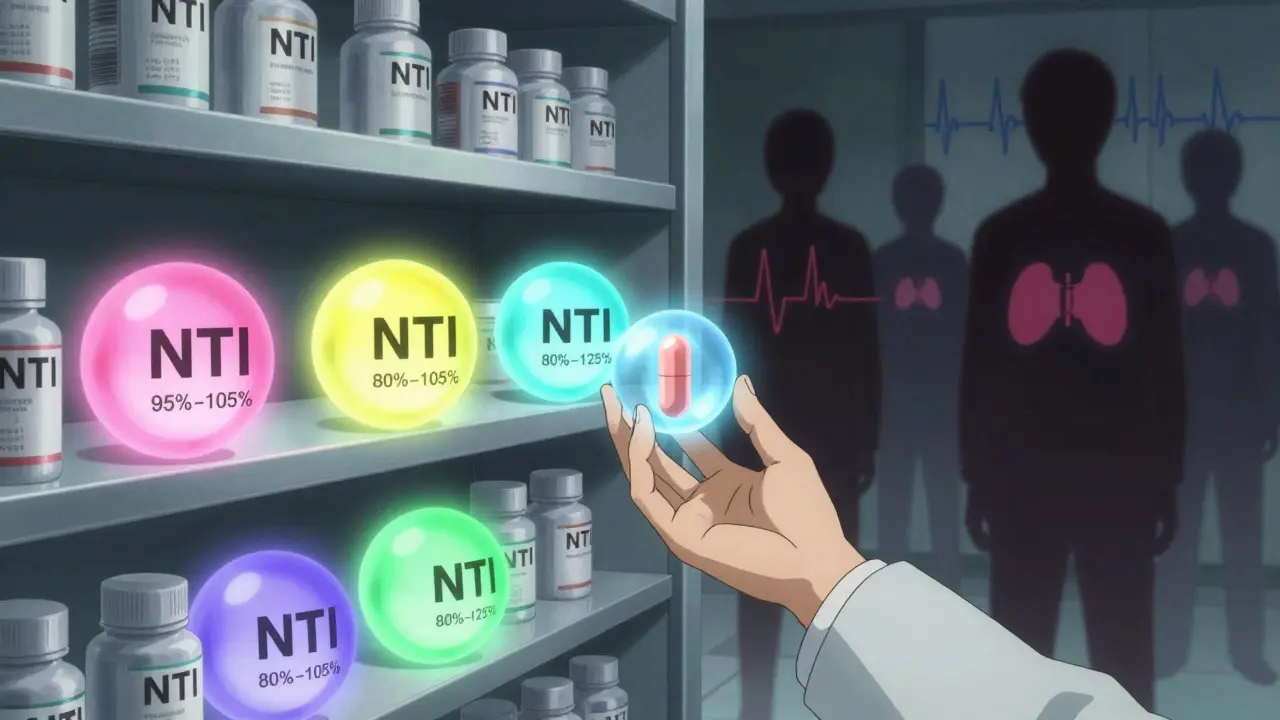
Not all generic drugs are created equal. When it comes to NTI generics - drugs with a narrow therapeutic index - even tiny differences in how the body absorbs the medicine can mean the difference between healing and harm. These are medications where the gap between a safe, effective dose and a dangerous one is razor-thin. Think warfarin, phenytoin, levothyroxine, and digoxin. A 5% variation in blood levels might make a seizure happen, or cause a blood clot. That’s why regulators around the world treat them differently than regular generics.
In the U.S., the FDA requires tighter controls. For standard generics, the acceptable range for how much drug is in the pill is 90% to 110% of the brand-name version. For NTI generics, that range shrinks to 95% to 105%. The same goes for bioequivalence - the measure of how quickly and completely the body absorbs the drug. Most generics only need to match the brand within 80% to 125%. For NTI drugs, the FDA demands equal or tighter limits - often 90% to 111% - based on the specific drug. This isn’t just paperwork. It’s about preventing real-world harm.
How the EU Handles NTI Generics
The European Medicines Agency (EMA) doesn’t have one single rulebook for the whole continent. Instead, it offers three pathways: the Centralized Procedure, the National Procedure, and the Mutual Recognition or Decentralized Procedures. The Centralized Procedure is the most rigorous. It’s voluntary for most generics, but many companies choose it for NTI drugs because it gives approval across all EU member states at once. The review takes about 210 days, and the data requirements are steep: full comparative bioequivalence studies, detailed dissolution profiles, and stress testing under extreme conditions.
But here’s the catch: even after EMA approval, individual countries can still set their own rules on who can prescribe or substitute these drugs. In Spain, the first generic to enter the market must be priced at least 40% lower than the brand. Other generics must match or beat that price. In Germany and Denmark, pricing is freer, but substitution rules vary by region. Pharmacists in France or Italy might be told they can’t swap an NTI generic without a doctor’s note, even if the EMA says it’s equivalent. This patchwork creates confusion - a 2022 survey found 58% of European hospital pharmacists struggled to keep up with the rules across borders.
Canada and Japan: Different Paths, Similar Goals
Health Canada takes a pragmatic approach. It allows companies to use foreign reference products - like a U.S.-made brand-name drug - for bioequivalence testing, as long as the formulation, solubility, and physical properties match exactly. They also require multi-point dissolution testing, meaning the drug must release at the same rate across multiple time points, not just one. This helps catch slow-release or modified formulations that might behave differently in the body.
Japan’s Pharmaceuticals and Medical Devices Agency (PMDA) is known for its meticulous attention to detail. While it doesn’t have a blanket NTI rule, it has issued specific guidance for topical drugs - a major category of NTI products - and demands extensive analytical data. Their focus is on consistency: batch-to-batch, site-to-site, year-to-year. If a generic manufacturer changes its production line, they must re-prove equivalence. It’s slower, but it reduces risk.

The U.S. Substitution Patchwork
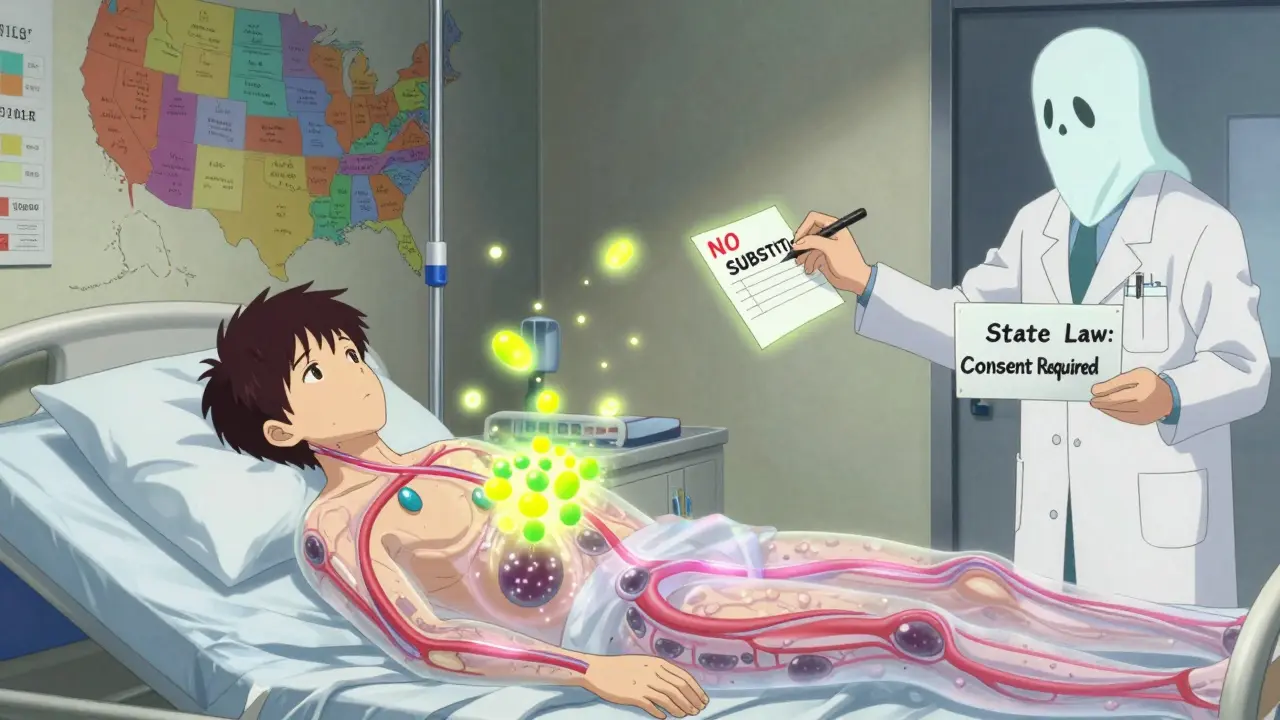
In the U.S., the FDA approves the drug. But whether a pharmacist can swap it for a generic? That’s up to the state. As of 2023, 26 states have special laws for NTI drugs. North Carolina requires written consent from both the doctor and patient before switching. Connecticut, Idaho, and Illinois demand extra notifications for anti-seizure drugs. Some states carve out entire classes - like levothyroxine - and ban automatic substitution entirely.
Why? Because prescribers are worried. A 2019 survey found that 67% of U.S. pharmacists get calls from doctors asking them not to substitute NTI generics. For anti-epileptic drugs, that number jumps to 78%. On Reddit’s r/pharmacy, pharmacists shared stories of patients whose thyroid levels swung wildly after switching levothyroxine brands - even though the FDA deemed them equivalent. One pharmacist wrote: “I’ve had three instances this year where patients had fluctuations after switching. Their TSH levels went from stable to off the charts.”
But it’s not all bad. A 2021 study of 12,500 patients across 15 European countries showed that when strict bioequivalence standards were followed, NTI generics worked just as well as brand names in 94.7% of cases. The problem isn’t always the drug - it’s the inconsistency in how it’s handled.
Who’s Making These Drugs, and How Much Does It Cost?
The global market for NTI generics was worth $48.7 billion in 2022 and is expected to hit $72.3 billion by 2027. The U.S. leads with 42% of sales, followed by Europe at 34%. Teva is the biggest player, controlling nearly 19% of the market. Mylan, Sandoz, and Hikma follow. But getting a product approved isn’t cheap or fast.
Developing a regular generic takes 12 to 18 months and $2-4 million. For an NTI generic? It’s 18 to 24 months and $5-7 million. Why? More bioequivalence studies. More stability testing. More analytical validation. One regulatory executive told me: “You’re not just proving it works. You’re proving it works the same way, every single time - even if the humidity changes or the tablet is stored for three years.”
And it’s still risky. In 2022, the FDA rejected 22% more NTI generic applications than non-NTI ones. The main reason? Bioequivalence data didn’t meet the tighter standards. A 2021 recall of a generic antihypertensive drug due to nitrosamine impurities reminded everyone: cutting corners on NTI drugs can have deadly consequences.
Global Efforts to Align Standards
There’s a growing push to fix this mess. The International Generic Drug Regulators Pilot (IGDRP), launched in 2012, brings together regulators from the U.S., EU, Canada, Japan, South Korea, Switzerland, Singapore, and Taiwan. They share data, compare methods, and try to harmonize requirements. The goal? Reduce duplication and speed up approvals.
Recent developments point to progress. In 2023, the ICH adopted the M9 guideline on biowaivers - a framework that could allow some NTI drugs to skip full bioequivalence studies if they meet strict solubility and dissolution criteria. The FDA’s GDUFA III program, effective since January 2023, adds new post-market monitoring for NTI generics. The EMA is seeing more companies choose the Centralized Procedure - up from 42% in 2018 to 68% in 2022.
Looking ahead, the FDA plans to use population bioequivalence models by 2025. Instead of testing 24 healthy volunteers, they’ll analyze data from hundreds of patients to better predict real-world performance. It’s a shift from lab perfection to real-life reliability.
What This Means for Patients and Providers
If you’re a patient on warfarin or levothyroxine, you need to know: your generic might not be interchangeable with another - even if both are FDA-approved. Stick with the same brand or generic unless your doctor says otherwise. Ask your pharmacist to document which version you’re on.
If you’re a prescriber, be aware of your state’s substitution laws. Don’t assume “generic” means “interchangeable” for NTI drugs. Document your decisions. If a patient has had stability issues, don’t switch.
For regulators, the challenge remains: how to balance access, affordability, and safety. The U.S. has strong science but fragmented rules. Europe has strong science but inconsistent enforcement. Canada and Japan are cautious, but slow. The answer isn’t one-size-fits-all. It’s better communication, shared data, and a global commitment to the fact that for NTI drugs, precision isn’t optional - it’s life or death.
Chris & Kara Cutler
February 1, 2026 AT 17:23Donna Macaranas
February 3, 2026 AT 05:20Rachel Liew
February 3, 2026 AT 12:17June Richards
February 3, 2026 AT 15:58Jaden Green
February 3, 2026 AT 23:02Lu Gao
February 5, 2026 AT 01:18Angel Fitzpatrick
February 6, 2026 AT 02:40Nidhi Rajpara
February 6, 2026 AT 03:17Aditya Gupta
February 6, 2026 AT 20:32Lisa Rodriguez
February 7, 2026 AT 15:44Ed Di Cristofaro
February 8, 2026 AT 12:54Lilliana Lowe
February 9, 2026 AT 05:26Melissa Melville
February 10, 2026 AT 04:25Donna Macaranas
February 10, 2026 AT 05:14