

You’re halfway across the globe. Your body clock is screaming that it’s 3 AM, but your phone says it’s noon in Tokyo. You reach for your pill organizer, and panic sets in: did you take your malaria prophylaxis too early? Is your antibiotic dose now dangerously delayed? For travelers managing chronic conditions or short-term prescriptions, crossing time zones isn’t just about sleep-it’s a pharmacological puzzle.
Getting this wrong can mean more than just discomfort. For those on antiretrovirals or strict antimalarial regimens, missing a window by even a few hours can risk drug resistance or treatment failure. Unlike a headache tablet, these medications rely on precise blood concentrations. Let’s break down how to keep your dosing schedule accurate without letting jet lag derail your health.
The Core Problem: Circadian Rhythms vs. Drug Half-Lives
Your body operates on an internal clock called the circadian rhythm. This system regulates hormone release, digestion, and metabolism. Most medications are designed with this rhythm in mind. When you fly from London to Sydney, you aren’t just changing locations; you’re shifting your biological timeline by up to 10 hours overnight.
The critical factor here is the drug’s half-life-the time it takes for half of the medication to leave your system. Short-acting drugs require strict adherence to intervals. Long-acting drugs offer more wiggle room. If you ignore this, you might end up taking two doses close together (increasing side effect risks) or leaving a gap so wide that bacteria or parasites get a chance to rebound.
Antimalarials: The Weekly vs. Daily Dilemma
Malaria prevention protocols vary wildly depending on the drug. This is where most travelers get tripped up because the rules change based on which prescription they have.
Atovaquone-proguanil (often sold as Malarone) is popular for its daily dosing requirement. It has a forgiving window of about 12 hours. If you normally take it at 8 PM UK time, and you land in Singapore where it’s 4 AM, you don’t need to wake up immediately. Wait until a reasonable local morning hour to take the next dose. However, consistency matters. Try to anchor the dose to a specific activity, like breakfast, rather than the clock.
Conversely, Mefloquine is taken once a week. This makes time zones almost irrelevant for scheduling. Whether you take it Tuesday night in New York or Wednesday morning in Paris, the weekly interval remains intact. Just be aware that Mefloquine carries a higher risk of neuropsychiatric side effects, which some travelers find exacerbated by severe jet lag.
| Medication | Dosing Frequency | Time Zone Flexibility | Key Constraint |
|---|---|---|---|
| Atovaquone-proguanil | Daily | Moderate (12-hour window) | Must be taken with food/milk for absorption. |
| Mefloquine | Weekly | High | Potential mood/sleep disturbances. |
| Doxycycline | Daily | Low (Strict 24-hour interval) | Sun sensitivity increases with erratic timing. |
| Artemether-lumefantrine | Complex (Day 1-3) | Very Low | Requires fat intake; strict 8-hour initial gaps. |
Antibiotics: Precision Matters More Than You Think
While antibiotics aren’t always discussed in the same breath as HIV meds, their timing is crucial for efficacy. Bacteria thrive when drug levels dip below the therapeutic threshold. If you’re on a course of amoxicillin or ciprofloxacin, you cannot simply shift your dose by six hours because you feel tired.
For standard oral antibiotics, aim to maintain the interval as close to home-time as possible for the first 48 hours. Then, gradually adjust. If you cross eastward (losing time), skip the intermediate dose if the gap is less than 4 hours. If you cross westward (gaining time), you may need to set an alarm to take a dose during what feels like the middle of the night locally.
A common mistake is "catching up." If you miss a dose because you were asleep, do not double up unless instructed by your doctor. Doubling increases gastrointestinal distress, which is already heightened by travel stress. Instead, resume the regular schedule. For short courses (5-7 days), the slight deviation is usually manageable, but for longer treatments, consult your pharmacist before flying.

Step-by-Step Strategy for Adjustment
Don’t wait until you’re on the plane to figure this out. Here is a practical workflow used by frequent flyers with medical needs:
- Calculate the Shift: Determine the total time difference between departure and arrival. A flight from Brighton to Bali crosses roughly 7-8 hours. That’s a significant jump.
- Pre-Trip Tapering: Three days before departure, start shifting your dose by 1 hour per day toward the destination time. This softens the blow for your body and maintains steady drug levels.
- The Flight Rule: During the flight, use the destination time for your meals and sleep attempts. Align your medication with these cues. If the flight is shorter than the dosing interval, you likely won’t need to take a dose mid-air unless it’s been over 24 hours since the last one.
- Arrival Anchor: Once you land, pick a fixed local time for your next dose (e.g., 8 AM). Stick to it strictly from then on, regardless of how tired you feel.
Special Case: Artemisinin-Based Combination Therapies (ACTs)
If you are treating active malaria rather than preventing it, things get complicated. Drugs like Artemether-lumefantrine require a rigorous schedule: four tablets immediately, four more after 8 hours, then twice daily for two days.
This regimen leaves almost no room for error. The 8-hour initial gap is non-negotiable for clearing the parasite load. If you are traveling while sick, stay put. Do not attempt long-haul flights during the first 24 hours of ACT treatment. The combination of jet lag, potential vomiting from the medication, and the strict dosing clock is a recipe for treatment failure.
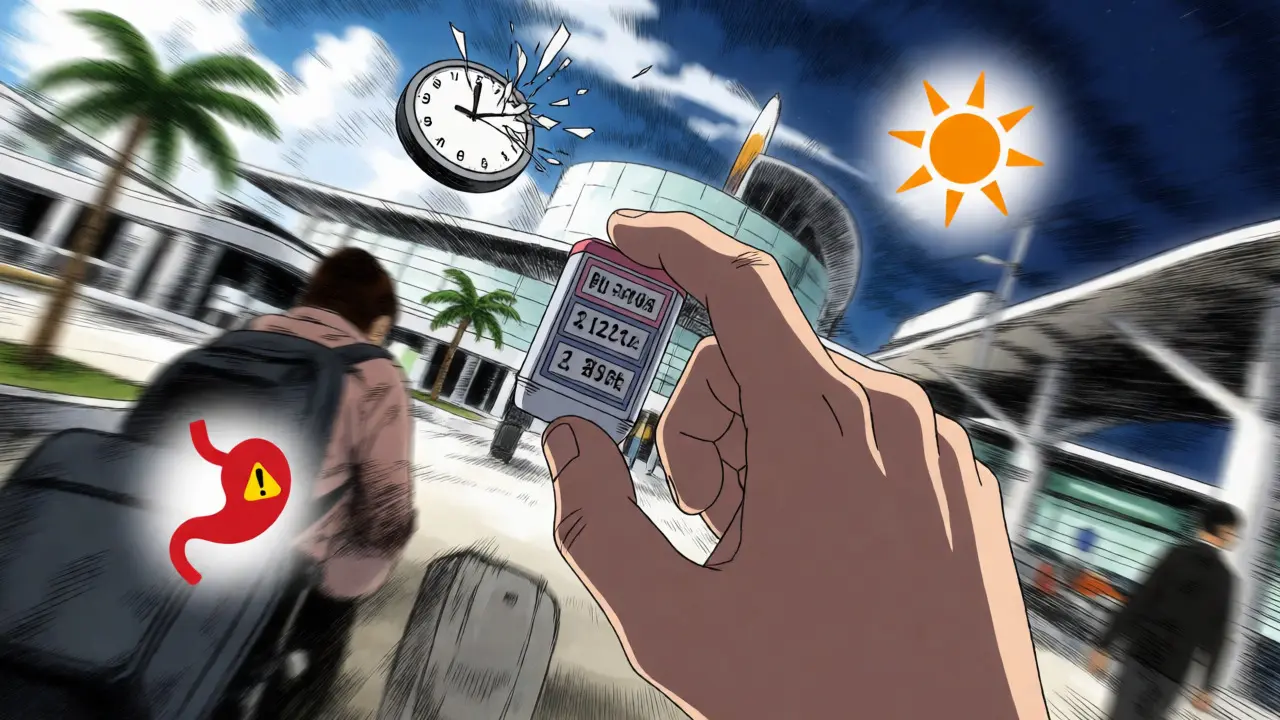
Tech Tools and Physical Aids
Memory fails under stress. Use external aids to keep track.
- Apps: Apps like Medisafe allow you to set multiple alarms for different time zones. You can configure a "travel mode" that alerts you based on the destination time while keeping a log of when you actually took the pill.
- Pill Organizers: Bring a separate, labeled organizer for the trip. Pre-load the pills for the duration of the journey plus two days. This prevents rummaging through luggage in dim cabin lights.
- Printed Schedule: Keep a physical card in your wallet with the drug name, dosage, and adjusted times. Pharmacists abroad can read this instantly if you need a refill.
Common Pitfalls to Avoid
Travelers often make three critical errors:
- Taking Malarone on an Empty Stomach: Atovaquone requires fat for absorption. Jet lag kills appetite, leading many to skip food. This reduces efficacy by up to 300%. Always pair it with a snack, yogurt, or milk.
- Ignoring Sun Sensitivity: Doxycycline makes skin sensitive to UV rays. If you adjust your dose to the morning but spend all day in tropical sun, you risk severe burns. Plan indoor activities or wear heavy protection during peak sun hours.
- Assuming All Pills Are Equal: A painkiller can wait an hour. An antibiotic cannot. Treat every prescription with the seriousness of a timed-release mechanism.
Frequently Asked Questions
What if I forget my medication during a long layover?
If you are within 4 hours of your scheduled dose, take it as soon as you remember. If it is closer to the next dose time, skip the missed one. Never double up, especially with antibiotics or antimalarials, as this increases side effects without improving protection.
Do I need to adjust my dose if I only cross one time zone?
Generally, no. A one-hour shift is negligible for most medications. Continue your normal routine. Only worry about adjustments when crossing three or more time zones, where the discrepancy becomes biologically significant.
Can I take my antimalarial with alcohol?
It depends on the drug. Mefloquine and Atovaquone-proguanil are generally safe with moderate alcohol, though alcohol can worsen jet lag symptoms. Doxycycline can interact with alcohol, potentially reducing its effectiveness. Always check the specific patient information leaflet.
How far in advance should I start adjusting my schedule?
Start adjusting 2-3 days before departure for daily medications. Shift your dose by 1 hour each day toward the destination time. This gradual approach helps maintain consistent blood levels and eases the transition for your body clock.
What happens if I vomit shortly after taking my pill?
If you vomit within 30 minutes of taking an antimalarial, you should repeat the dose. If it has been more than an hour, assume the medication was absorbed and wait for the next scheduled dose. Consult a doctor if vomiting persists, as this may indicate an adverse reaction or illness.
larry williams
September 2, 2026 AT 04:02I really appreciate how you broke down the difference between half-lives and circadian rhythms because honestly, most travel advice just says 'take it at the same time' without explaining why that is so dangerous for specific drugs like antimalarials or antibiotics.
It is crucial to remember that our bodies are not simple machines that can be reset with a button press; they are complex biological systems that rely on steady-state concentrations of medication to remain effective against pathogens. When we fly across multiple time zones, we are essentially asking our liver enzymes and kidney filtration rates to work on a schedule that contradicts their internal master clock, which can lead to unpredictable absorption rates and potential toxicity if we are not careful.
The suggestion about pre-trip tapering by shifting the dose one hour per day is particularly insightful because it respects the body's natural ability to adjust gradually rather than forcing an abrupt change that could stress the system further.
Also, the emphasis on anchoring doses to activities like breakfast rather than strict clock times is a practical tip that many travelers overlook in favor of rigid scheduling, which often leads to missed doses when sleep schedules are disrupted by jet lag.
We must also consider the psychological aspect of medication adherence, as the anxiety of potentially missing a dose can sometimes be more debilitating than the slight timing error itself, especially for those managing chronic conditions.
Your point about Malarone requiring food for absorption is vital because jet lag frequently suppresses appetite, leading people to take these medications on empty stomachs and inadvertently reducing their efficacy by a significant margin.
I think it would be beneficial to add a note about hydration levels affecting drug metabolism during long flights, as dehydration can concentrate blood plasma and alter the perceived effects of certain medications.
The distinction between weekly and daily dosing regimens is clearly explained, providing a reassuring framework for those who might feel overwhelmed by the complexity of international travel health protocols.
Frequent flyers with medical needs should definitely invest in a dedicated pill organizer and digital alarms that account for time zone changes, as relying on memory alone in a state of fatigue is a recipe for disaster.
This guide serves as an excellent reminder that pharmacology and chronobiology intersect in profound ways that require thoughtful planning rather than last-minute improvisation.
Stephen Horn
September 3, 2026 AT 20:29One cannot simply dismiss the inherent risks associated with pharmaceutical manipulation of human biology without considering the broader implications of corporate-driven medical guidelines.
The insistence on precise dosing intervals serves primarily to maximize patent revenue and ensure patient dependency rather than solely optimizing therapeutic outcomes for the average traveler.
Consider the fact that the 'strict' windows mentioned are often arbitrary constructs designed to justify the marketing of specialized time-release formulations that offer little genuine benefit over standard generic equivalents.
Furthermore, the reliance on apps and digital trackers introduces a layer of surveillance capitalism into personal health management, where data collection takes precedence over intuitive bodily awareness.
It is highly suspicious that mainstream medical literature consistently fails to acknowledge the placebo effect's role in perceived adherence success, thereby obscuring the true efficacy of these rigid schedules.
Travelers are conditioned to believe that without these specific protocols, treatment failure is imminent, yet historical evidence suggests that human resilience often compensates for minor temporal deviations.
The recommendation to consult pharmacists abroad assumes a uniformity of training and access that does not exist in many developing nations, creating a false sense of security for the Western tourist.
Moreover, the interaction between alcohol and antimalarials is often understated to encourage tourism spending, despite clear biochemical conflicts that could compromise immune function.
We must question whether the current paradigm of 'precision medicine' is actually serving the patient or merely serving the logistical demands of global supply chains.
In conclusion, while the advice provided is technically sound within conventional frameworks, it ignores the systemic biases that prioritize commercial interests over holistic physiological understanding.
Gurjit Singh
September 5, 2026 AT 08:36It is morally imperative that we adhere strictly to prescribed medical regimens as a duty to oneself and to society.
Negligence in taking medication on time reflects a lack of discipline and respect for the scientific progress that made such treatments possible.
Those who complain about the inconvenience of time zones are often the same individuals who disregard other basic health responsibilities.
We must maintain high standards of compliance to prevent the spread of resistant strains of malaria and bacteria.
Personal comfort should never take precedence over medical necessity and public health safety.
Every individual has a responsibility to follow instructions precisely to avoid burdening the healthcare system.
Excuses regarding jet lag are insufficient justification for potential lapses in treatment efficacy.
Discipline in medication timing builds character and demonstrates commitment to one's own well-being.
Society functions best when individuals fulfill their obligations without complaint or deviation.
Let us strive for excellence in adherence rather than seeking shortcuts that compromise integrity.
hareesh kumar
September 7, 2026 AT 06:56OMG WAIT A SEC!!!
Did anyone else notice that this whole thing is probably a setup by Big Pharma to sell us those fancy smart pill boxes??
Because seriously, who has the mental energy to calculate half lives while being drunk on plane wine??
I bet they want us to buy the special timed release versions that cost triple the price just so we don't have to think!!
And what about the conspiracy that time zones themselves are fake??
Like maybe the earth doesn't actually rotate but we just move the clocks??
If that's true then all this math is useless and we are just slaves to the tick tock!!
I read somewhere that pilots know the truth but they won't say anything because of NDAs!!
So basically we are all just guinea pigs testing if our brains melt from confusion before the meds kick in!!
Anyway I took my doxyycline 3 hours late yesterday and i didnt die so maybe its all bogus??
Or maybe im just lucky cause i drink lots of water which flushes out the lies!!
Dont trust the table they gave me at the pharmacy it was printed in small font on purpose!!
Wake up sheeple the only thing keeping us sick is the fear of missing a dose!!
Venkatesan V.K.
September 9, 2026 AT 05:33The article presents a superficial overview of a complex pharmacokinetic issue without adequately addressing the variability in individual metabolic rates.
While the general advice is acceptable for laypeople, it lacks the nuance required for patients with compromised hepatic or renal function.
The comparison table is misleadingly simplified, ignoring critical interactions with common dietary components found in different regions.
Furthermore, the assertion that one-hour shifts are negligible contradicts recent studies on chronopharmacology in elderly populations.
The tone is overly optimistic, failing to acknowledge the significant morbidity associated with even minor adherence errors in severe cases.
Ultimately, this content feels like recycled blog filler rather than authoritative medical guidance.
Marc-David Mayer
September 10, 2026 AT 16:54This is such a helpful guide! 🌍✈️💊
I used to panic every time I flew east because I didn't know if I should skip a dose or double up. 😰
The tip about anchoring to breakfast instead of the clock is a game changer for me! 🍳☕
Also, using Medisafe with travel mode saved my life (literally!) on my last trip to Asia. 📱✨
Don't forget to pack extra pills in your carry-on just in case! 🎒🚀
You've got this! Stay healthy and happy travels! 💪😊❤️
Stuart Lorne
September 10, 2026 AT 20:39look mate
youre making it way too complicated
just take it when you wake up
if you miss it take it later
your body knows what to do
stop overthinking it
we did fine before apps existed
its just a pill
relax
and stop worrying about half lives
nobody cares
go have a pint
Anderson Miller
September 11, 2026 AT 02:45Is it truly possible to separate the biological self from the mechanical clock... or are we merely illusions of consistency?
We cling to these numbers... these tiny integers... as if they hold the power to define our reality... when in truth... time is fluid... subjective... and utterly indifferent to our prescriptions.
To speak of 'half-lives' is to admit that we are decaying... slowly... steadily... inevitably... regardless of whether we swallow the tablet at 8 AM or 8 PM.
Perhaps the anxiety surrounding missed doses is less about bacterial resistance... and more about our desperate need to control the uncontrollable chaos of existence.
We build these elaborate systems... apps... organizers... schedules... to ward off the void... but the void always wins... eventually...
Jet lag is not a malfunction... it is a reminder... that we are creatures of light and dark... not of Greenwich Mean Time.
So... take your pill... or don't... the universe will expand... either way...
But do try to eat something... because hunger... unlike time... is quite real... and terribly inconvenient...
In the end... we are all just waiting for the next dose... hoping it fixes what cannot be fixed...
Or perhaps... we are already cured... and simply forgot to notice...