
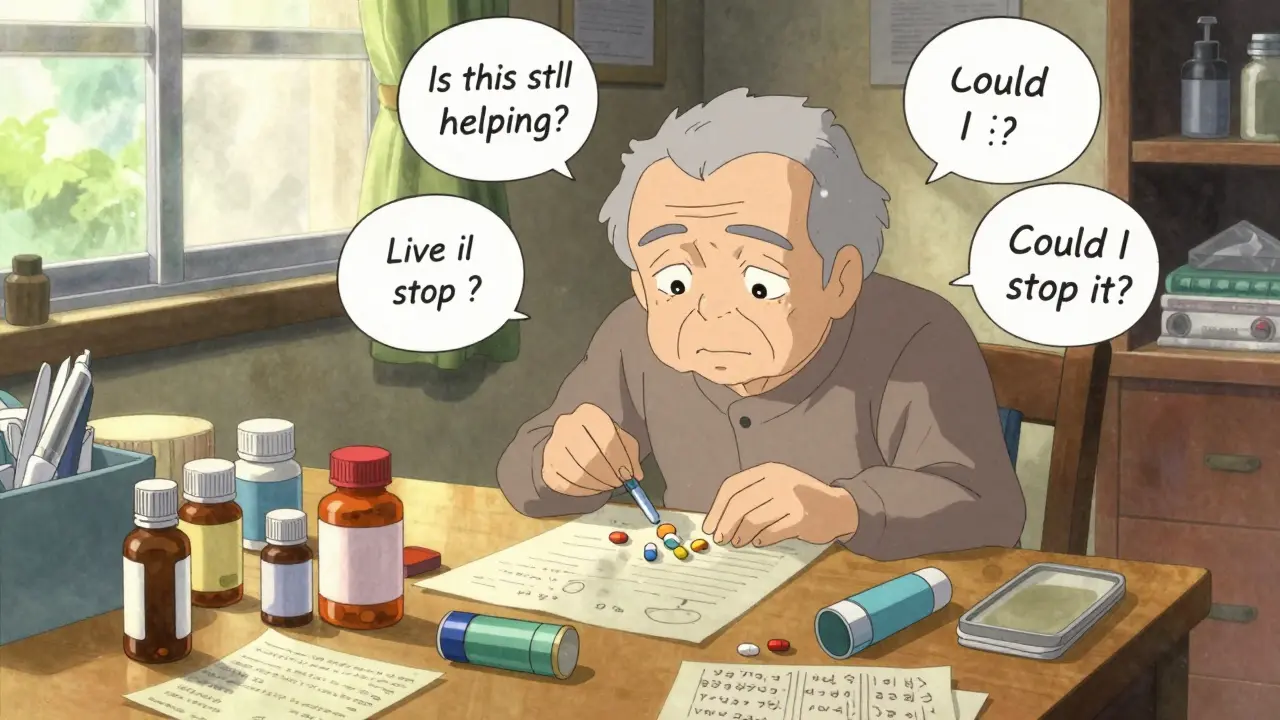
When you’re taking multiple medications, even a simple appointment can feel overwhelming. But a medication review isn’t just another checkup-it’s a safety net. It’s where your doctor or pharmacist sits down with you, looks at every pill, patch, inhaler, and supplement you’re using, and asks: Is this still helping? Is it safe? If you’ve been invited for one, don’t ignore it. In the UK, many GP practices now stop issuing repeat prescriptions if you don’t attend. It’s not punishment-it’s protection.
What Exactly Is a Medication Review?
A medication review is a structured conversation about everything you’re taking. It’s not just about prescriptions. It includes over-the-counter painkillers, herbal remedies, vitamins, even creams you rub on your skin. The goal? To make sure each medicine is still necessary, working as it should, and not causing harm. According to the Godiva Group Practice NHS, these reviews should happen at least once a year. If you’re over 65, taking five or more medications, or have a condition like Parkinson’s, diabetes, or heart disease, you might need one more often.Some reviews are done by your GP. Others are led by a clinical pharmacist-a specialist trained in how drugs interact. These sessions can last 20 to 45 minutes. That’s because they’re not rushed. They’re meant to be thorough. And if you’re doing it over video or phone, you’ll need to be even more prepared.
What to Bring: Your Medication Toolkit
Don’t just list your meds. Bring them. All of them.- Every prescription bottle, even if it’s almost empty
- Over-the-counter pills like ibuprofen, paracetamol, or antacids
- Vitamins, supplements, and herbal teas you take daily
- Inhalers, eye drops, creams, patches
- Any leftover medicines from past treatments
The Northern Health and Social Services Board says it plainly: “By medicines we mean anything you take.” That includes the ginger capsules you started last month for your joints, or the melatonin you bought online to help you sleep. If it’s in your medicine cabinet, bring it.
Why? Because sometimes, you forget you’re still taking something. Or the label says “take one daily,” but you’ve been doubling up because you thought it wasn’t working. Or you got a new prescription from a specialist and never told your GP. These gaps are exactly what a medication review is designed to catch.
Write Down the Details
Before your appointment, grab a notebook or open a note on your phone. For each medicine, write:- The full name (e.g., “Metformin 500mg” not just “diabetes pill”)
- The dose (how many milligrams or millilitres)
- How often you take it (e.g., “once a day at breakfast”)
- Why you’re taking it (e.g., “for high blood pressure”)
- Who prescribed it (e.g., “Dr. Patel, cardiology”)
- Any side effects you’ve noticed (dizziness, nausea, rash, tiredness)
For people with Parkinson’s, timing matters even more. Medications like levodopa need to be taken within 30 minutes of each other, or they won’t work. If you’re doing a video call, your pharmacist won’t be able to see your pillbox. So you need to be precise. Write down your exact schedule: “7:00 AM: Sinemet 100/25; 10:00 AM: Pramipexole 0.18mg; 1:00 PM: Ropinirole 1mg.”
Think About Your Goals
Are you still feeling better? Or are you just taking pills because “that’s what you’ve always done”? A good medication review doesn’t just check boxes-it asks questions like:- Is this medicine helping me feel better or live longer?
- Is the side effect worse than the condition it’s treating?
- Am I taking something just because another doctor prescribed it?
- Would I be better off with fewer pills?
Dr. Antoine Geffrard at RMS Consultations says patients who come with clear goals-like “I want to stop feeling dizzy” or “I don’t want to take so many pills before breakfast”-have better outcomes. You’re not just a patient. You’re part of the team.
Prepare Your Questions
You don’t have to be a doctor to ask smart questions. Here are a few that can change your care:- “Is this medicine still necessary? Could I stop it?”
- “Are there simpler or cheaper alternatives?”
- “What happens if I don’t take this anymore?”
- “Could this interact with my other meds or my diet?”
- “Is there a non-drug option I could try first?”
The Health Innovation Network says shared decision-making is the heart of a good review. That means you and your provider make choices together. Don’t be shy. If you’re unsure about something, say so. If you don’t understand a term, ask them to explain it.
What If You Can’t Get to the Clinic?
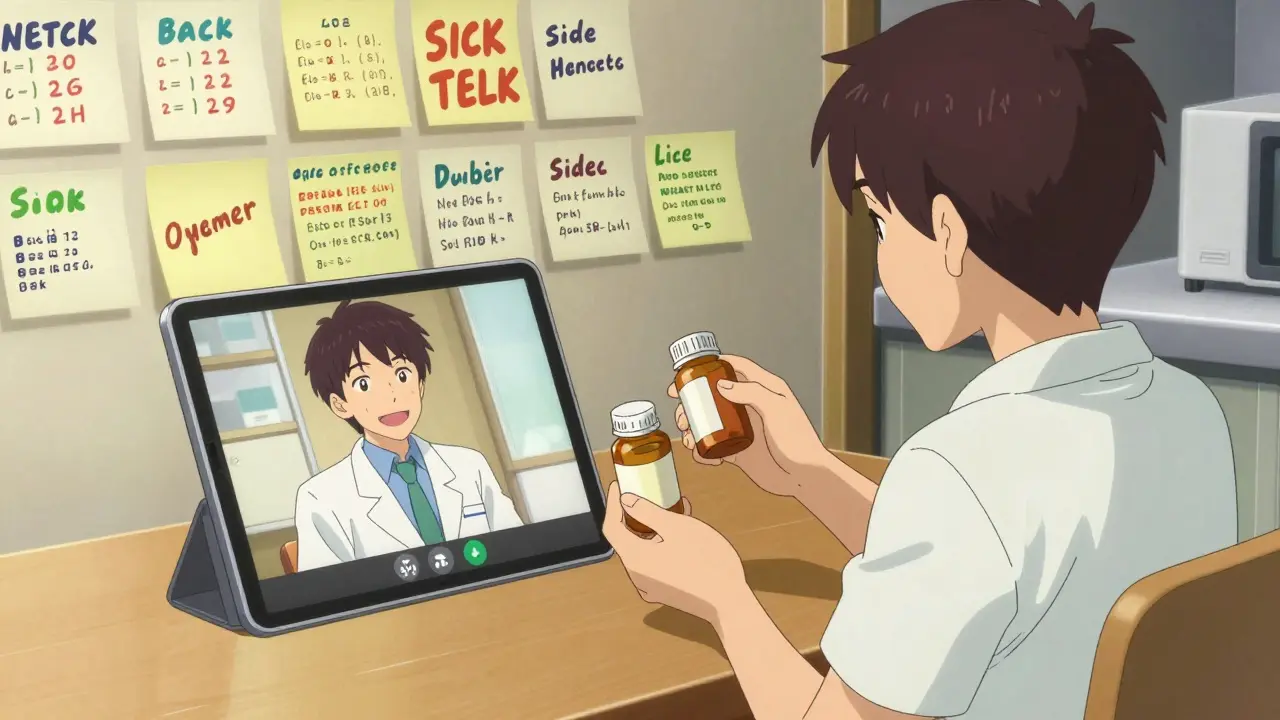
If mobility, transport, or health issues make it hard to leave home, ask about alternatives. The Northern Health and Social Services Board says some practices offer home visits. Others can do phone or video reviews. But if it’s virtual, your preparation gets even more critical.For telehealth reviews:
- Set up your device (phone, tablet, laptop) before the call
- Have your meds in front of you so you can show them on camera
- Use good lighting so the pharmacist can read labels
- Have your written list ready to read aloud
- Test your internet connection ahead of time
Parkinson’s UK says video reviews are now common-and many patients prefer them. But without physical inspection, your list becomes your lifeline. Double-check it.
What Happens If You Don’t Show Up?
This isn’t optional. The Godiva Group Practice NHS has a clear policy: after sending three monthly reminders, they reduce your repeat prescriptions to a one-month supply. If you still don’t attend, they stop issuing prescriptions entirely. Why? Because taking the wrong mix of drugs-especially as you age-can lead to falls, confusion, kidney damage, or even hospitalisation.It’s not about control. It’s about safety. Medications don’t just sit in your body. They interact. A common painkiller like ibuprofen can raise your blood pressure if you’re on heart meds. A supplement like St. John’s Wort can make your antidepressant useless. These risks aren’t theoretical. They’re documented. And they’re why this review exists.
After the Review: What to Do Next
At the end of your appointment, you should walk away with:- A clear list of what to keep, stop, or change
- Updated instructions for each medicine
- Next steps: new prescriptions, follow-up tests, referrals
- A date for your next review
Ask for a printed copy or a digital version sent to your email. Then, update your personal medication list. Tell a family member or carer what changed. If you’re taking fewer pills, celebrate. That’s progress.
And don’t wait for the next invitation. If your health changes-new symptoms, a new diagnosis, a fall, a change in memory-call your GP. You don’t need to wait for a letter.
What if I don’t know what all my medications are for?
That’s normal. Many people take pills for years without knowing why. Write down everything you have, even if you’re unsure. Your pharmacist or doctor will look up the purpose. You don’t need to know everything-just be honest about what you don’t know. They’re there to help you figure it out.
Can I just rely on my pharmacy’s list?
Pharmacy records are helpful, but they’re not always complete. They might miss over-the-counter drugs, supplements, or medications prescribed by specialists outside your practice. Always bring your own list and your actual pills. It’s the only way to be sure.
What if I’m taking something I shouldn’t be?
Don’t panic. Many people take things they no longer need-like old antibiotics or leftover painkillers. The review is designed to find these safely. Your provider won’t judge you. They’ll help you stop safely, often by tapering doses or replacing them with better options. Honesty here saves lives.
Do I need to bring my supplements if they’re natural?
Yes. Natural doesn’t mean harmless. Herbal supplements like ginkgo, garlic, or turmeric can interfere with blood thinners, blood pressure meds, or chemotherapy. Even vitamin K can cancel out warfarin. Every supplement counts. Bring them all.
Can I ask to stop a medication during the review?
Absolutely. In fact, that’s one of the best reasons to go. Many people take medications long after they’re needed. If you’re feeling worse, not better, say so. Your provider can help you safely stop, switch, or reduce doses. You have a right to question your treatment.
Leah Dobbin
March 13, 2026 AT 19:22It’s fascinating how healthcare systems have turned medication management into a compliance ritual rather than a collaborative care process. The real issue isn’t patients forgetting their pills-it’s that providers rarely question why they were prescribed in the first place. I’ve seen patients on six antihypertensives because ‘someone else started it.’ No one ever stops to ask if the patient even has hypertension anymore. This isn’t safety. It’s inertia dressed up as protocol.
Ali Hughey
March 14, 2026 AT 23:53THEY’RE HIDING SOMETHING. 🤔 WHY DO THEY ONLY DO THIS REVIEW IF YOU’RE OVER 65 OR ON FIVE MEDS? WHAT ABOUT THE YOUNG PEOPLE ON ANTIDEPRESSANTS, STEROIDS, OR BETA-BLOCKERS? THEY’RE BEING TARGETED-AND IT’S NOT ABOUT SAFETY. IT’S ABOUT CONTROL. 🚨 I’M NOT SAYING DON’T DO IT-I’M SAYING ASK WHO BENEFITS. 🧠💊 #MedicationManipulation
Alex MC
March 15, 2026 AT 11:40This is actually one of the most thoughtful pieces on medication management I’ve read. The emphasis on bringing physical pills-not just lists-is spot on. I’ve had patients show up with 12 bottles and realize they’ve been taking expired antibiotics for years. No judgment, just relief. The goal isn’t to reduce pills-it’s to reduce confusion. And yes, video reviews work if you prep. I’ve done dozens. Simple tools, big impact.
rakesh sabharwal
March 16, 2026 AT 10:34The entire framework is predicated on a flawed biomedical model that pathologizes polypharmacy as a personal failing rather than a systemic one. The clinical pharmacist’s involvement, while ostensibly beneficial, merely reifies the hegemony of pharmaceutical governance. One must interrogate the epistemological foundations of 'necessary' versus 'redundant'-these are not clinical categories, but administrative ones. The very notion of a 'medication toolkit' commodifies agency into a performative checklist. Truly, the patient becomes a data point in a neoliberal healthcare apparatus.
Aaron Leib
March 17, 2026 AT 22:48Good summary. I especially like the part about writing down why you’re taking each med. So many people don’t know. Just bringing the bottles alone can spark clarity. No need to overthink it. Show up. Bring the pills. Say what you’re feeling. That’s all it takes.
Dylan Patrick
March 19, 2026 AT 19:11Bring your meds. All of them. Even the ones you're not sure about. Even the ones you forgot you had. Even the ones you got from that guy at the gas station who said 'this'll fix your back.' 🙃 You think you're being weird? Nah. You're being smart. This isn't about rules. It's about not waking up dizzy on the floor because some pill you took in 2018 is still in your system. Do the thing. You got this.
Kathy Leslie
March 21, 2026 AT 14:43I did this last month. Brought 17 bottles. Turned out I was still taking a thyroid med I stopped needing in 2020. Also, my 'daily' aspirin was making my stomach hurt. We cut two things. Felt lighter. Literally. No drama. Just a 20-minute chat. It’s weird how simple it is when you stop overcomplicating it.
Amisha Patel
March 23, 2026 AT 07:57I’ve been on six meds for 12 years. Never questioned any of them. This article made me write down everything I take. Turns out I’ve been taking melatonin for sleep… and ginkgo for memory… and turmeric for inflammation. All from Amazon. Never told my doctor. I’m scared to ask if they interact. But I’m going. I’m bringing everything. Even the ones I’m embarrassed about.
Elsa Rodriguez
March 24, 2026 AT 00:01MY MOM GOT HER PRESCRIPTIONS CUT OFF LAST YEAR BECAUSE SHE MISSED ONE REVIEW. SHE WASN’T EVEN SICK. SHE WAS JUST TOO TIRED TO DRIVE. THEY TOOK AWAY HER BLOOD PRESSURE MEDS. SHE HAD A STROKE. I’M NOT SAYING DON’T DO THE REVIEW. I’M SAYING THEY DON’T CARE IF YOU LIVE OR DIE. THEY JUST WANT YOU TO COMPLY. 🤬 THIS ISN’T HEALTHCARE. IT’S A SYSTEM THAT WANTS TO BE IN CONTROL. I’M TELLING YOU THIS BECAUSE NO ONE ELSE WILL.
Serena Petrie
March 25, 2026 AT 02:54Bring your meds. That’s it.
Buddy Nataatmadja
March 25, 2026 AT 19:38Interesting how the UK system handles this. In Indonesia, we just refill prescriptions without review. But I’ve seen elders on 10+ meds with no one checking. Maybe this model works better than we think. Not perfect, but better than nothing.
mir yasir
March 26, 2026 AT 05:41The notion of a 'medication review' as a regulatory instrument is emblematic of the modern healthcare state’s obsession with quantifiable outcomes over qualitative care. The conflation of adherence with therapeutic efficacy is not only methodologically unsound-it is ethically suspect. One must interrogate the underlying biopolitical logic that reduces patient autonomy to a checklist of pharmaceutical compliance.
Stephanie Paluch
March 27, 2026 AT 01:05I took my mom to her review. She was nervous. We brought everything-even the gummy vitamins and the leftover antibiotics from her last infection. The pharmacist smiled and said, 'You’re doing great just by showing up.' She got off three meds. Said she feels like she can breathe again. I cried in the parking lot. This isn’t about rules. It’s about being seen. Thank you for writing this.