
Most back pain goes away on its own. In fact, about 90% of acute low back pain cases are nonspecific and self-limiting. You can usually manage them with rest, gentle movement, and over-the-counter pain relievers. But the other 10%? Those cases hide serious conditions that need immediate attention. Missing these warning signs can lead to permanent damage or even life-threatening complications.
This is where back pain red flags come in. These are specific clinical indicators that suggest something more than just a strained muscle is going on. They signal potential underlying pathologies like infections, fractures, tumors, or neurological emergencies. Knowing these signs helps you decide when it’s time to stop waiting and start seeking professional help.
What Are Back Pain Red Flags?
Red flags aren’t just vague feelings of discomfort. They are distinct symptoms or history factors that raise the suspicion of serious spinal pathology. The concept was formalized by major medical organizations including the American College of Physicians (ACP) and the American College of Radiology (ACR). Their goal is simple: identify potentially dangerous conditions before irreversible harm occurs.
According to a 2017 systematic review published in the Journal of Orthopaedic & Sports Physical Therapy, only two red flags have high diagnostic accuracy for malignancy: a personal history of cancer and high clinical suspicion from a physician. However, many other indicators warrant careful evaluation.
- Age extremes: Patients younger than 18 or older than 50 years face higher risks. Vertebral compression fractures occur in 36.5% of patients over 70 with back pain, compared to just 9.1% in those under 50.
- Unrelenting pain: Pain that doesn’t resolve with standard analgesia is a critical sign. It appears in 78% of spinal infection cases versus only 22% in mechanical back pain.
- History of trauma: Recent falls, accidents, or spinal interventions serve as red flags in 92% of fracture cases.
- Infection risk factors: Fever, intravenous drug use, or recent infections appear in 67% of spinal osteomyelitis cases.
- Osteoporosis or steroid use: These affect 45% of patients with compression fractures versus 12% of those with typical mechanical back pain.
The "Must Not Miss" Conditions
When doctors screen for red flags, they are looking for four main categories of serious conditions. The International Framework for Red Flags for Spinal Pathologies calls these "must not miss" diagnoses because delaying treatment can be catastrophic.
- Cauda Equina Syndrome: A rare but severe condition where nerves at the base of the spine are compressed. Symptoms include loss of bowel or bladder control, saddle anesthesia (numbness in the groin area), and severe leg weakness. Surgery is often required within 48 hours to prevent permanent disability.
- Spinal Infections: Conditions like osteomyelitis or epidural abscesses. These require prompt antibiotic treatment and sometimes surgery. Fever combined with back pain is a major warning sign.
- Fractures: Vertebral compression fractures, especially in older adults or those with osteoporosis. Plain radiographs miss many of these, so CT scans are often needed.
- Malignancies: Primary bone tumors or metastatic cancer spreading to the spine. Unexplained weight loss and night pain are key indicators.
Imaging Guidelines: When Is an MRI Needed?
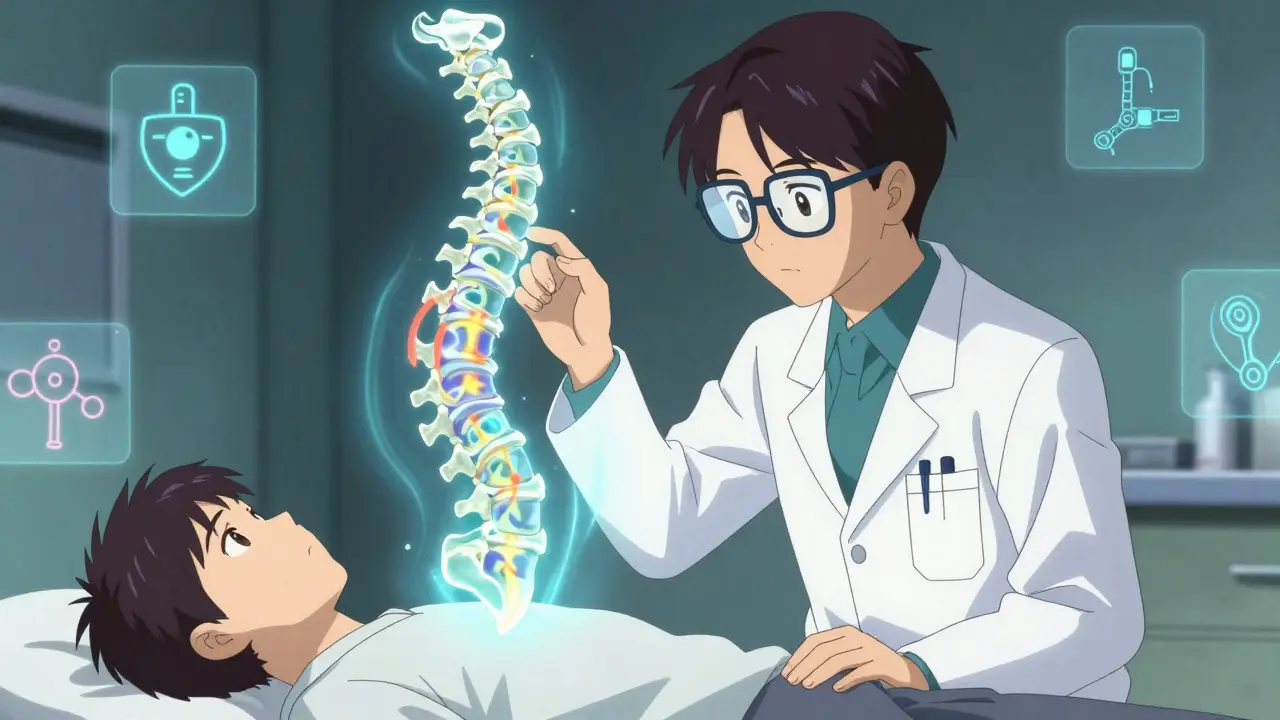
One of the biggest debates in back pain management is when to order imaging. Too little imaging misses serious problems; too much leads to unnecessary costs and false positives. The American College of Radiology (ACR) Appropriateness Criteria provides clear guidance.
For acute low back pain without red flags, initial imaging is generally discouraged. A 2020 systematic review found that inappropriate imaging occurred in 34% of such cases. Conversely, patients with red flag signs were not appropriately imaged in 65.6% of cases involving serious pathology. This gap highlights the importance of proper screening.
| Modality | Best For | Sensitivity/Accuracy | Limitations |
|---|---|---|---|
| MRI | Cord compression, cauda equina, infection, tumors | 95% sensitivity for cauda equina | Expensive, shows age-related degeneration in asymptomatic people |
| CT Scan | Fractures, bony abnormalities | 98% sensitivity for fractures | Radiation exposure, less detail on soft tissues |
| Plain Radiographs (X-ray) | Initial screening for fractures in high-risk patients | 64% sensitivity for fractures in patients over 50 | Poor detection of early infections or small fractures |
MRI is the gold standard for detecting nerve compression, infections, and tumors. However, Dr. Michael Modic noted in a 2021 Radiology editorial that clinical correlation is essential. Why? Because 27% of asymptomatic 40-year-olds and 79% of asymptomatic 80-year-olds show disc degeneration on MRI. Finding a bulging disc doesn’t always mean it’s causing your pain.
Referral Timelines and Conservative Care
Not every red flag requires an emergency room visit immediately. Some situations allow for a brief period of conservative care first. The American Academy of Family Physicians (AAFP) suggests that even with weaker red flags, four to six weeks of conservative treatment may be appropriate before considering advanced imaging. This approach avoids unnecessary procedures while monitoring for improvement.
However, if you fail to improve after one month, that itself becomes a validated red flag. A 2018 study in the journal *Spine* showed that patients not improving after four weeks had a 19.3 times higher likelihood of requiring surgical intervention later. So, patience has limits.
Physical therapists play a crucial role here. According to Physiopedia guidelines updated in 2022, therapists should refer patients with red flags to emergency care for conditions like cauda equina syndrome or to primary care for further investigation. Failure to refer carries significant malpractice risk, as evidenced by 12% of spinal litigation cases involving delayed diagnosis.
The Cost of Over-Imaging
Why do guidelines discourage routine imaging? Money and safety. The U.S. spends an estimated $3 billion annually on unnecessary lumbar spine imaging. The Choosing Wisely campaign, launched by the American Board of Internal Medicine Foundation, specifically targets this issue. By 2020, 78% of participating organizations included avoiding unnecessary back imaging in their top-five recommendations.
Insurance companies agree. Anthem’s medical policy explicitly states that physicians should not obtain radiologic imaging for non-specific acute low back pain without red flags. In 2022, they denied coverage for such imaging in 42% of appealed cases. This isn’t just about saving money-it’s about protecting patients from radiation exposure, incidental findings that lead to anxiety, and invasive follow-up tests that rarely help.
Future Directions in Back Pain Screening
Medicine is evolving. The 2023 ACR update now incorporates machine learning algorithms to improve red flag prediction, showing 89% accuracy compared to 76% for traditional methods. Additionally, point-of-care ultrasound (POCUS) is emerging as a valuable tool. A 2022 study showed POCUS has 92% accuracy in detecting post-void residual volume, which screens for suspected cord compression. This could reduce unnecessary MRI referrals by 35%.
The American Pain Society’s 2024 draft guidelines propose replacing the binary red flag system with a risk-stratification model using the STarT Back tool. This tool demonstrated 83% sensitivity for predicting serious pathology in a large multicenter trial. Meanwhile, the ongoing INTEGRATE trial is evaluating whether combining red flag screening with biomarker testing (like C-reactive protein levels) can speed up the diagnosis of spinal infections, which currently takes an average of 18.7 days.
When should I go to the ER for back pain?
Go to the ER immediately if you experience loss of bowel or bladder control, numbness in the groin area (saddle anesthesia), severe weakness in both legs, fever with back pain, or back pain following significant trauma. These are signs of cauda equina syndrome, infection, or fracture, which require urgent intervention.
Is an MRI always necessary for chronic back pain?
No. For chronic back pain without red flags, guidelines recommend trying conservative treatments like physical therapy and medication for at least six weeks before ordering an MRI. MRIs often show age-related changes that don’t cause pain, leading to unnecessary worry and procedures.
What are the most reliable red flags for spinal cancer?
The most reliable red flags for spinal malignancy are a personal history of cancer and unexplained weight loss. Night pain that wakes you up and pain that doesn’t improve with rest are also concerning signs that warrant further investigation.
How long should I wait before seeing a specialist for back pain?
If you have no red flags, try conservative care for 4-6 weeks. If you have mild red flags or no improvement after one month, see your primary care provider. If you have severe red flags like neurological deficits or fever, seek immediate medical attention.
Does insurance cover back pain imaging without red flags?
Often, no. Many insurers, including Anthem, deny coverage for imaging in non-specific acute back pain cases without red flags. They follow evidence-based guidelines to avoid unnecessary costs and procedures.