

Fexofenadine Juice Interaction Calculator
Calculate your risk: Select which juice you plan to consume with fexofenadine to see exactly how much it reduces absorption and when it's safe to take your medication.
🥦 Select Your Beverage
Click on a beverage to see its impact on fexofenadine absorption:
Absorption Analysis
Select a beverage above to see detailed absorption analysis
You take your allergy pill in the morning with a big glass of orange juice, expecting relief from sneezing and itchy eyes. Instead, you spend the day miserable. It’s not just bad luck or a particularly strong pollen season. You are likely experiencing one of the most significant-and surprising-drug-food interactions known to pharmacology. Fexofenadine loses its power when mixed with certain fruit juices, rendering it nearly useless for millions of users who don’t know better.
This isn’t a minor side effect. We’re talking about a reduction in drug absorption that can leave you unprotected against histamine attacks. Understanding why this happens, which juices are the culprits, and how to fix your routine is essential if you want your medication to actually work.
The Counterintuitive Discovery
To understand why fexofenadine behaves this way, we have to look back at early 2000s research. Scientists at the University of Western Ontario, led by Dr. Gail K. Dresser and Dr. David G. Bailey, were studying grapefruit juice. At the time, everyone knew grapefruit juice boosted the levels of many drugs by blocking liver enzymes (specifically CYP3A4). They expected it might do the same for fexofenadine, potentially causing overdose risks.
They were wrong. In fact, the opposite happened. Their landmark study published in Clinical Pharmacology & Therapeutics in 2002 showed that grapefruit juice drastically decreased the amount of fexofenadine entering the bloodstream. This was a shock to the medical community because it revealed a completely different mechanism of interaction: transporter inhibition rather than enzyme inhibition.
This discovery changed how regulators view food-drug interactions. It proved that food could block the "doors" that let drugs into our system, not just the factories that break them down. Today, the FDA mandates clear labeling on all fexofenadine products warning patients to avoid fruit juices.
How Juices Block Your Medicine
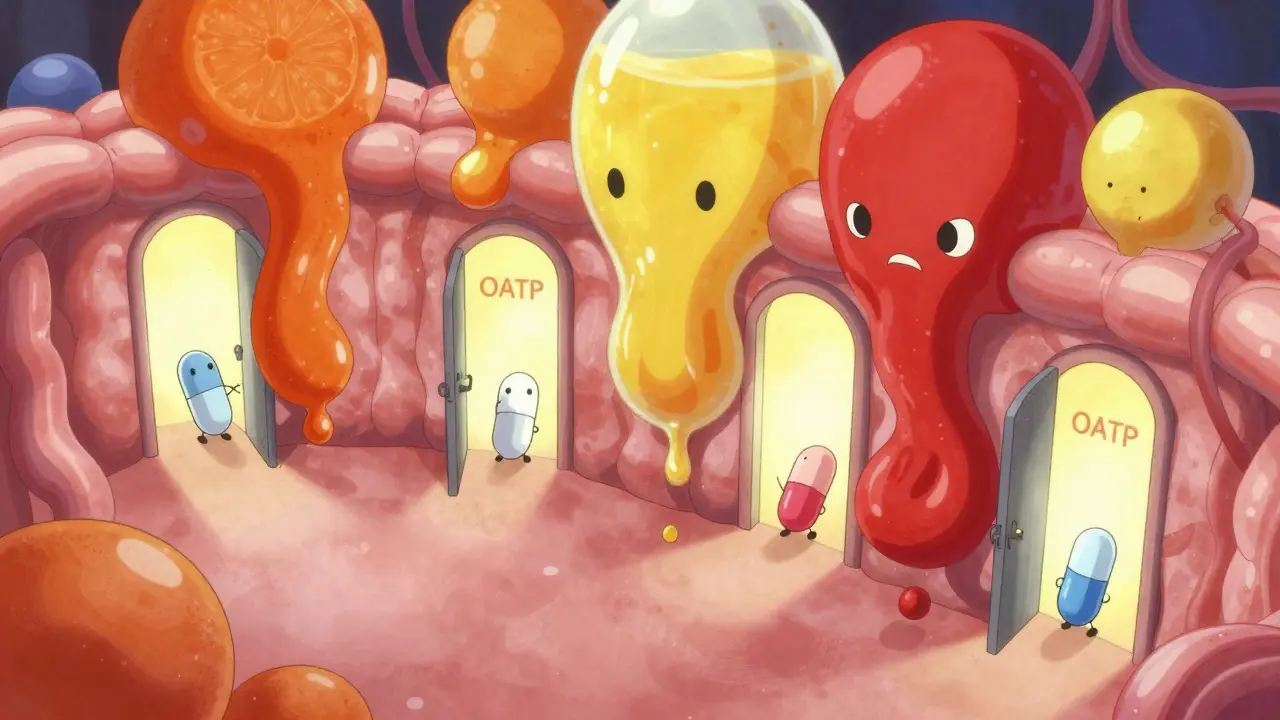
Your body absorbs fexofenadine through specific proteins in your intestines called organic anion-transporting polypeptides (OATPs). Think of these OATPs as bouncers at a club who check IDs and let guests inside. For fexofenadine to work, it needs these bouncers to open the door so the drug can enter your blood.
Certain compounds found in fruit juices act like distractions or blockers for these bouncers. Specifically, flavonoids like naringin in grapefruit and hesperidin in oranges bind to the OATP transporters (OATP1A2, OATP1B1, OATP1B3, and OATP2B1). When these transporters are occupied or inhibited, fexofenadine gets stuck outside the intestinal wall. It passes right through you without ever reaching the receptors that stop your allergic reactions.
This is distinct from other common interactions. Grapefruit juice increases blood levels of statins or blood pressure meds by stopping their breakdown. With fexofenadine, the juice stops its entry. The result? Less drug in your system means less symptom control.
Which Juices Are the Worst Offenders?
Not all liquids are created equal. Water is safe. Milk is generally fine. But three specific fruit juices have been clinically proven to slash fexofenadine absorption significantly. Based on data from the pivotal studies by Dresser et al., here is how they compare:
| Juice Type | Absorption Reduction (AUC) | Key Inhibiting Compound | Clinical Significance |
|---|---|---|---|
| Apple Juice | 77% decrease | Phloridzin and other polyphenols | Highest risk among common juices |
| Orange Juice | 72% decrease | Hesperidin | Very high risk; common breakfast beverage |
| Grapefruit Juice | 67% decrease | Naringin and bergamottin | High risk; well-documented inhibitor |
It is crucial to note that apple juice is often overlooked because it tastes mild and sweet, but it is actually the strongest inhibitor in clinical trials. Orange juice is the most dangerous simply because it is the most popular morning drink paired with medication. Even dilute grapefruit juice reduces absorption by over 20%, proving that concentration matters but doesn't eliminate the risk entirely.
Does Volume Matter?
You might wonder if taking your pill with a tiny sip of juice makes a difference. The answer is yes, but the degree varies. The original studies used large volumes (1.2 liters) to establish the maximum effect. However, subsequent research confirmed that even a standard 8-ounce glass of grapefruit juice reduces the area under the curve (AUC)-a measure of total drug exposure-by approximately 23%.
While a 23% drop might seem manageable, allergy medications often operate on a narrow therapeutic window. For sensitive individuals, that small dip can mean the difference between sleeping soundly and waking up congested. Furthermore, the effect is cumulative if you drink juice throughout the morning. The inhibition lasts for more than two hours, meaning your transporters remain blocked for a significant window after consumption.
Some experts argue that typical consumption habits might not cause total treatment failure, but the consensus remains cautious. Why risk partial efficacy when avoiding juice is effortless? The European Medicines Agency notes insufficient evidence to quantify impact at low volumes, yet a 2021 meta-analysis suggests even moderate intake compromises efficacy in sensitive patients.
Timing Is Everything: How to Fix It
You don’t need to give up your morning juice forever. You just need to separate it from your medication. The key is timing. Since the inhibitory effect on OATP transporters lasts between 2 to 4 hours, you must create a buffer zone.
Follow this simple protocol to ensure full absorption:
- Take fexofenadine with water only. This ensures no inhibitors are present in your stomach during absorption.
- Wait at least 4 hours before drinking fruit juice. If you take your pill at 8 AM, save your orange juice until noon or later.
- If you already drank juice, wait 1-2 hours before taking the pill. This allows the initial wave of inhibitors to pass through the upper intestine where absorption occurs.
Many people make the mistake of taking their allergy med with breakfast juice because it’s convenient. Community forums are filled with stories of long-term users suddenly finding their medication "stopped working" only to realize they had started a new habit of morning citrus drinks. Switching back to water often restores effectiveness within days.

What About Other Drinks and Foods?
While the big three juices are the primary concerns, other substances can interfere. Green tea contains catechins that may also inhibit OATP transporters, though the effect is generally weaker than fruit juices. It is wise to treat green tea with similar caution.
Whole fruits pose a risk too. Eating a whole grapefruit or drinking fresh-squeezed juice concentrates the same polyphenols. A small glass of juice packs as many active inhibitors as an entire fruit. So, eating a grapefruit segment right before your pill is just as risky as drinking the juice.
Interestingly, tomato juice does not appear to significantly inhibit these transporters, despite tomatoes being botanically fruits. Similarly, cranberry juice has not shown the same potent blocking effect in human studies, though individual responses can vary.
Also be mindful of antacids containing magnesium or aluminum. These can bind to fexofenadine in the gut, reducing absorption through a different mechanism (chelation). If you need an antacid, space it out by at least two hours from your antihistamine dose.
Alternatives That Don't Care About Juice
If separating your medication from your favorite breakfast drink feels impossible, you might consider switching medications. Not all second-generation antihistamines share this vulnerability. Drugs like Cetirizine (Zyrtec) and Loratadine (Claritin) are absorbed differently and do not rely heavily on the OATP transporters that fruit juices block.
In fact, competitors have capitalized on this weakness. Marketing campaigns for Zyrtec explicitly highlight that it doesn't interact with fruit juice, appealing to consumers who find the fexofenadine restrictions cumbersome. If lifestyle convenience is your priority, discussing a switch to cetirizine or loratadine with your doctor is a valid option. However, keep in mind that cetirizine carries a slightly higher risk of drowsiness for some users compared to fexofenadine.
Why This Matters for Your Health
Ignoring this interaction isn't just about wasted money. Poorly controlled allergies can lead to sleep disturbances, reduced productivity, and increased inflammation. Over time, chronic allergic rhinitis can exacerbate asthma symptoms or lead to sinus infections. Ensuring your medication reaches its target is critical for long-term health management.
The good news is that once you adjust your routine, the solution is simple. Keep a bottle of water by your bedside or desk. Save the juice for lunch or dinner. Within a week, most patients report a noticeable return to baseline symptom control. Don't let a glass of juice steal your comfort.
Can I take fexofenadine with milk?
Yes, milk is generally considered safe to take with fexofenadine. Unlike fruit juices, dairy products do not contain the flavonoids that inhibit OATP transporters. However, always check with your pharmacist if you have other conditions or take multiple medications.
Does vitamin C juice affect fexofenadine?
If the vitamin C juice is made from oranges, lemons, or grapefruits, it will likely reduce absorption. Pure synthetic vitamin C tablets taken with water are fine, but liquid supplements derived from fruit juices carry the same risk as the juice itself due to residual polyphenols.
How long does the fruit juice effect last?
The inhibition of OATP transporters typically lasts between 2 to 4 hours after consumption. To be safe, experts recommend waiting at least 4 hours after drinking juice before taking fexofenadine, or waiting 1-2 hours after taking the pill before consuming juice.
Is diluted juice safer to take with fexofenadine?
Diluted juice reduces the concentration of inhibitors, but it does not eliminate the risk. Studies show that even 50% strength grapefruit juice can reduce fexofenadine absorption by over 20%. For optimal efficacy, stick to water.
Do other antihistamines have this problem?
No, this interaction is specific to fexofenadine among common second-generation antihistamines. Cetirizine (Zyrtec), Loratadine (Claritin), and Desloratadine (Clarinex) do not rely on the same OATP transporters for absorption and are not affected by fruit juices.