
Route of Administration Calculator
Find the Right Medication Route for You
This tool compares side effect risks and effectiveness based on your specific needs. The article explains why route of administration matters more than you think.
Side Effect Risk
Based on your selections
Side Effect Risk
Based on your selections
Side Effect Risk
Based on your selections
Key Factors:
Why Your Medication’s Path Into Your Body Changes Everything
You take a pill for your headache. Your diabetic partner injects insulin. Your mom rubs a cream on her arthritic knee. All three are treating pain or illness-but they’re doing it in completely different ways. And those differences? They’re not just about convenience. They shape how fast the drug works, how much of it actually reaches your bloodstream, and most importantly-what kind of side effects you’re likely to get. The route of administration isn’t just a technical term. It’s the deciding factor between a mild stomach upset and a dangerous drop in blood pressure. Between a skin rash and a full-body reaction. Between feeling better in an hour or needing weeks to see results. Let’s break down the three most common ways medicines enter your body: swallowed (oral), injected (into muscle, vein, or under the skin), and applied (topical). You’ll see how each one trades off speed, control, and safety-and why your doctor picks one over the other.Oral: The Most Popular, But Not Always the Safest
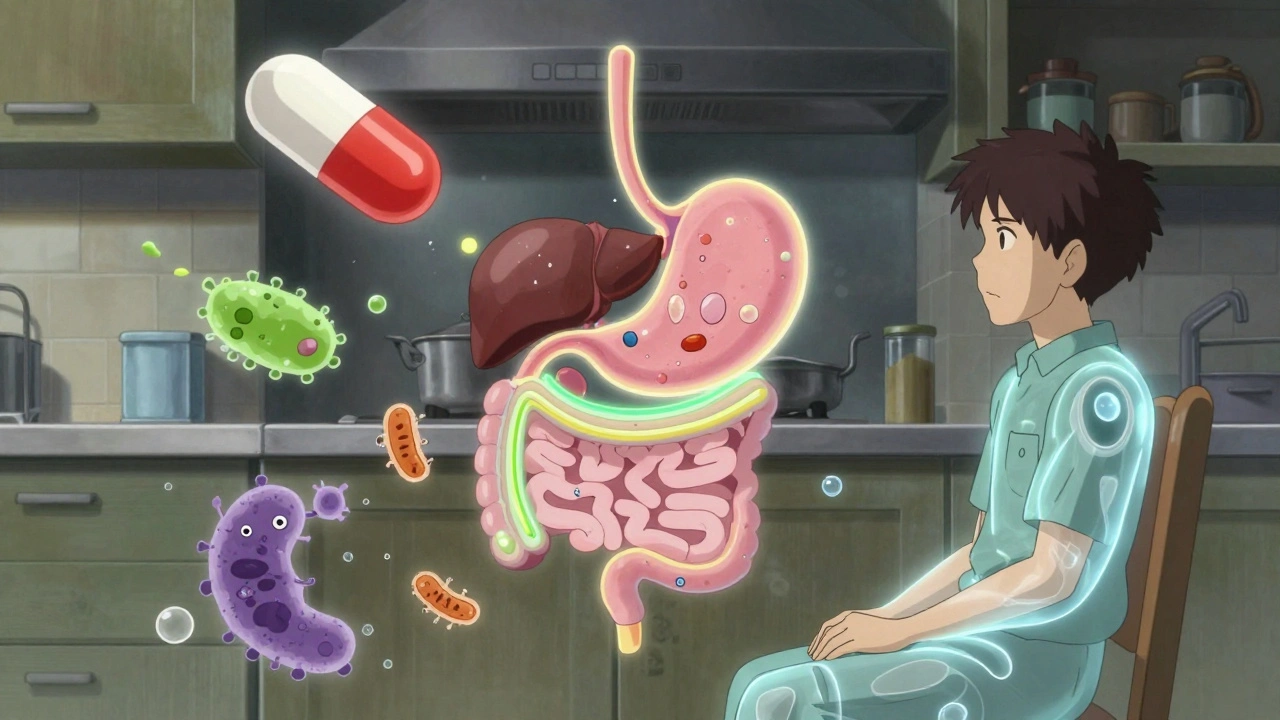
About 75% of all medications are taken by mouth. It’s easy. You don’t need needles. You can do it at home, in the car, before bed. But that convenience comes with hidden costs. When you swallow a pill, it doesn’t just go straight to your bloodstream. It travels through your stomach, gets broken down by acids, then passes through your liver before entering circulation. That’s called first-pass metabolism. And it’s a major reason why many drugs lose half-or even 90%-of their potency before they ever reach your target. That’s why you might need a 50mg pill when an injection of the same drug only needs 10mg. Higher doses mean higher chances of side effects. NSAIDs like ibuprofen or naproxen? They’re notorious for causing stomach irritation. Around 1-2% of long-term users develop ulcers. Nausea, bloating, heartburn-these aren’t rare. They’re expected. And it’s not just the stomach. Oral drugs interact with food, other meds, even your gut bacteria. One study found that 40% of commonly prescribed pills are affected by what you eat. Grapefruit juice can turn a safe dose of a cholesterol drug into a dangerous one. Antacids can block absorption of antibiotics. You’re not just taking a pill-you’re managing a chemical dance inside your body. On the plus side, oral meds are cheap. A month’s supply of a generic blood pressure pill might cost $10. The same drug in injectable form? Could be $200. And you don’t need training to take a pill. But if you forget a dose, or take it at the wrong time, your blood levels swing up and down. That’s why some people on oral pain meds feel “peaks and valleys”-good for a few hours, then back to hurting.Injections: Fast, Precise, But With Real Risks
If you need a drug to work fast-like during a heart attack, severe infection, or allergic reaction-injection is the only reliable option. Intravenous (IV) drugs hit your bloodstream in 2-5 minutes. Oral versions? 30 to 90 minutes. That difference can be life-saving. Injections bypass the liver and gut entirely. That means 100% of the dose gets into your system. No first-pass metabolism. No food interference. You get exactly what the doctor ordered. But that precision comes with trade-offs. Every injection carries a small risk of infection. About 1-5% of people get redness, swelling, or even abscesses at the injection site. Diabetics on long-term insulin often develop lumps under the skin called lipohypertrophy. It’s not dangerous, but it messes with absorption and makes dosing unpredictable. Then there’s the fear factor. Around 20-25% of adults have needle phobia. It’s real. It’s common. And it leads people to skip doses-even life-saving ones. One survey found nearly 30% of patients on biologic injectables for rheumatoid arthritis missed doses because they dreaded the needle. Cost is another big issue. A single shot of a biologic drug like Humira or Enbrel can run $2,500-$5,000. The oral version? If it exists, it’s often under $100. That’s why many patients stop using injectables-not because they don’t work, but because they can’t afford them. And while IVs are fast, they’re also temporary. The drug spikes quickly, then drops. That’s why some people on injectable pain meds feel a sudden rush of relief, followed by a crash. It’s not the drug failing-it’s the delivery method.
Topical: Localized Relief, Minimal Systemic Trouble
Think of topical medications as targeted strikes. Creams, gels, patches, sprays-they stay mostly where you put them. That’s why they’re the go-to for eczema, joint pain, or fungal infections. Because the drug doesn’t need to travel through your whole body, systemic side effects are rare. A 2022 study showed topical corticosteroids cause 92% less hormone disruption than the same dose taken by mouth. That’s huge for people with chronic skin conditions who’d otherwise risk weight gain, mood swings, or bone thinning from oral steroids. Even transdermal patches-like nicotine or fentanyl patches-are designed to release medicine slowly through the skin. That means steady levels, no spikes, no crashes. A Mayo Clinic survey found 74% of chronic pain patients preferred patches over pills because they felt more consistent relief. But topical isn’t perfect. Skin isn’t a magic portal. It blocks most molecules bigger than 500 Daltons. That’s why you can’t put a pill on your skin and expect it to work. Biologics-like insulin or antibodies-still need injections. But new tech is changing that. In 2023, a new ultrasound-enhanced patch increased drug delivery through skin by 600%. That could mean fewer injections in the future. The biggest problem? People don’t use topical meds right. A National Eczema Association survey found 60% of patients apply too little cream. One fingertip unit (the amount from the tip of your finger to the first crease) is the standard dose. Most people use half that. Result? Half the benefit. Also, some skin conditions absorb more than others. Psoriasis-affected skin soaks up medication 3-5 times faster than healthy skin. That means you can accidentally overdose if you’re not careful. And yes-there’s still a chance of local irritation. Redness, itching, burning. But compared to stomach ulcers or allergic reactions from pills or shots? That’s a small price to pay.Which Route Is Right for You?
There’s no single best route. It depends on what you’re treating, how fast you need relief, and what side effects you can tolerate. Choose oral if: - You need long-term, steady treatment (like blood pressure or thyroid meds) - You’re comfortable taking pills daily - Cost matters - You don’t have stomach issues Choose injection if: - You need fast action (emergency, infection, acute pain) - Your gut can’t absorb pills (Crohn’s, vomiting, surgery recovery) - You’re on a biologic and your doctor says it’s the only option - You can manage the cost and needle fear Choose topical if: - Your problem is localized (skin, joints, eyes) - You want to avoid stomach or liver side effects - You’ve had bad reactions to pills or shots - You’re willing to learn proper application
What’s Changing in Drug Delivery?
The future of medicine isn’t just about new drugs-it’s about better ways to deliver them. New oral tech, like liquid-in-capsule systems, is boosting bioavailability of poorly absorbed drugs by 30-50%. That means lower doses, fewer side effects. Auto-injectors with real-time feedback are helping people hit the right depth, reducing injection site problems by nearly a third. And the biggest shift? Topical delivery is growing fast. Once limited to small molecules, new patches and gels are now capable of delivering proteins and even some biologics-without needles. By 2030, experts predict a quarter of current injectable drugs will move to advanced topical or oral forms. That’s not science fiction. It’s happening now.Final Takeaway: It’s Not Just the Drug-It’s the Delivery
You wouldn’t use a garden hose to put out a house fire. And you shouldn’t treat every illness the same way. The same drug, delivered differently, can mean the difference between relief and ruin. A pill that gives you stomach pain. An injection that causes infection. A cream that doesn’t work because you didn’t use enough. Talk to your doctor or pharmacist. Ask: “Why this route? What side effects should I watch for? Is there a safer or more effective option?” Your body doesn’t care what the label says. It only responds to how the medicine gets in. Choose wisely.Can I switch from an oral pill to a topical cream for the same condition?
Not always. Topical forms only work for conditions that affect the skin or nearby tissues-like arthritis in the knee, eczema, or muscle strains. If your condition is systemic-like high blood pressure, diabetes, or an infection inside your body-topical creams won’t reach deep enough. Always check with your doctor before switching routes. The active ingredient might be the same, but the dose, absorption, and effect are not.
Why do some drugs only come as injections?
Some drugs are too large, too fragile, or too poorly absorbed to survive digestion or pass through the skin. Biologics-like insulin, antibodies, or vaccines-are made of proteins that get broken down in the stomach. That’s why they must be injected. Even if you could swallow them, your body wouldn’t absorb them. Researchers are working on oral versions, but for now, injections are the only reliable option for these drugs.
Do topical medications ever cause side effects elsewhere in the body?
Yes, but it’s rare and usually only happens with heavy, long-term use. Strong corticosteroid creams applied over large areas for months can be absorbed enough to affect your hormones, leading to weight gain, high blood pressure, or even adrenal suppression. This is why doctors limit the amount and duration of topical steroid use. Always follow the prescribed amount-using more won’t make it work faster, and it could harm you.
Is it true that oral medications cause more drug interactions?
Yes. Because oral drugs pass through the digestive system and liver, they’re more likely to interact with food, other pills, and even your gut bacteria. Grapefruit juice, antacids, and certain antibiotics can all block or boost absorption. Injectables and topicals mostly avoid these interactions because they bypass the gut. That’s one reason why injectables are preferred in hospitals-fewer variables to manage.
Which route is safest for older adults?
For most older adults, topical is the safest option when appropriate-like for joint pain or skin conditions-because it avoids liver and kidney stress. But if they need systemic treatment, oral is still preferred over injection, unless they have swallowing problems or gut absorption issues. The key is simplicity: fewer pills, fewer injections, and clear instructions on how to use creams. Many seniors struggle with applying topical meds correctly, so using pre-measured gels or patches can help reduce errors.
Can I use more of a topical cream to make it work faster?
No. Applying more than the recommended amount doesn’t speed up results-it increases your risk of side effects. Skin has a limit to how much it can absorb. Excess cream just sits on the surface, gets wiped off, or soaks in too deeply and causes systemic effects. Always use the fingertip unit (about 0.5g) for each area the size of two adult hands. More isn’t better.
Why do some injectables hurt more than others?
It’s not just the needle. The liquid itself matters. Some drugs are acidic, thick, or contain preservatives that irritate tissue. Insulin and some antibiotics are known to sting. Others, like saline-based vaccines, are nearly painless. Your provider can sometimes switch to a less irritating formulation or suggest applying ice beforehand. Don’t assume pain means it’s working-it just means the formulation is harsh on your skin.
Are there any drugs that can only be taken orally?
Not really. Almost every oral drug can be delivered another way-but sometimes it’s impractical. For example, some antibiotics are only made as pills because injecting them wouldn’t improve absorption or speed. Oral is cheaper, safer, and just as effective for those cases. The real question isn’t “can it be injected?” but “should it be?” Often, the answer is no.
Tejas Bubane
December 9, 2025 AT 04:12precious amzy
December 11, 2025 AT 03:49William Umstattd
December 12, 2025 AT 17:03Sabrina Thurn
December 14, 2025 AT 15:55Andrea Beilstein
December 15, 2025 AT 07:48Simran Chettiar
December 17, 2025 AT 00:35Ruth Witte
December 17, 2025 AT 02:42Elliot Barrett
December 17, 2025 AT 21:17Noah Raines
December 19, 2025 AT 15:15Rich Paul
December 20, 2025 AT 19:46Delaine Kiara
December 20, 2025 AT 19:48Sarah Gray
December 21, 2025 AT 19:06Maria Elisha
December 23, 2025 AT 00:37