
Most people throw away expired medications without a second thought. You see the date on the bottle, it’s past, and you toss it-maybe out of habit, maybe out of fear. But what if most of those pills, capsules, and tablets are still perfectly fine? What if the expiration date isn’t a cliff edge where your medicine suddenly turns useless? The truth is more complicated-and more surprising-than the label lets on.
Expiration Dates Aren’t What You Think
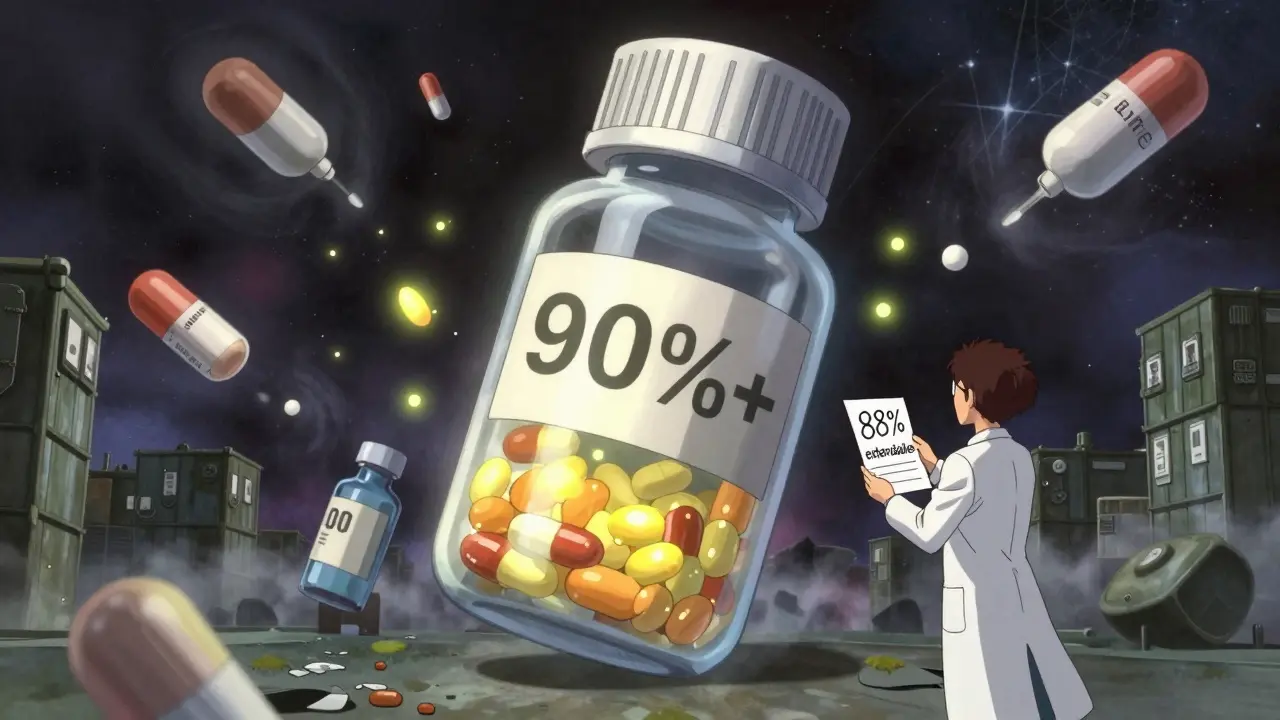
The expiration date on your medicine isn’t a death sentence. It’s a guarantee. Pharmaceutical companies are required by the FDA to test their drugs and say, "We promise this medication will be at least 90% potent up until this date." That’s it. They don’t have to prove what happens after. Most don’t even try. That’s why you see expiration dates ranging from 12 to 60 months. It’s not because the drug expires then-it’s because that’s the window manufacturers are willing to test.
A landmark 2012 study from the University of California-San Francisco looked at drugs that had expired 28 to 40 years ago. Yes, decades. They tested 15 different active ingredients across eight prescription medications. Twelve of the 14 drugs tested still had at least 90% of their original potency. Eight stayed fully potent for the full 40 years. The only ones that consistently lost strength? Aspirin and amphetamine. Even then, they didn’t drop to zero. They just dipped below the 90% threshold. And remember, the FDA allows drugs to be anywhere from 90% to 110% of the labeled amount and still be considered safe and effective.
What Stays Strong? What Doesn’t?
Not all medications age the same way. The form matters. Solid pills and capsules? They’re tough. They last. If they’ve been kept dry, cool, and out of sunlight-in their original sealed bottles-they can stay effective for years, sometimes decades. A 2006 study of 122 expired products found two-thirds were still stable and safe. The Department of Defense’s Shelf-Life Extension Program (SLEP), which has been testing military drug stockpiles since 1986, found that 88% of drugs could have their expiration dates extended by at least one year. On average, they gained 66 more months. Some went over 20 years past the original date.
But liquids? That’s a different story. Insulin, liquid antibiotics, eye drops, and reconstituted powders degrade faster. Moisture, air, and temperature changes wreck them. Epinephrine auto-injectors (EpiPens) are another big one. Studies show their potency drops over time, even if they’re still within the labeled expiration window. Nitroglycerin tablets lose strength quickly-sometimes within months after opening. Mefloquine (an antimalarial) and tetracycline also fall apart faster than most.
Here’s the simple rule: if it’s a solid tablet or capsule, and it’s still sealed in its original container, it’s probably fine. If it’s liquid, injectable, or something meant for immediate use (like an EpiPen), don’t risk it.
Storage Is Everything
Where you keep your meds matters more than the date on the bottle. A bathroom cabinet? That’s a steam room. Humidity and heat destroy potency. A drawer in a cool, dark closet? That’s ideal. The FDA’s own testing shows that under perfect conditions-dry, cool, and protected from light-around 90% of drugs remain effective for at least 15 years past their expiration date.
But here’s where people mess up: they transfer pills into pill organizers, plastic bags, or pharmacy canisters. Those containers aren’t sealed. Air gets in. Moisture gets in. Light gets in. Suddenly, your once-stable aspirin tablet is breaking down faster than it should. A 2012 Harvard Health article pointed out that medications moved out of original packaging degrade much faster. Keep them in the bottle they came in. Keep the desiccant packet (that little cotton-like thing) inside. Don’t remove it.
Why Do Manufacturers Set Such Short Dates?
It’s not science. It’s business. Drug companies have no legal requirement to test beyond a few years. Why would they? If your medicine lasts 20 years, you won’t need to buy another one. That cuts into sales. There’s no profit in longevity. The FDA doesn’t demand long-term studies. So manufacturers pick a date that’s safe, simple, and profitable.
Think about it: Americans spend over $300 billion a year on prescription drugs. If even half of expired meds were still usable, the waste would be staggering. The DoD’s SLEP program saved millions by extending drug life. But that’s not happening in pharmacies or homes. Why? Because the system isn’t built for it. Liability, not science, drives the rules.
Is It Safe to Take Expired Medication?
Here’s the honest answer: for most solid medications, yes-if they’ve been stored properly. There’s no evidence that expired drugs become toxic. They just lose strength. So taking an expired ibuprofen won’t poison you. It might not help as much.
But there are exceptions. Never use expired insulin. It can kill. Never use expired epinephrine. If you’re having an allergic reaction, a weak EpiPen could mean the difference between life and death. Liquid antibiotics? If they’ve expired, don’t take them. They might not fully treat the infection, leading to antibiotic resistance. Nitroglycerin? If you’re having chest pain, you need full potency. A weak dose could be fatal.
Dr. Lee Cantrell, who led the 2012 study, put it plainly: "This study provides additional evidence that many prescription pharmaceuticals retain their full potency for decades beyond their manufacturer-ascribed expiration dates." But he also warned: "This doesn’t mean you should dig through the trash for your expired meds." He’s not saying take everything. He’s saying: stop assuming everything is useless.
What Should You Do?
Don’t panic. Don’t throw everything away. Don’t start hoarding expired pills either.
- Check the form. Solid pills? Probably fine. Liquids? Toss them.
- Check the storage. Was it in a hot, humid bathroom? If yes, toss it. Was it in a dark drawer? It’s likely still good.
- Check the drug. If it’s insulin, EpiPen, nitroglycerin, or liquid antibiotics-don’t risk it.
- Check the appearance. If pills are crumbling, discolored, or smell weird-don’t take them.
- For chronic conditions (like high blood pressure or cholesterol), if your medication is just a few months past expiration, it’s probably okay. But if you’re unsure, get a refill.
- For emergencies (like asthma inhalers or allergy meds), always use unexpired ones. Don’t gamble.
The FDA says expired drugs "can be less effective or risky." They’re not wrong. But they’re also not telling the whole story. The real risk isn’t the date on the bottle. It’s not knowing which drugs are safe and which aren’t.
What’s Next?
Research keeps piling up. The NIH’s 2020 review confirmed that potency doesn’t vanish the moment the date passes. It fades slowly. The problem? No one’s changing the rules. Drug companies won’t fund long-term studies. Regulators won’t force them. Consumers are stuck in the middle.
But awareness is growing. If you’ve got a drawer full of expired pills, you’re not alone. And now you know: not all of them are trash. Some are just sitting there, still working, waiting for someone to understand what the label doesn’t say.
Are expired medications dangerous to take?
For most solid medications-like tablets and capsules-that have been stored properly, expired drugs are not dangerous. They don’t become toxic. They just lose potency over time. The main risk is that they won’t work as well. However, certain medications like insulin, epinephrine, liquid antibiotics, and nitroglycerin can become unsafe or ineffective after expiration and should never be used past their labeled date.
How long do pills last after expiration?
Under ideal conditions-cool, dry, and in original sealed packaging-many solid medications retain at least 90% of their potency for 5 to 10 years past the expiration date. Some studies show certain drugs, like aspirin and codeine, remain effective for over 30 years. However, liquids, injectables, and medications that require refrigeration degrade much faster and should not be used after expiration.
Does storing medicine in the bathroom ruin it?
Yes. Bathrooms are hot and humid, which speeds up the breakdown of medication. Moisture and heat cause pills to degrade faster, even before the expiration date. Store medications in a cool, dry place like a bedroom drawer or cabinet away from sunlight and steam. Keep them in their original containers with the desiccant packet inside.
Why do drug companies set such short expiration dates?
Expiration dates are based on manufacturer testing, not scientific necessity. The FDA only requires testing up to a few years. Drug companies don’t test beyond that because longer shelf life means fewer repeat sales. Setting short dates helps maintain profits. A 2012 study showed that extending expiration dates could save billions in healthcare costs-but there’s little incentive for companies to do so.
Can I use expired EpiPens or insulin?
No. EpiPens and insulin are critical for life-threatening emergencies. Studies show their potency drops significantly after expiration. Using an expired EpiPen during an allergic reaction could be fatal. Expired insulin may not lower blood sugar effectively, leading to dangerous spikes. Always replace these medications before they expire. Never rely on an expired version in an emergency.
tatiana verdesoto
March 4, 2026 AT 01:01Wow, this actually changed how I think about my medicine cabinet. I used to toss everything the second it expired, but now I’m checking storage conditions instead. My blood pressure pills are in a dark drawer-probably still good. Thanks for the clarity.
Tobias Mösl
March 4, 2026 AT 04:44Oh great, so now we’re supposed to trust Big Pharma’s leftovers? This is just corporate gaslighting dressed up as science. The FDA doesn’t test beyond 5 years because they’re paid off. I’ve seen pills turn to dust in my bathroom-how’s that for 'potency'?
And don’t even get me started on the desiccant packet. That’s not a 'safety feature,' it’s a placebo for people who don’t read the fine print. The real danger? You think you’re saving money, but you’re just gambling with your liver.
Ethan Zeeb
March 6, 2026 AT 01:41Storage matters more than the date. That’s the only takeaway that matters. I keep all my meds in a sealed glass jar in the back of a closet. No humidity, no light, no heat. If it’s a solid tablet, I’d take it 10 years out. But if it’s in a plastic bag from Walmart? No thanks.
Darren Torpey
March 7, 2026 AT 09:40Imagine if your car had an expiration date that wasn’t about safety, but about profit. You’d be furious. Yet we accept this with pills? Wild. The fact that the DoD saved millions by extending shelf life and no one’s pushing this publicly? That’s not negligence-it’s a conspiracy of convenience.
My grandma’s 20-year-old aspirin still works. She’s 92. She swears by it. I say: if it looks, smells, and tastes like it should, and it’s solid and dry? It’s probably still doing its job. We’ve been scared into wasting billions.
Lebogang kekana
March 8, 2026 AT 03:06This is Africa-level thinking right here. In my village, we don’t throw out medicine-we pass it down like heirlooms. My uncle took expired antimalarials for 12 years. He’s still alive. Maybe the West is too obsessed with labels and not enough with results.
Also, why are we trusting pharmaceuticals that cost $200 a pill but won’t tell us how long they last? The real scandal isn’t expired meds-it’s that we’re being sold a lie to keep paying.
Jessica Chaloux
March 9, 2026 AT 00:04OMG I had no idea!! 😱 I just tossed my 3-year-old Xanax last week… I feel so guilty now… 💔 Maybe I should’ve kept it? 😞
Mariah Carle
March 10, 2026 AT 08:00It’s not about the pill-it’s about the metaphysics of expiration. The date isn’t a fact, it’s a social contract. We’ve been conditioned to worship the timestamp like a digital oracle. But time doesn’t decay molecules; neglect does.
Perhaps the real expiration is our willingness to outsource our health to corporations who profit from our fear.
Raman Kapri
March 10, 2026 AT 21:22The assertion that expired medications retain potency lacks robust longitudinal clinical validation. While anecdotal evidence and military studies exist, extrapolating these findings to civilian use without controlled trials is scientifically unsound. Regulatory frameworks exist for a reason: to mitigate risk, not maximize convenience.
Megan Nayak
March 11, 2026 AT 16:02Oh, so now we’re supposed to be amateur pharmacists? Let me guess-next you’ll be telling us to use expired antibiotics to treat our kid’s ear infection. Because why not? Who needs a doctor when you’ve got a drawer and a hunch?
And let’s not pretend this isn’t just a thinly veiled excuse to hoard pills like preppers. ‘I’m saving money!’ Yeah, until you end up in the ER because your ‘still potent’ insulin didn’t work.
Don’t romanticize neglect. This isn’t survivalist wisdom. It’s dangerous wishful thinking.
Tildi Fletes
March 13, 2026 AT 11:06As a clinical pharmacist with 22 years of experience, I can confirm: solid oral dosage forms stored under ideal conditions (15–25°C, <60% RH, in original packaging) routinely retain >90% potency for 5–10 years beyond expiration. The FDA’s 1985 Shelf-Life Extension Program data supports this. However, this does not apply to suspensions, injectables, or medications exposed to environmental stressors. Clinical judgment and patient safety must always precede cost-saving assumptions.
Siri Elena
March 13, 2026 AT 22:29Oh honey, you really think the FDA is your friend? 😏 The expiration date is just the pharmaceutical industry’s way of saying, ‘Buy more, darling.’
Meanwhile, I’ve got a 17-year-old bottle of ibuprofen that’s been living in my nightstand since college. It’s still white. It still smells like aspirin. I take it like a vitamin. Who’s the real idiot? The one who trusts the label… or the one who trusts the truth?
Divya Mallick
March 15, 2026 AT 14:25Western medicine is built on corporate exploitation. In India, we’ve been using expired antibiotics for decades-no one dies. The West turns every pill into a lottery ticket because they want you dependent. This article? It’s not about science. It’s about breaking the capitalist stranglehold on health.
Why do you think insulin costs $300? Because they know you’ll pay. Because they know you’ll throw out the old one and buy new. This isn’t pharmacology. It’s economic warfare.
Pankaj Gupta
March 15, 2026 AT 16:01The data presented is compelling and aligns with peer-reviewed literature from the FDA’s SLEP program and the 2012 UCSF study. However, public health messaging must balance evidence with precaution. While many solid dosage forms remain stable, individual variability in storage, formulation, and degradation kinetics necessitates caution. The goal should be education-not blanket endorsement.
Alex Brad
March 15, 2026 AT 18:20Keep it dry. Keep it dark. Keep it in the bottle. Everything else is noise.
Callum Duffy
March 17, 2026 AT 04:59Thank you for this measured and evidence-based overview. The distinction between solid oral medications and liquid/injectable formulations is critical, and the emphasis on storage conditions is often overlooked. While the commercial incentives behind expiration dates are indeed problematic, the responsibility remains with the individual to assess context, not just date.
For non-critical, non-emergency medications under optimal conditions, the evidence strongly suggests continued efficacy. The key is informed discretion, not fear-driven disposal.
tatiana verdesoto
March 17, 2026 AT 21:29Actually, I just checked my bottle-my amoxicillin was in the bathroom for a year. Now I’m tossing it. Good call on the humidity warning.